

Appendix
283
θ(t i − t j ) . . . θ(t k − t l )θ(t l − t)θ(t − t r ) . . . ˆ
H I (t i ) ˆ
H I (t j ) . . . ˆ
H I (t l )
ˆ
O I (t) ˆ
H I (t r ) . . . ˆ
H I (t u )
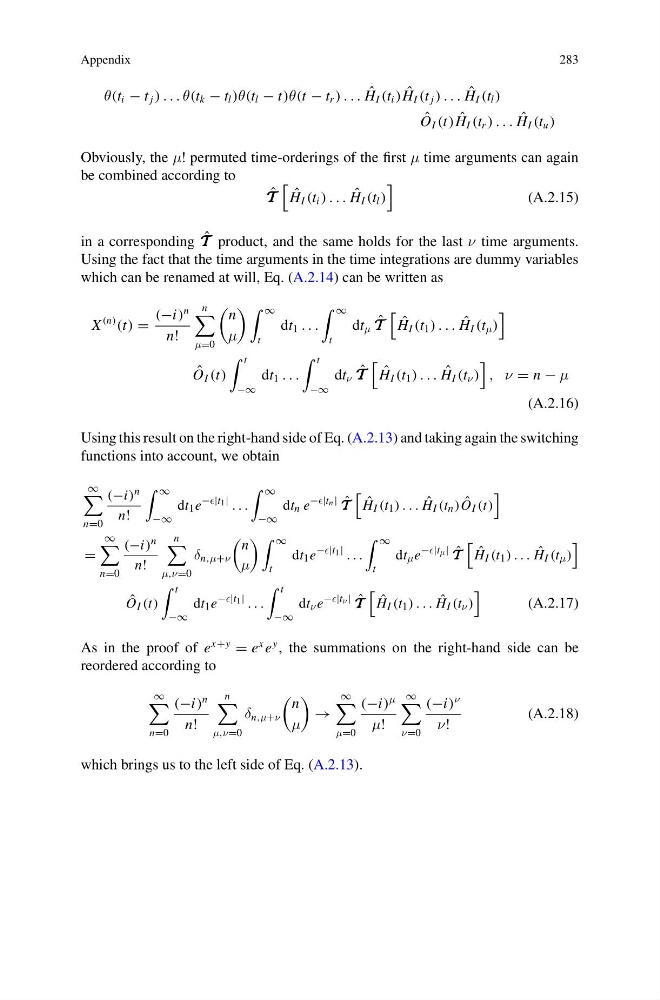
Obviously, the μ! permuted time-orderings of the first μ time arguments can again
be combined according to
ˆ
T T T
ˆ
H I (t i ) . . . ˆ
H I (t l )
(A.2.15)
in a corresponding ˆ
T T T product, and the same holds for the last ν time arguments.
Using the fact that the time arguments in the time integrations are dummy variables
which can be renamed at will, Eq. (A.2.14) can be written as
X
(n)
(t) =
(−i)
n
n!
n
μ=0
n
μ
∞
t
dt 1 . . .
∞
t
dt μ ˆ
T T T
ˆ
H I (t 1 ) . . . ˆ
H I (t μ )
ˆ
O I (t)
t
−∞
dt 1 . . .
t
−∞
dt ν ˆ
T T T
ˆ
H I (t 1 ) . . . ˆ
H I (t ν )
, ν = n − μ
(A.2.16)
Using this result on the right-hand side of Eq. (A.2.13) and taking again the switching
functions into account, we obtain
∞
n=0
(−i) n
n!
∞
−∞
dt 1 e
−|t 1 |
. . .
∞
−∞
dt n e
−|t n | ˆ
T T T
ˆ
H I (t 1 ) . . . ˆ
H I (t n ) ˆ
O I (t)
=
∞
n=0
(−i) n
n!
n
μ,ν=0
δ n,μ+ν
n
μ
∞
t
dt 1 e
−|t 1 |
. . .
∞
t
dt μ e
−|t μ | ˆ
T T T
ˆ
H I (t 1 ) . . . ˆ
H I (t μ )
ˆ
O I (t)
t
−∞
dt 1 e
−|t 1 |
. . .
t
−∞
dt ν e
−|t ν | ˆ
T T T
ˆ
H I (t 1 ) . . . ˆ
H I (t ν )
(A.2.17)
As in the proof of e
x+y
= e
x e
y , the summations on the right-hand side can be
reordered according to
∞
n=0
(−i)
n
n!
n
μ,ν=0
δ n,μ+ν
n
μ
→
∞
μ=0
(−i)
μ
μ!
∞
ν=0
(−i)
ν
ν!
(A.2.18)
which brings us to the left side of Eq. (A.2.13).
283
θ(t i − t j ) . . . θ(t k − t l )θ(t l − t)θ(t − t r ) . . . ˆ
H I (t i ) ˆ
H I (t j ) . . . ˆ
H I (t l )
ˆ
O I (t) ˆ
H I (t r ) . . . ˆ
H I (t u )
Obviously, the μ! permuted time-orderings of the first μ time arguments can again
be combined according to
ˆ
T T T
ˆ
H I (t i ) . . . ˆ
H I (t l )
(A.2.15)
in a corresponding ˆ
T T T product, and the same holds for the last ν time arguments.
Using the fact that the time arguments in the time integrations are dummy variables
which can be renamed at will, Eq. (A.2.14) can be written as
X
(n)
(t) =
(−i)
n
n!
n
μ=0
n
μ
∞
t
dt 1 . . .
∞
t
dt μ ˆ
T T T
ˆ
H I (t 1 ) . . . ˆ
H I (t μ )
ˆ
O I (t)
t
−∞
dt 1 . . .
t
−∞
dt ν ˆ
T T T
ˆ
H I (t 1 ) . . . ˆ
H I (t ν )
, ν = n − μ
(A.2.16)
Using this result on the right-hand side of Eq. (A.2.13) and taking again the switching
functions into account, we obtain
∞
n=0
(−i) n
n!
∞
−∞
dt 1 e
−|t 1 |
. . .
∞
−∞
dt n e
−|t n | ˆ
T T T
ˆ
H I (t 1 ) . . . ˆ
H I (t n ) ˆ
O I (t)
=
∞
n=0
(−i) n
n!
n
μ,ν=0
δ n,μ+ν
n
μ
∞
t
dt 1 e
−|t 1 |
. . .
∞
t
dt μ e
−|t μ | ˆ
T T T
ˆ
H I (t 1 ) . . . ˆ
H I (t μ )
ˆ
O I (t)
t
−∞
dt 1 e
−|t 1 |
. . .
t
−∞
dt ν e
−|t ν | ˆ
T T T
ˆ
H I (t 1 ) . . . ˆ
H I (t ν )
(A.2.17)
As in the proof of e
x+y
= e
x e
y , the summations on the right-hand side can be
reordered according to
∞
n=0
(−i)
n
n!
n
μ,ν=0
δ n,μ+ν
n
μ
→
∞
μ=0
(−i)
μ
μ!
∞
ν=0
(−i)
ν
ν!
(A.2.18)
which brings us to the left side of Eq. (A.2.13).