

16
1 Systems of Identical Particles
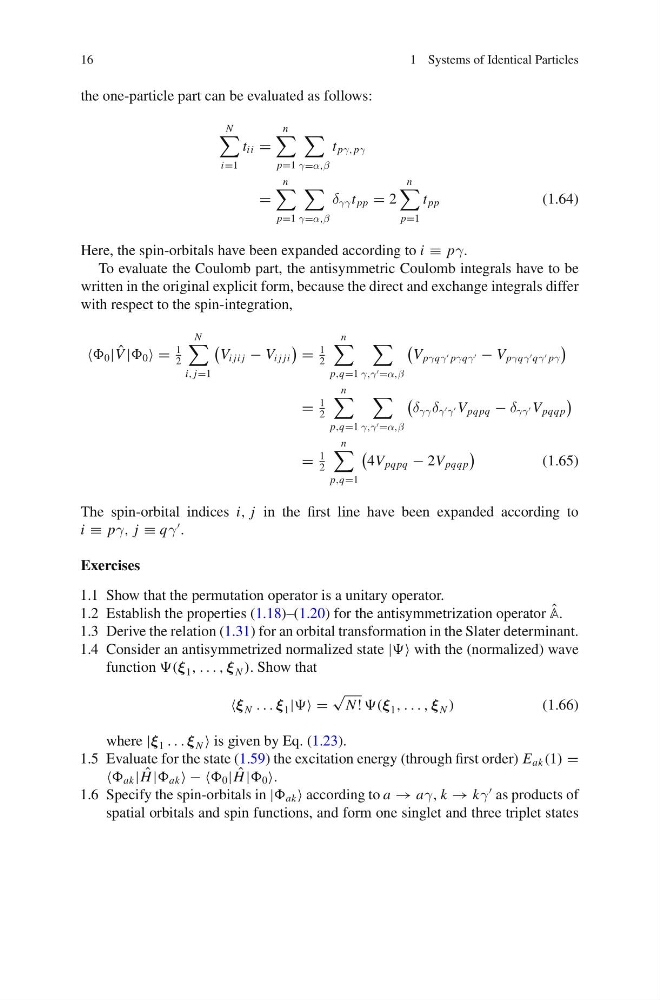
the one-particle part can be evaluated as follows:
N
i=1
t ii =
n
p=1
γ=α,β
t pγ, pγ
=
n
p=1
γ=α,β
δ γγ t pp = 2
n
p=1
t pp
(1.64)
Here, the spin-orbitals have been expanded according to i ≡ pγ.
To evaluate the Coulomb part, the antisymmetric Coulomb integrals have to be
written in the original explicit form, because the direct and exchange integrals differ
with respect to the spin-integration,
0 | ˆ
V | 0 =
1
2
N
i, j=1
V i ji j − V i j ji
=
1
2
n
p,q=1
γ,γ =α,β
V pγqγ pγqγ − V pγqγ qγ pγ
=
1
2
n
p,q=1
γ,γ =α,β
δ γγ δ γ γ V pqpq − δ γγ V pqqp
=
1
2
n
p,q=1
4V pqpq − 2V pqqp
(1.65)
The spin-orbital indices i, j in the first line have been expanded according to
i ≡ pγ, j ≡ qγ
.
Exercises
1.1 Show that the permutation operator is a unitary operator.
1.2 Establish the properties (1.18)–(1.20) for the antisymmetrization operator ˆ
A.
1.3 Derive the relation (1.31) for an orbital transformation in the Slater determinant.
1.4 Consider an antisymmetrized normalized state | with the (normalized) wave
function (ξ 1 , . . . , ξ N ). Show that
ξ N . . . ξ 1 | =
√
N ! (ξ 1 , . . . , ξ N )
(1.66)
where |ξ 1 . . . ξ N is given by Eq. (1.23).
1.5 Evaluate for the state (1.59) the excitation energy (through first order) E ak (1) =
ak | ˆ
H | ak − − 0 | ˆ
H | 0 .
1.6 Specify the spin-orbitals in | ak according to a → aγ, k → kγ
as products of
spatial orbitals and spin functions, and form one singlet and three triplet states
1 Systems of Identical Particles
the one-particle part can be evaluated as follows:
N
i=1
t ii =
n
p=1
γ=α,β
t pγ, pγ
=
n
p=1
γ=α,β
δ γγ t pp = 2
n
p=1
t pp
(1.64)
Here, the spin-orbitals have been expanded according to i ≡ pγ.
To evaluate the Coulomb part, the antisymmetric Coulomb integrals have to be
written in the original explicit form, because the direct and exchange integrals differ
with respect to the spin-integration,
0 | ˆ
V | 0 =
1
2
N
i, j=1
V i ji j − V i j ji
=
1
2
n
p,q=1
γ,γ =α,β
V pγqγ pγqγ − V pγqγ qγ pγ
=
1
2
n
p,q=1
γ,γ =α,β
δ γγ δ γ γ V pqpq − δ γγ V pqqp
=
1
2
n
p,q=1
4V pqpq − 2V pqqp
(1.65)
The spin-orbital indices i, j in the first line have been expanded according to
i ≡ pγ, j ≡ qγ
.
Exercises
1.1 Show that the permutation operator is a unitary operator.
1.2 Establish the properties (1.18)–(1.20) for the antisymmetrization operator ˆ
A.
1.3 Derive the relation (1.31) for an orbital transformation in the Slater determinant.
1.4 Consider an antisymmetrized normalized state | with the (normalized) wave
function (ξ 1 , . . . , ξ N ). Show that
ξ N . . . ξ 1 | =
√
N ! (ξ 1 , . . . , ξ N )
(1.66)
where |ξ 1 . . . ξ N is given by Eq. (1.23).
1.5 Evaluate for the state (1.59) the excitation energy (through first order) E ak (1) =
ak | ˆ
H | ak − − 0 | ˆ
H | 0 .
1.6 Specify the spin-orbitals in | ak according to a → aγ, k → kγ
as products of
spatial orbitals and spin functions, and form one singlet and three triplet states