

242
16 Algebraic Propagator Methods
|
N −1
n
= ˆ
n | 0
(16.1)
where ˆ
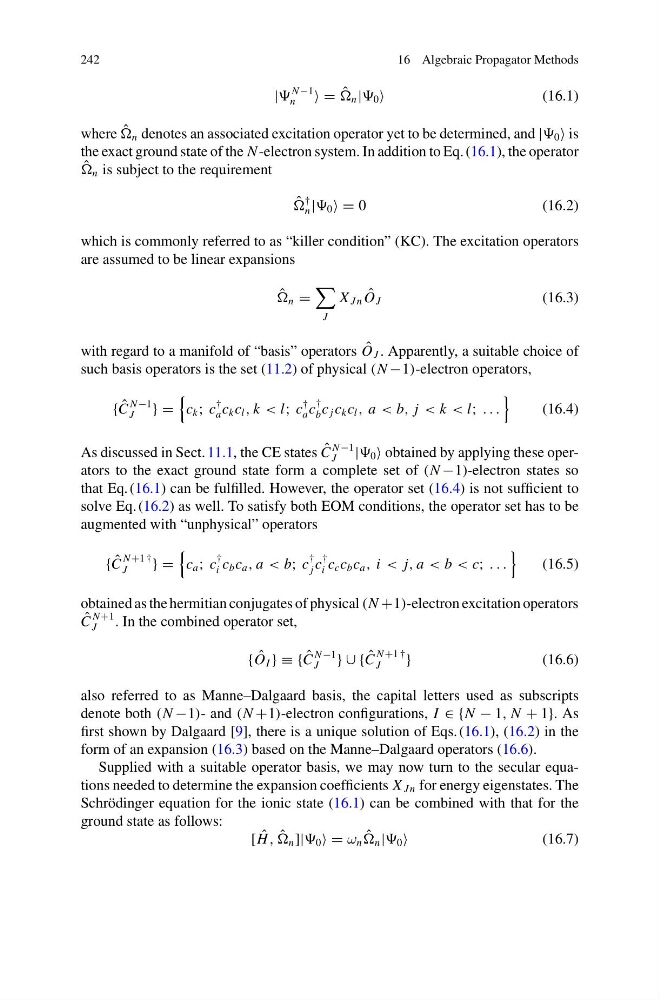
n denotes an associated excitation operator yet to be determined, and | 0 is
the exact ground state of the N -electron system. In addition to Eq. (16.1), the operator
ˆ
n is subject to the requirement
ˆ
†
n | 0 = 0
(16.2)
which is commonly referred to as “killer condition” (KC). The excitation operators
are assumed to be linear expansions
ˆ
n =
J
X J n ˆ
O J
(16.3)
with regard to a manifold of “basis” operators ˆ
O J . Apparently, a suitable choice of
such basis operators is the set (11.2) of physical (N −1)-electron operators,
{ ˆ
C
N −1
J
} =
c k ; c
†
a c k c l , k < l; c
†
a c
†
b c j c k c l , a < b, j < k < l; . . .
(16.4)
As discussed in Sect. 11.1, the CE states ˆ
C
N −1
J
| 0 obtained by applying these operators to the exact ground state form a complete set of (N −1)-electron states so
that Eq. (16.1) can be fulfilled. However, the operator set (16.4) is not sufficient to
solve Eq. (16.2) as well. To satisfy both EOM conditions, the operator set has to be
augmented with “unphysical” operators
{ ˆ
C
N +1 †
J
} =
c a ; c
†
i c b c a , a < b; c
†
j c
†
i c c c b c a , i < j, a < b < c; . . .
(16.5)
obtained as the hermitian conjugates of physical (N +1)-electron excitation operators
ˆ
C
N +1
J
. In the combined operator set,
{ ˆ
O I } ≡ { ˆ
C
N −1
J
} ∪ { ˆ
C
N +1 †
J
}
(16.6)
also referred to as Manne–Dalgaard basis, the capital letters used as subscripts
denote both (N −1)- and (N +1)-electron configurations, I ∈ {N − 1, N + 1}. As
first shown by Dalgaard [9], there is a unique solution of Eqs. (16.1), (16.2) in the
form of an expansion (16.3) based on the Manne–Dalgaard operators (16.6).
Supplied with a suitable operator basis, we may now turn to the secular equations needed to determine the expansion coefficients X J n for energy eigenstates. The
Schrödinger equation for the ionic state (16.1) can be combined with that for the
ground state as follows:
[ ˆ
H , ˆ
n ]| 0 = ω n ˆ
n | 0
(16.7)
16 Algebraic Propagator Methods
|
N −1
n
= ˆ
n | 0
(16.1)
where ˆ
n denotes an associated excitation operator yet to be determined, and | 0 is
the exact ground state of the N -electron system. In addition to Eq. (16.1), the operator
ˆ
n is subject to the requirement
ˆ
†
n | 0 = 0
(16.2)
which is commonly referred to as “killer condition” (KC). The excitation operators
are assumed to be linear expansions
ˆ
n =
J
X J n ˆ
O J
(16.3)
with regard to a manifold of “basis” operators ˆ
O J . Apparently, a suitable choice of
such basis operators is the set (11.2) of physical (N −1)-electron operators,
{ ˆ
C
N −1
J
} =
c k ; c
†
a c k c l , k < l; c
†
a c
†
b c j c k c l , a < b, j < k < l; . . .
(16.4)
As discussed in Sect. 11.1, the CE states ˆ
C
N −1
J
| 0 obtained by applying these operators to the exact ground state form a complete set of (N −1)-electron states so
that Eq. (16.1) can be fulfilled. However, the operator set (16.4) is not sufficient to
solve Eq. (16.2) as well. To satisfy both EOM conditions, the operator set has to be
augmented with “unphysical” operators
{ ˆ
C
N +1 †
J
} =
c a ; c
†
i c b c a , a < b; c
†
j c
†
i c c c b c a , i < j, a < b < c; . . .
(16.5)
obtained as the hermitian conjugates of physical (N +1)-electron excitation operators
ˆ
C
N +1
J
. In the combined operator set,
{ ˆ
O I } ≡ { ˆ
C
N −1
J
} ∪ { ˆ
C
N +1 †
J
}
(16.6)
also referred to as Manne–Dalgaard basis, the capital letters used as subscripts
denote both (N −1)- and (N +1)-electron configurations, I ∈ {N − 1, N + 1}. As
first shown by Dalgaard [9], there is a unique solution of Eqs. (16.1), (16.2) in the
form of an expansion (16.3) based on the Manne–Dalgaard operators (16.6).
Supplied with a suitable operator basis, we may now turn to the secular equations needed to determine the expansion coefficients X J n for energy eigenstates. The
Schrödinger equation for the ionic state (16.1) can be combined with that for the
ground state as follows:
[ ˆ
H , ˆ
n ]| 0 = ω n ˆ
n | 0
(16.7)