

234
15 Random-Phase Approximation (RPA)
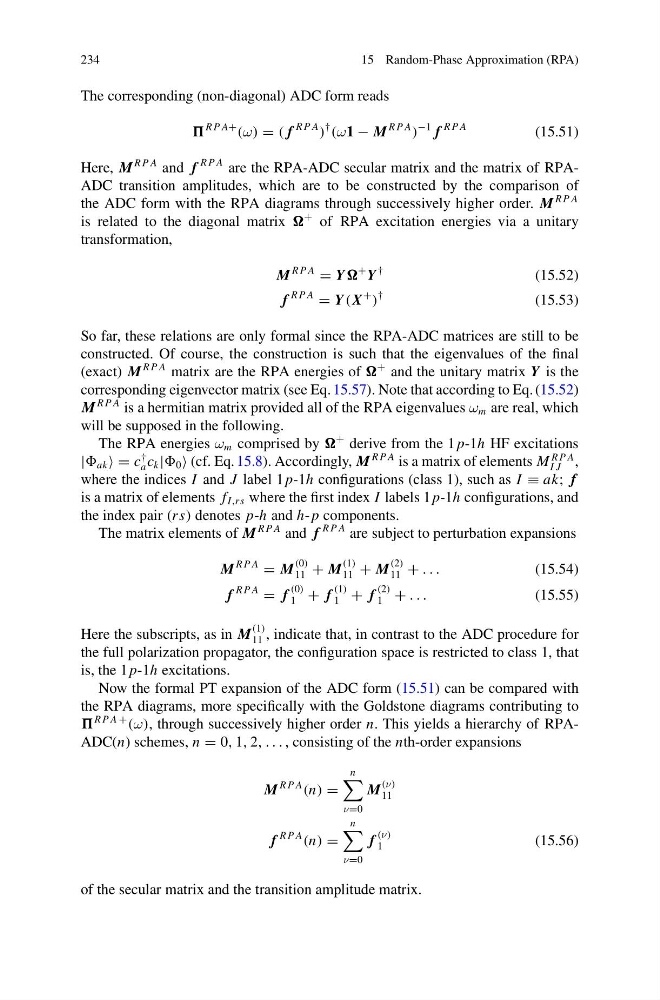
The corresponding (non-diagonal) ADC form reads
R P A+
(ω) = ( f
R P A
)
†
(ω1 − M
R P A
)
−1 f
R P A
(15.51)
Here, M
R P A and f
R P A are the RPA-ADC secular matrix and the matrix of RPAADC transition amplitudes, which are to be constructed by the comparison of
the ADC form with the RPA diagrams through successively higher order. M
R P A
is related to the diagonal matrix
+ of RPA excitation energies via a unitary
transformation,
M
R P A
= Y
+ Y
†
(15.52)
f
R P A
= Y (X
+
)
†
(15.53)
So far, these relations are only formal since the RPA-ADC matrices are still to be
constructed. Of course, the construction is such that the eigenvalues of the final
(exact) M
R P A matrix are the RPA energies of
+ and the unitary matrix Y is the
corresponding eigenvector matrix (see Eq. 15.57). Note that according to Eq. (15.52)
M
R P A is a hermitian matrix provided all of the RPA eigenvalues ω m are real, which
will be supposed in the following.
The RPA energies ω m comprised by
+ derive from the 1 p-1h HF excitations
| ak = c
†
a c k | 0 (cf. Eq. 15.8). Accordingly, M
R P A is a matrix of elements M
R P A
I J ,
where the indices I and J label 1 p-1h configurations (class 1), such as I ≡ ak; f
is a matrix of elements f I,rs where the first index I labels 1 p-1h configurations, and
the index pair (rs) denotes p-h and h- p components.
The matrix elements of M
R P A and f
R P A are subject to perturbation expansions
M
R P A
= M
(0)
11 + M
(1)
11 + M
(2)
11 + . . .
(15.54)
f
R P A
= f
(0)
1 + f
(1)
1 + f
(2)
1 + . . .
(15.55)
Here the subscripts, as in M
(1)
11 , indicate that, in contrast to the ADC procedure for
the full polarization propagator, the configuration space is restricted to class 1, that
is, the 1 p-1h excitations.
Now the formal PT expansion of the ADC form (15.51) can be compared with
the RPA diagrams, more specifically with the Goldstone diagrams contributing to
R P A +
(ω), through successively higher order n. This yields a hierarchy of RPAADC(n) schemes, n = 0, 1, 2, . . . , consisting of the nth-order expansions
M
R P A
(n) =
n
ν=0
M
(ν)
11
f
R P A
(n) =
n
ν=0
f
(ν)
1
(15.56)
of the secular matrix and the transition amplitude matrix.
15 Random-Phase Approximation (RPA)
The corresponding (non-diagonal) ADC form reads
R P A+
(ω) = ( f
R P A
)
†
(ω1 − M
R P A
)
−1 f
R P A
(15.51)
Here, M
R P A and f
R P A are the RPA-ADC secular matrix and the matrix of RPAADC transition amplitudes, which are to be constructed by the comparison of
the ADC form with the RPA diagrams through successively higher order. M
R P A
is related to the diagonal matrix
+ of RPA excitation energies via a unitary
transformation,
M
R P A
= Y
+ Y
†
(15.52)
f
R P A
= Y (X
+
)
†
(15.53)
So far, these relations are only formal since the RPA-ADC matrices are still to be
constructed. Of course, the construction is such that the eigenvalues of the final
(exact) M
R P A matrix are the RPA energies of
+ and the unitary matrix Y is the
corresponding eigenvector matrix (see Eq. 15.57). Note that according to Eq. (15.52)
M
R P A is a hermitian matrix provided all of the RPA eigenvalues ω m are real, which
will be supposed in the following.
The RPA energies ω m comprised by
+ derive from the 1 p-1h HF excitations
| ak = c
†
a c k | 0 (cf. Eq. 15.8). Accordingly, M
R P A is a matrix of elements M
R P A
I J ,
where the indices I and J label 1 p-1h configurations (class 1), such as I ≡ ak; f
is a matrix of elements f I,rs where the first index I labels 1 p-1h configurations, and
the index pair (rs) denotes p-h and h- p components.
The matrix elements of M
R P A and f
R P A are subject to perturbation expansions
M
R P A
= M
(0)
11 + M
(1)
11 + M
(2)
11 + . . .
(15.54)
f
R P A
= f
(0)
1 + f
(1)
1 + f
(2)
1 + . . .
(15.55)
Here the subscripts, as in M
(1)
11 , indicate that, in contrast to the ADC procedure for
the full polarization propagator, the configuration space is restricted to class 1, that
is, the 1 p-1h excitations.
Now the formal PT expansion of the ADC form (15.51) can be compared with
the RPA diagrams, more specifically with the Goldstone diagrams contributing to
R P A +
(ω), through successively higher order n. This yields a hierarchy of RPAADC(n) schemes, n = 0, 1, 2, . . . , consisting of the nth-order expansions
M
R P A
(n) =
n
ν=0
M
(ν)
11
f
R P A
(n) =
n
ν=0
f
(ν)
1
(15.56)
of the secular matrix and the transition amplitude matrix.