

232
15 Random-Phase Approximation (RPA)
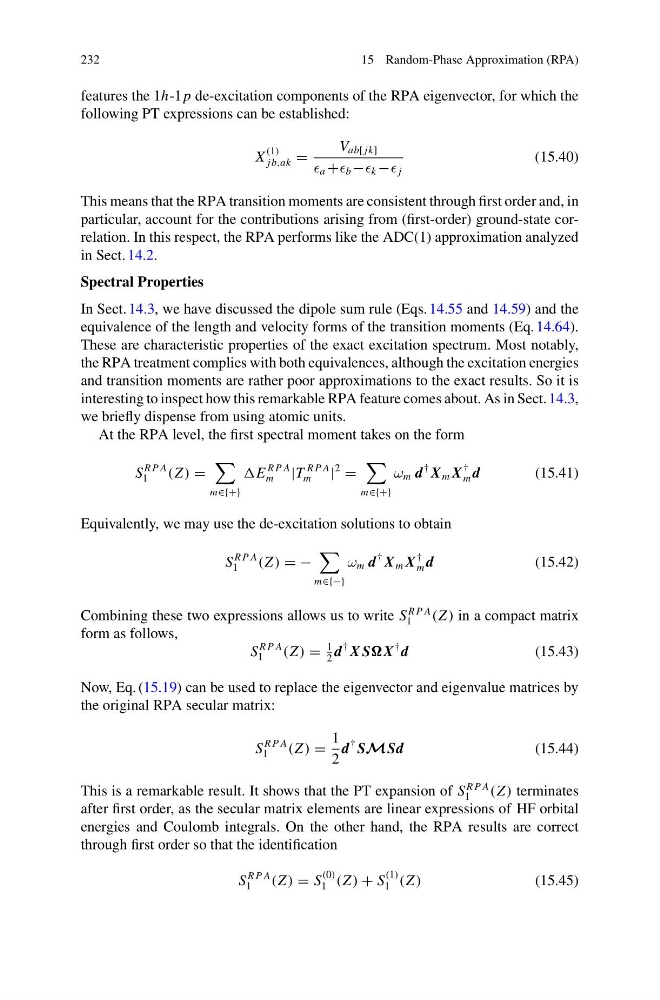
features the 1h-1 p de-excitation components of the RPA eigenvector, for which the
following PT expressions can be established:
X
(1)
jb,ak =
V ab[ jk]
a + b − k − j
(15.40)
This means that the RPA transition moments are consistent through first order and, in
particular, account for the contributions arising from (first-order) ground-state correlation. In this respect, the RPA performs like the ADC(1) approximation analyzed
in Sect. 14.2.
Spectral Properties
In Sect. 14.3, we have discussed the dipole sum rule (Eqs. 14.55 and 14.59) and the
equivalence of the length and velocity forms of the transition moments (Eq. 14.64).
These are characteristic properties of the exact excitation spectrum. Most notably,
the RPA treatment complies with both equivalences, although the excitation energies
and transition moments are rather poor approximations to the exact results. So it is
interesting to inspect how this remarkable RPA feature comes about. As in Sect. 14.3,
we briefly dispense from using atomic units.
At the RPA level, the first spectral moment takes on the form
S
R P A
1
(Z ) =
m∈{+}
E
R P A
m
|T
R P A
m
|
2
=
m∈{+}
ω m d
† X m X
†
m d
(15.41)
Equivalently, we may use the de-excitation solutions to obtain
S
R P A
1
(Z ) = −
m∈{−}
ω m d
† X m X
†
m d
(15.42)
Combining these two expressions allows us to write S
R P A
1
(Z ) in a compact matrix
form as follows,
S
R P A
1
(Z ) =
1
2
d
† X SX
† d
(15.43)
Now, Eq. (15.19) can be used to replace the eigenvector and eigenvalue matrices by
the original RPA secular matrix:
S
R P A
1
(Z ) =
1
2
d
† SMSd
(15.44)
This is a remarkable result. It shows that the PT expansion of S
R P A
1
(Z ) terminates
after first order, as the secular matrix elements are linear expressions of HF orbital
energies and Coulomb integrals. On the other hand, the RPA results are correct
through first order so that the identification
S
R P A
1
(Z ) = S
(0)
1 (Z ) + S
(1)
1 (Z )
(15.45)
15 Random-Phase Approximation (RPA)
features the 1h-1 p de-excitation components of the RPA eigenvector, for which the
following PT expressions can be established:
X
(1)
jb,ak =
V ab[ jk]
a + b − k − j
(15.40)
This means that the RPA transition moments are consistent through first order and, in
particular, account for the contributions arising from (first-order) ground-state correlation. In this respect, the RPA performs like the ADC(1) approximation analyzed
in Sect. 14.2.
Spectral Properties
In Sect. 14.3, we have discussed the dipole sum rule (Eqs. 14.55 and 14.59) and the
equivalence of the length and velocity forms of the transition moments (Eq. 14.64).
These are characteristic properties of the exact excitation spectrum. Most notably,
the RPA treatment complies with both equivalences, although the excitation energies
and transition moments are rather poor approximations to the exact results. So it is
interesting to inspect how this remarkable RPA feature comes about. As in Sect. 14.3,
we briefly dispense from using atomic units.
At the RPA level, the first spectral moment takes on the form
S
R P A
1
(Z ) =
m∈{+}
E
R P A
m
|T
R P A
m
|
2
=
m∈{+}
ω m d
† X m X
†
m d
(15.41)
Equivalently, we may use the de-excitation solutions to obtain
S
R P A
1
(Z ) = −
m∈{−}
ω m d
† X m X
†
m d
(15.42)
Combining these two expressions allows us to write S
R P A
1
(Z ) in a compact matrix
form as follows,
S
R P A
1
(Z ) =
1
2
d
† X SX
† d
(15.43)
Now, Eq. (15.19) can be used to replace the eigenvector and eigenvalue matrices by
the original RPA secular matrix:
S
R P A
1
(Z ) =
1
2
d
† SMSd
(15.44)
This is a remarkable result. It shows that the PT expansion of S
R P A
1
(Z ) terminates
after first order, as the secular matrix elements are linear expressions of HF orbital
energies and Coulomb integrals. On the other hand, the RPA results are correct
through first order so that the identification
S
R P A
1
(Z ) = S
(0)
1 (Z ) + S
(1)
1 (Z )
(15.45)