

230
15 Random-Phase Approximation (RPA)
presence of an electron in the virtual orbital a. The necessary correction is established
at the first-order level: Here, the Coulomb repulsion between electrons in orbitals k
and a, J ak = V akak is subtracted from the zeroth-order result. The other first-order
term is the exchange integral, K ak = V akka , accounting for the energy difference
between the singlet and triplet excitations (see Exercise 1.6).
At second order, one goes beyond the static one-particle picture and begins to
incorporate electron correlation and dynamic effects accompanying the excitation.
The first of the second-order terms in Eq. (15.33), U
(2)
ak (1 p-1h), is due to the admixture of other 1 p-1h excitations. The explicit PT expression is of little interest, as the
1 p-1h (single) configuration interaction (CI) is rigorously treated at the RPA level
via the A block of the secular matrix. The original HF orbital k and even more so the
virtual orbital a may not afford an adequate representation of the final excited state,
and that is corrected by means of the 1 p-1h admixtures.
More important is the U
(2)
ak (2 p-2h) contribution, resulting from the coupling
with 2 p-2h excitations. Via the admixture of 2 p-2h configurations of the type
c
†
b c j c
†
a c k | 0 , b = a, j = k the response of the so far unaffected electrons comes
into play. Here, we may distinguish relaxation and polarization: The electrons
“relax” as a response to the removal of an electron from the orbital k; and the electron promoted to the virtual orbital a “polarizes” the charge distribution of the ionic
core. The relaxation and polarization response leads to a substantial lowering of the
first-order (static) excitation energy. It is interesting to note that these two effects
compensate each other to a certain extent, roughly as in E R P = −(R − P)
2 , the
energy lowerings being −R
2 and −P
2 separately for relaxation and polarization,
respectively. For a more detailled discussion of the PT analysis of the relaxation and
polarization energies, the reader is referred to Ref. [5].
The third term, U
(2)
ak (3 p-3h), accounts for correlation in the excited state. The
only 3 p-3h excitations that can couple with | ak are of the type c
†
b c
†
c c i c j c
†
a c k | 0 ,
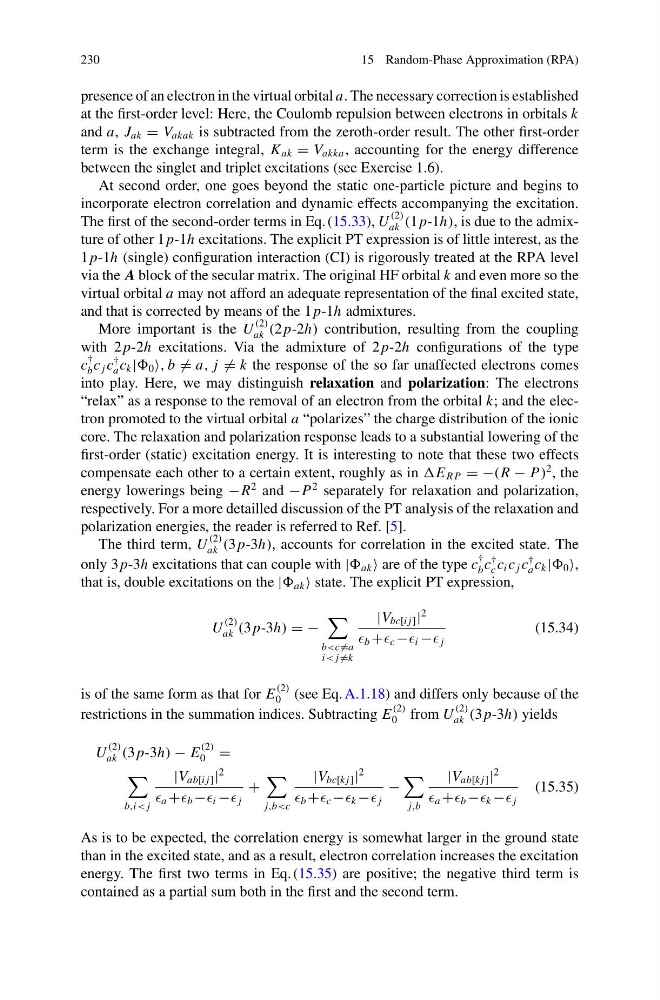
that is, double excitations on the | ak state. The explicit PT expression,
U
(2)
ak (3 p-3h) = −
b
|V bc[i j] |
2
b + c − i − j
(15.34)
is of the same form as that for E
(2)
0 (see Eq. A.1.18) and differs only because of the
restrictions in the summation indices. Subtracting E
(2)
0 from U
(2)
ak (3 p-3h) yields
U
(2)
ak (3 p-3h) − E
(2)
0 =
b,i< j
|V ab[i j] |
2
a + b − i − j
+
j,b
2
b + c − k − j
−
j,b
|V ab[k j] |
2
a + b − k − j
(15.35)
As is to be expected, the correlation energy is somewhat larger in the ground state
than in the excited state, and as a result, electron correlation increases the excitation
energy. The first two terms in Eq. (15.35) are positive; the negative third term is
contained as a partial sum both in the first and the second term.
15 Random-Phase Approximation (RPA)
presence of an electron in the virtual orbital a. The necessary correction is established
at the first-order level: Here, the Coulomb repulsion between electrons in orbitals k
and a, J ak = V akak is subtracted from the zeroth-order result. The other first-order
term is the exchange integral, K ak = V akka , accounting for the energy difference
between the singlet and triplet excitations (see Exercise 1.6).
At second order, one goes beyond the static one-particle picture and begins to
incorporate electron correlation and dynamic effects accompanying the excitation.
The first of the second-order terms in Eq. (15.33), U
(2)
ak (1 p-1h), is due to the admixture of other 1 p-1h excitations. The explicit PT expression is of little interest, as the
1 p-1h (single) configuration interaction (CI) is rigorously treated at the RPA level
via the A block of the secular matrix. The original HF orbital k and even more so the
virtual orbital a may not afford an adequate representation of the final excited state,
and that is corrected by means of the 1 p-1h admixtures.
More important is the U
(2)
ak (2 p-2h) contribution, resulting from the coupling
with 2 p-2h excitations. Via the admixture of 2 p-2h configurations of the type
c
†
b c j c
†
a c k | 0 , b = a, j = k the response of the so far unaffected electrons comes
into play. Here, we may distinguish relaxation and polarization: The electrons
“relax” as a response to the removal of an electron from the orbital k; and the electron promoted to the virtual orbital a “polarizes” the charge distribution of the ionic
core. The relaxation and polarization response leads to a substantial lowering of the
first-order (static) excitation energy. It is interesting to note that these two effects
compensate each other to a certain extent, roughly as in E R P = −(R − P)
2 , the
energy lowerings being −R
2 and −P
2 separately for relaxation and polarization,
respectively. For a more detailled discussion of the PT analysis of the relaxation and
polarization energies, the reader is referred to Ref. [5].
The third term, U
(2)
ak (3 p-3h), accounts for correlation in the excited state. The
only 3 p-3h excitations that can couple with | ak are of the type c
†
b c
†
c c i c j c
†
a c k | 0 ,
that is, double excitations on the | ak state. The explicit PT expression,
U
(2)
ak (3 p-3h) = −
b
|V bc[i j] |
2
b + c − i − j
(15.34)
is of the same form as that for E
(2)
0 (see Eq. A.1.18) and differs only because of the
restrictions in the summation indices. Subtracting E
(2)
0 from U
(2)
ak (3 p-3h) yields
U
(2)
ak (3 p-3h) − E
(2)
0 =
b,i< j
|V ab[i j] |
2
a + b − i − j
+
j,b
2
b + c − k − j
−
j,b
|V ab[k j] |
2
a + b − k − j
(15.35)
As is to be expected, the correlation energy is somewhat larger in the ground state
than in the excited state, and as a result, electron correlation increases the excitation
energy. The first two terms in Eq. (15.35) are positive; the negative third term is
contained as a partial sum both in the first and the second term.