

6
1 Systems of Identical Particles
As in Eq. (1.4), |ξ 1 . . . |ξ N denotes the corresponding Hartree product (in ket form)
of the one-particle coordinate eigenfunctions |ξ i .
For a convenient formulation of antisymmetric product states, it is expedient to
introduce the antisymmetrization operator
ˆ
A =
1
N !
P
(−1)
P ˆ
P
(1.17)
Here, the sum runs over all N ! permutations P (of N elements). The following
properties are readily established (see Exercise 1.2):
ˆ
A = ˆ
A
†
hermiticity
(1.18)
ˆ
P ˆ
A = (−1)
P ˆ
A
(1.19)
ˆ
A
2
= ˆ
A
projector
(1.20)
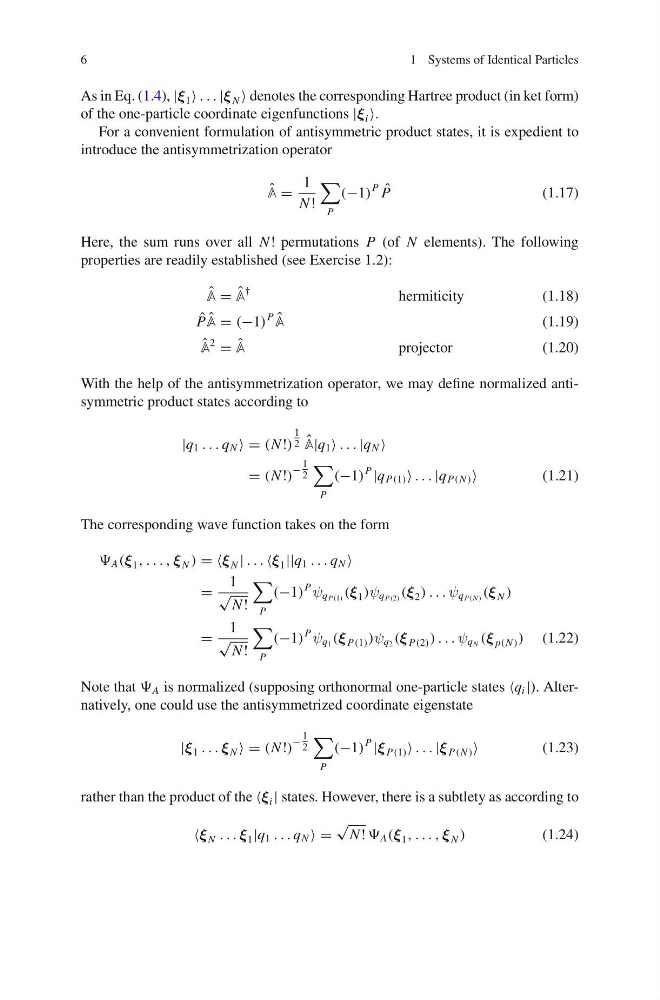
With the help of the antisymmetrization operator, we may define normalized antisymmetric product states according to
|q 1 . . . q N = (N !)
1
2 ˆ
A|q 1 . . . |q N
= (N !)
−
1
2
P
(−1)
P
|q P(1) . . . |q P(N )
(1.21)
The corresponding wave function takes on the form
A (ξ 1 , . . . , ξ N ) = =ξ N | . . . ξ 1 ||q 1 . . . q N
=
1
√
N !
P
(−1)
P
ψ q P(1) (ξ 1 )ψ q P(2) (ξ 2 ) . . . ψ q P(N ) (ξ N )
=
1
√
N !
P
(−1)
P
ψ q 1 (ξ P(1) )ψ q 2 (ξ P(2) ) . . . ψ q N (ξ p(N ) ) (1.22)
Note that A is normalized (supposing orthonormal one-particle states q i |). Alternatively, one could use the antisymmetrized coordinate eigenstate
|ξ 1 . . . ξ N = (N !)
−
1
2
P
(−1)
P
|ξ P(1) . . . |ξ P(N )
(1.23)
rather than the product of the ξ i | states. However, there is a subtlety as according to
ξ N . . . ξ 1 |q 1 . . . q N =
√
N ! A (ξ 1 , . . . , ξ N )
(1.24)
1 Systems of Identical Particles
As in Eq. (1.4), |ξ 1 . . . |ξ N denotes the corresponding Hartree product (in ket form)
of the one-particle coordinate eigenfunctions |ξ i .
For a convenient formulation of antisymmetric product states, it is expedient to
introduce the antisymmetrization operator
ˆ
A =
1
N !
P
(−1)
P ˆ
P
(1.17)
Here, the sum runs over all N ! permutations P (of N elements). The following
properties are readily established (see Exercise 1.2):
ˆ
A = ˆ
A
†
hermiticity
(1.18)
ˆ
P ˆ
A = (−1)
P ˆ
A
(1.19)
ˆ
A
2
= ˆ
A
projector
(1.20)
With the help of the antisymmetrization operator, we may define normalized antisymmetric product states according to
|q 1 . . . q N = (N !)
1
2 ˆ
A|q 1 . . . |q N
= (N !)
−
1
2
P
(−1)
P
|q P(1) . . . |q P(N )
(1.21)
The corresponding wave function takes on the form
A (ξ 1 , . . . , ξ N ) = =ξ N | . . . ξ 1 ||q 1 . . . q N
=
1
√
N !
P
(−1)
P
ψ q P(1) (ξ 1 )ψ q P(2) (ξ 2 ) . . . ψ q P(N ) (ξ N )
=
1
√
N !
P
(−1)
P
ψ q 1 (ξ P(1) )ψ q 2 (ξ P(2) ) . . . ψ q N (ξ p(N ) ) (1.22)
Note that A is normalized (supposing orthonormal one-particle states q i |). Alternatively, one could use the antisymmetrized coordinate eigenstate
|ξ 1 . . . ξ N = (N !)
−
1
2
P
(−1)
P
|ξ P(1) . . . |ξ P(N )
(1.23)
rather than the product of the ξ i | states. However, there is a subtlety as according to
ξ N . . . ξ 1 |q 1 . . . q N =
√
N ! A (ξ 1 , . . . , ξ N )
(1.24)