

11.1 Correlated Excited States and Excitation Class Orthogonalization
165
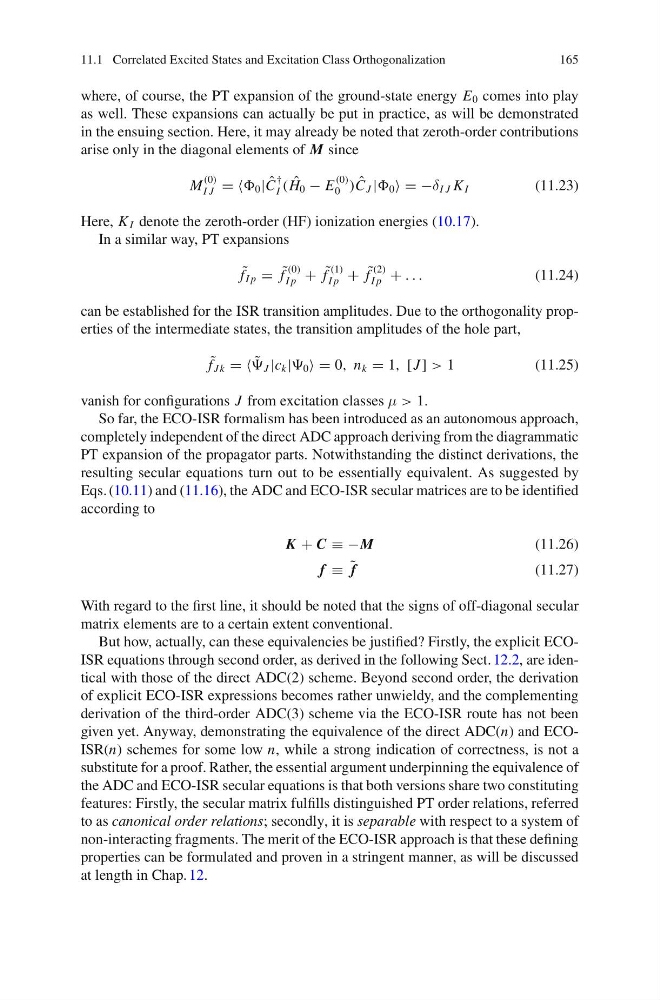
where, of course, the PT expansion of the ground-state energy E 0 comes into play
as well. These expansions can actually be put in practice, as will be demonstrated
in the ensuing section. Here, it may already be noted that zeroth-order contributions
arise only in the diagonal elements of M since
M
(0)
I J = = 0 | ˆ
C
†
I ( ˆ
H 0 − E
(0)
0 ) ˆ
C J | 0 = −δ I J K I
(11.23)
Here, K I denote the zeroth-order (HF) ionization energies (10.17).
In a similar way, PT expansions
˜
f I p = ˜
f
(0)
I p + ˜
f
(1)
I p + ˜
f
(2)
I p + . . .
(11.24)
can be established for the ISR transition amplitudes. Due to the orthogonality properties of the intermediate states, the transition amplitudes of the hole part,
˜
f J k = = ˜
J |c k | 0 = 0, n k = 1, [J ] > 1
(11.25)
vanish for configurations J from excitation classes μ > 1.
So far, the ECO-ISR formalism has been introduced as an autonomous approach,
completely independent of the direct ADC approach deriving from the diagrammatic
PT expansion of the propagator parts. Notwithstanding the distinct derivations, the
resulting secular equations turn out to be essentially equivalent. As suggested by
Eqs. (10.11) and (11.16), the ADC and ECO-ISR secular matrices are to be identified
according to
K + C ≡ −M
(11.26)
f ≡ ˜ f
(11.27)
With regard to the first line, it should be noted that the signs of off-diagonal secular
matrix elements are to a certain extent conventional.
But how, actually, can these equivalencies be justified? Firstly, the explicit ECOISR equations through second order, as derived in the following Sect. 12.2, are identical with those of the direct ADC(2) scheme. Beyond second order, the derivation
of explicit ECO-ISR expressions becomes rather unwieldy, and the complementing
derivation of the third-order ADC(3) scheme via the ECO-ISR route has not been
given yet. Anyway, demonstrating the equivalence of the direct ADC(n) and ECOISR(n) schemes for some low n, while a strong indication of correctness, is not a
substitute for a proof. Rather, the essential argument underpinning the equivalence of
the ADC and ECO-ISR secular equations is that both versions share two constituting
features: Firstly, the secular matrix fulfills distinguished PT order relations, referred
to as canonical order relations; secondly, it is separable with respect to a system of
non-interacting fragments. The merit of the ECO-ISR approach is that these defining
properties can be formulated and proven in a stringent manner, as will be discussed
at length in Chap. 12.
165
where, of course, the PT expansion of the ground-state energy E 0 comes into play
as well. These expansions can actually be put in practice, as will be demonstrated
in the ensuing section. Here, it may already be noted that zeroth-order contributions
arise only in the diagonal elements of M since
M
(0)
I J = = 0 | ˆ
C
†
I ( ˆ
H 0 − E
(0)
0 ) ˆ
C J | 0 = −δ I J K I
(11.23)
Here, K I denote the zeroth-order (HF) ionization energies (10.17).
In a similar way, PT expansions
˜
f I p = ˜
f
(0)
I p + ˜
f
(1)
I p + ˜
f
(2)
I p + . . .
(11.24)
can be established for the ISR transition amplitudes. Due to the orthogonality properties of the intermediate states, the transition amplitudes of the hole part,
˜
f J k = = ˜
J |c k | 0 = 0, n k = 1, [J ] > 1
(11.25)
vanish for configurations J from excitation classes μ > 1.
So far, the ECO-ISR formalism has been introduced as an autonomous approach,
completely independent of the direct ADC approach deriving from the diagrammatic
PT expansion of the propagator parts. Notwithstanding the distinct derivations, the
resulting secular equations turn out to be essentially equivalent. As suggested by
Eqs. (10.11) and (11.16), the ADC and ECO-ISR secular matrices are to be identified
according to
K + C ≡ −M
(11.26)
f ≡ ˜ f
(11.27)
With regard to the first line, it should be noted that the signs of off-diagonal secular
matrix elements are to a certain extent conventional.
But how, actually, can these equivalencies be justified? Firstly, the explicit ECOISR equations through second order, as derived in the following Sect. 12.2, are identical with those of the direct ADC(2) scheme. Beyond second order, the derivation
of explicit ECO-ISR expressions becomes rather unwieldy, and the complementing
derivation of the third-order ADC(3) scheme via the ECO-ISR route has not been
given yet. Anyway, demonstrating the equivalence of the direct ADC(n) and ECOISR(n) schemes for some low n, while a strong indication of correctness, is not a
substitute for a proof. Rather, the essential argument underpinning the equivalence of
the ADC and ECO-ISR secular equations is that both versions share two constituting
features: Firstly, the secular matrix fulfills distinguished PT order relations, referred
to as canonical order relations; secondly, it is separable with respect to a system of
non-interacting fragments. The merit of the ECO-ISR approach is that these defining
properties can be formulated and proven in a stringent manner, as will be discussed
at length in Chap. 12.