

158
10 Direct ADC Procedure for the Electron Propagator
FCI results are typically in the order of ±0.2 eV. This level of accuracy is consistent
with what has been found in numerous studies from the comparison of ADC(3)
ionization energies with experimental results.
ADC Expressions for Ground-State Expectation Values
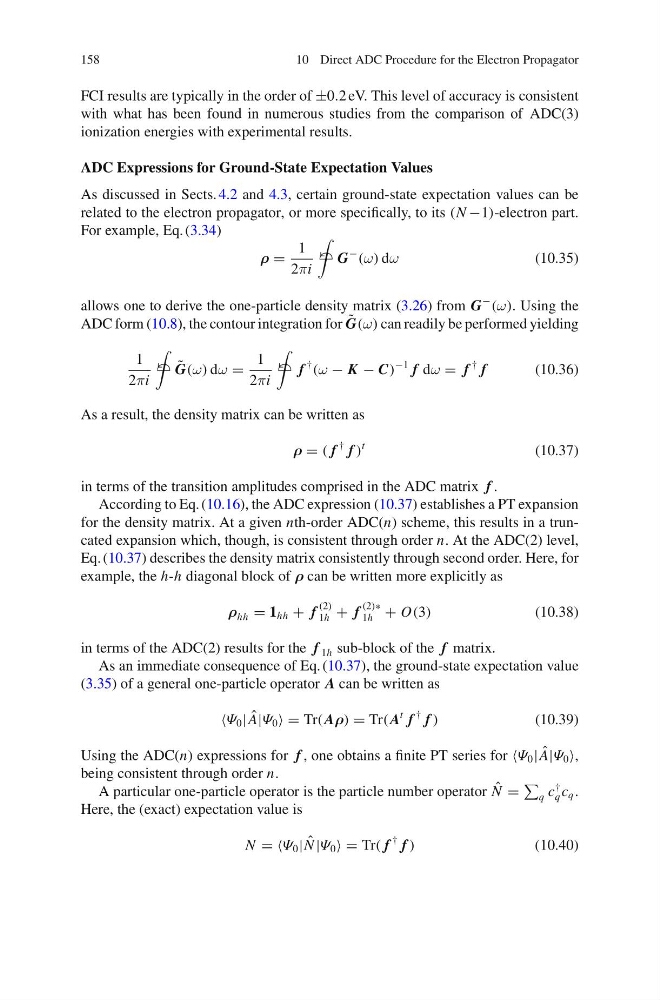
As discussed in Sects. 4.2 and 4.3, certain ground-state expectation values can be
related to the electron propagator, or more specifically, to its (N −1)-electron part.
For example, Eq. (3.34)
ρ =
1
2πi
2 G
−
(ω) dω
(10.35)
allows one to derive the one-particle density matrix (3.26) from G
−
(ω). Using the
ADC form (10.8), the contour integration for ˜
G(ω) can readily be performed yielding
1
2πi
2 ˜
G(ω) dω =
1
2πi
2 f
†
(ω − K − C)
−1 f dω = f
† f
(10.36)
As a result, the density matrix can be written as
ρ = ( f
† f )
t
(10.37)
in terms of the transition amplitudes comprised in the ADC matrix f .
According to Eq. (10.16), the ADC expression (10.37) establishes a PT expansion
for the density matrix. At a given nth-order ADC(n) scheme, this results in a truncated expansion which, though, is consistent through order n. At the ADC(2) level,
Eq. (10.37) describes the density matrix consistently through second order. Here, for
example, the h-h diagonal block of ρ can be written more explicitly as
ρ hh = 1 hh + f
(2)
1h + f
(2)∗
1h + O(3)
(10.38)
in terms of the ADC(2) results for the f 1h sub-block of the f matrix.
As an immediate consequence of Eq. (10.37), the ground-state expectation value
(3.35) of a general one-particle operator A can be written as
Ψ 0 | ˆ
A|Ψ 0 = Tr( Aρ) = Tr( A
t f
† f )
(10.39)
Using the ADC(n) expressions for f , one obtains a finite PT series for Ψ 0 | ˆ
A|Ψ 0 ,
being consistent through order n.
A particular one-particle operator is the particle number operator ˆ
N =
q c
†
q c q .
Here, the (exact) expectation value is
N = =Ψ 0 | ˆ
N |Ψ 0 = Tr( f
† f )
(10.40)
10 Direct ADC Procedure for the Electron Propagator
FCI results are typically in the order of ±0.2 eV. This level of accuracy is consistent
with what has been found in numerous studies from the comparison of ADC(3)
ionization energies with experimental results.
ADC Expressions for Ground-State Expectation Values
As discussed in Sects. 4.2 and 4.3, certain ground-state expectation values can be
related to the electron propagator, or more specifically, to its (N −1)-electron part.
For example, Eq. (3.34)
ρ =
1
2πi
2 G
−
(ω) dω
(10.35)
allows one to derive the one-particle density matrix (3.26) from G
−
(ω). Using the
ADC form (10.8), the contour integration for ˜
G(ω) can readily be performed yielding
1
2πi
2 ˜
G(ω) dω =
1
2πi
2 f
†
(ω − K − C)
−1 f dω = f
† f
(10.36)
As a result, the density matrix can be written as
ρ = ( f
† f )
t
(10.37)
in terms of the transition amplitudes comprised in the ADC matrix f .
According to Eq. (10.16), the ADC expression (10.37) establishes a PT expansion
for the density matrix. At a given nth-order ADC(n) scheme, this results in a truncated expansion which, though, is consistent through order n. At the ADC(2) level,
Eq. (10.37) describes the density matrix consistently through second order. Here, for
example, the h-h diagonal block of ρ can be written more explicitly as
ρ hh = 1 hh + f
(2)
1h + f
(2)∗
1h + O(3)
(10.38)
in terms of the ADC(2) results for the f 1h sub-block of the f matrix.
As an immediate consequence of Eq. (10.37), the ground-state expectation value
(3.35) of a general one-particle operator A can be written as
Ψ 0 | ˆ
A|Ψ 0 = Tr( Aρ) = Tr( A
t f
† f )
(10.39)
Using the ADC(n) expressions for f , one obtains a finite PT series for Ψ 0 | ˆ
A|Ψ 0 ,
being consistent through order n.
A particular one-particle operator is the particle number operator ˆ
N =
q c
†
q c q .
Here, the (exact) expectation value is
N = =Ψ 0 | ˆ
N |Ψ 0 = Tr( f
† f )
(10.40)