

156
10 Direct ADC Procedure for the Electron Propagator
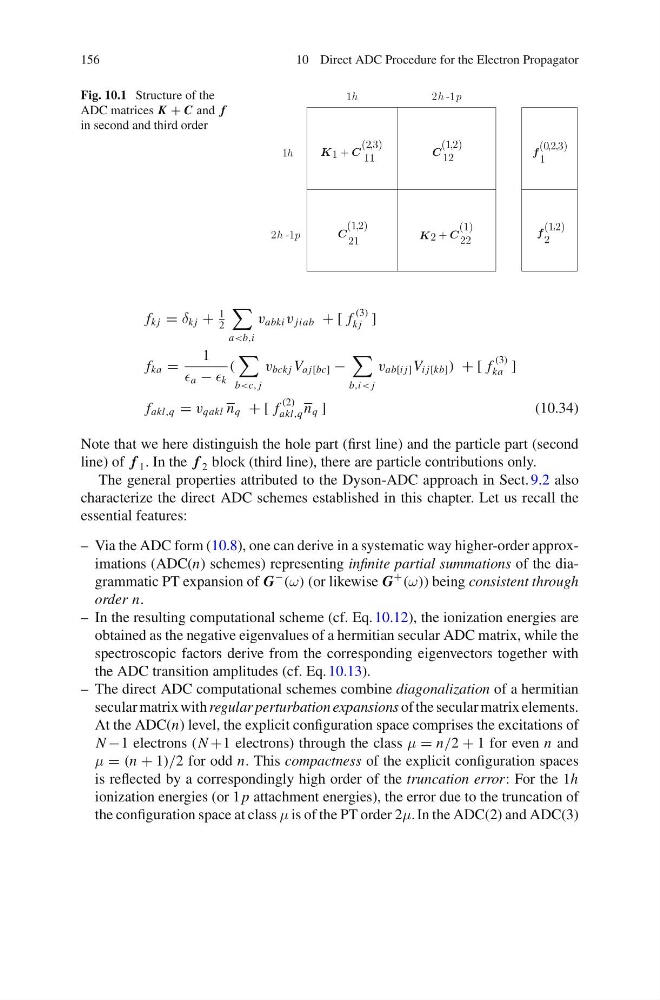
Fig. 10.1 Structure of the
ADC matrices K + C and f
in second and third order
1h
2h -1p
1h
K 1 + C
(2,3)
11
C
(1,2)
12
2h -1p
C
(1,2)
21
K2 + C
(1)
22
f
(0,2,3)
1
f
(1,2)
2
f k j = δ k j +
1
2
a
(3)
k j ]
f ka =
1
a − k
(
b
b,i< j
v ab[i j] V i j[kb] ) + [ f
(3)
ka ]
f akl,q = v qakl n q + [ f
(2)
akl,q n q ]
(10.34)
Note that we here distinguish the hole part (first line) and the particle part (second
line) of f 1 . In the f 2 block (third line), there are particle contributions only.
The general properties attributed to the Dyson-ADC approach in Sect. 9.2 also
characterize the direct ADC schemes established in this chapter. Let us recall the
essential features:
– Via the ADC form (10.8), one can derive in a systematic way higher-order approximations (ADC(n) schemes) representing infinite partial summations of the diagrammatic PT expansion of G
−
(ω) (or likewise G
+
(ω)) being consistent through
order n.
– In the resulting computational scheme (cf. Eq. 10.12), the ionization energies are
obtained as the negative eigenvalues of a hermitian secular ADC matrix, while the
spectroscopic factors derive from the corresponding eigenvectors together with
the ADC transition amplitudes (cf. Eq. 10.13).
– The direct ADC computational schemes combine diagonalization of a hermitian
secular matrix with regular perturbation expansions of the secular matrix elements.
At the ADC(n) level, the explicit configuration space comprises the excitations of
N −1 electrons (N +1 electrons) through the class μ = n/2 + 1 for even n and
μ = (n + 1)/2 for odd n. This compactness of the explicit configuration spaces
is reflected by a correspondingly high order of the truncation error: For the 1h
ionization energies (or 1 p attachment energies), the error due to the truncation of
the configuration space at class μ is of the PT order 2μ. In the ADC(2) and ADC(3)
10 Direct ADC Procedure for the Electron Propagator
Fig. 10.1 Structure of the
ADC matrices K + C and f
in second and third order
1h
2h -1p
1h
K 1 + C
(2,3)
11
C
(1,2)
12
2h -1p
C
(1,2)
21
K2 + C
(1)
22
f
(0,2,3)
1
f
(1,2)
2
f k j = δ k j +
1
2
a
(3)
k j ]
f ka =
1
a − k
(
b
b,i< j
v ab[i j] V i j[kb] ) + [ f
(3)
ka ]
f akl,q = v qakl n q + [ f
(2)
akl,q n q ]
(10.34)
Note that we here distinguish the hole part (first line) and the particle part (second
line) of f 1 . In the f 2 block (third line), there are particle contributions only.
The general properties attributed to the Dyson-ADC approach in Sect. 9.2 also
characterize the direct ADC schemes established in this chapter. Let us recall the
essential features:
– Via the ADC form (10.8), one can derive in a systematic way higher-order approximations (ADC(n) schemes) representing infinite partial summations of the diagrammatic PT expansion of G
−
(ω) (or likewise G
+
(ω)) being consistent through
order n.
– In the resulting computational scheme (cf. Eq. 10.12), the ionization energies are
obtained as the negative eigenvalues of a hermitian secular ADC matrix, while the
spectroscopic factors derive from the corresponding eigenvectors together with
the ADC transition amplitudes (cf. Eq. 10.13).
– The direct ADC computational schemes combine diagonalization of a hermitian
secular matrix with regular perturbation expansions of the secular matrix elements.
At the ADC(n) level, the explicit configuration space comprises the excitations of
N −1 electrons (N +1 electrons) through the class μ = n/2 + 1 for even n and
μ = (n + 1)/2 for odd n. This compactness of the explicit configuration spaces
is reflected by a correspondingly high order of the truncation error: For the 1h
ionization energies (or 1 p attachment energies), the error due to the truncation of
the configuration space at class μ is of the PT order 2μ. In the ADC(2) and ADC(3)