

148
10 Direct ADC Procedure for the Electron Propagator
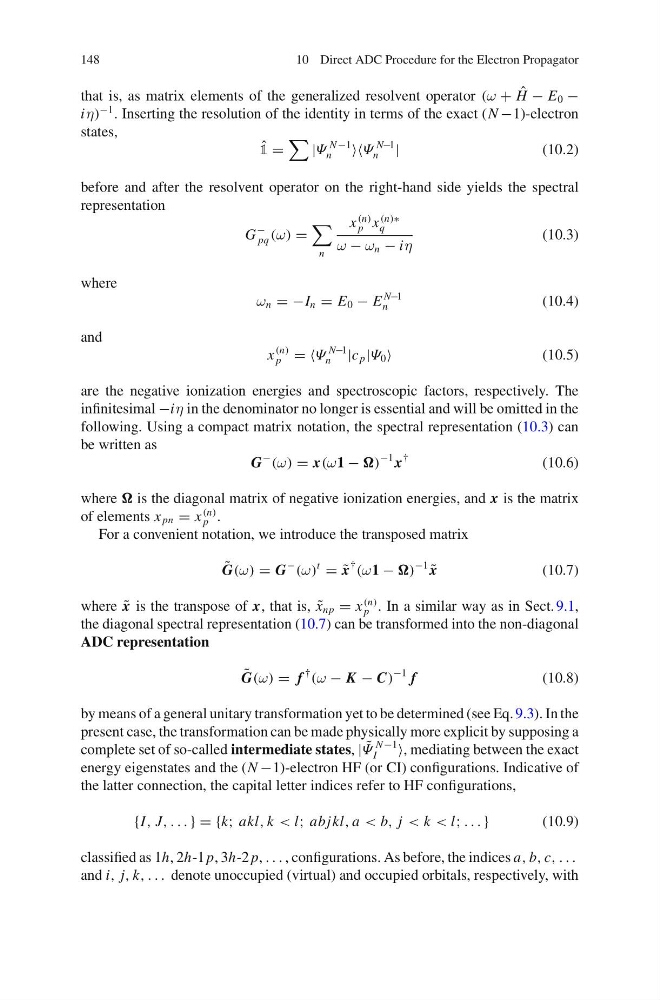
that is, as matrix elements of the generalized resolvent operator (ω + ˆ
H − E 0 −
iη)
−1 . Inserting the resolution of the identity in terms of the exact (N −1)-electron
states,
ˆ
1 =
|Ψ
N −1
n
Ψ
N−1
n
|
(10.2)
before and after the resolvent operator on the right-hand side yields the spectral
representation
G
−
pq (ω) =
n
x
(n)
p x
(n)∗
q
ω − ω n − iη
(10.3)
where
ω n = −I n = E 0 − E
N−1
n
(10.4)
and
x
(n)
p = =Ψ
N−1
n
|c p |Ψ 0
(10.5)
are the negative ionization energies and spectroscopic factors, respectively. The
infinitesimal −iη in the denominator no longer is essential and will be omitted in the
following. Using a compact matrix notation, the spectral representation (10.3) can
be written as
G
−
(ω) = x(ω1 − )
−1 x
†
(10.6)
where is the diagonal matrix of negative ionization energies, and x is the matrix
of elements x pn = x
(n)
p .
For a convenient notation, we introduce the transposed matrix
˜
G(ω) = G
−
(ω)
t
= ˜
x
† (ω1 − )
−1
˜
x
(10.7)
where ˜
x is the transpose of x, that is, ˜
x np = x
(n)
p . In a similar way as in Sect. 9.1,
the diagonal spectral representation (10.7) can be transformed into the non-diagonal
ADC representation
˜
G(ω) = f
†
(ω − K − C)
−1 f
(10.8)
by means of a general unitary transformation yet to be determined (see Eq. 9.3). In the
present case, the transformation can be made physically more explicit by supposing a
complete set of so-called intermediate states, | ˜
Ψ
N −1
I
, mediating between the exact
energy eigenstates and the (N −1)-electron HF (or CI) configurations. Indicative of
the latter connection, the capital letter indices refer to HF configurations,
{I, J, . . . } = {k; akl, k < l; abjkl, a < b, j < k < l; . . . }
(10.9)
classified as 1h, 2h-1 p, 3h-2 p, . . . , configurations. As before, the indices a, b, c, . . .
and i, j, k, . . . denote unoccupied (virtual) and occupied orbitals, respectively, with
10 Direct ADC Procedure for the Electron Propagator
that is, as matrix elements of the generalized resolvent operator (ω + ˆ
H − E 0 −
iη)
−1 . Inserting the resolution of the identity in terms of the exact (N −1)-electron
states,
ˆ
1 =
|Ψ
N −1
n
Ψ
N−1
n
|
(10.2)
before and after the resolvent operator on the right-hand side yields the spectral
representation
G
−
pq (ω) =
n
x
(n)
p x
(n)∗
q
ω − ω n − iη
(10.3)
where
ω n = −I n = E 0 − E
N−1
n
(10.4)
and
x
(n)
p = =Ψ
N−1
n
|c p |Ψ 0
(10.5)
are the negative ionization energies and spectroscopic factors, respectively. The
infinitesimal −iη in the denominator no longer is essential and will be omitted in the
following. Using a compact matrix notation, the spectral representation (10.3) can
be written as
G
−
(ω) = x(ω1 − )
−1 x
†
(10.6)
where is the diagonal matrix of negative ionization energies, and x is the matrix
of elements x pn = x
(n)
p .
For a convenient notation, we introduce the transposed matrix
˜
G(ω) = G
−
(ω)
t
= ˜
x
† (ω1 − )
−1
˜
x
(10.7)
where ˜
x is the transpose of x, that is, ˜
x np = x
(n)
p . In a similar way as in Sect. 9.1,
the diagonal spectral representation (10.7) can be transformed into the non-diagonal
ADC representation
˜
G(ω) = f
†
(ω − K − C)
−1 f
(10.8)
by means of a general unitary transformation yet to be determined (see Eq. 9.3). In the
present case, the transformation can be made physically more explicit by supposing a
complete set of so-called intermediate states, | ˜
Ψ
N −1
I
, mediating between the exact
energy eigenstates and the (N −1)-electron HF (or CI) configurations. Indicative of
the latter connection, the capital letter indices refer to HF configurations,
{I, J, . . . } = {k; akl, k < l; abjkl, a < b, j < k < l; . . . }
(10.9)
classified as 1h, 2h-1 p, 3h-2 p, . . . , configurations. As before, the indices a, b, c, . . .
and i, j, k, . . . denote unoccupied (virtual) and occupied orbitals, respectively, with