

144
9 Algebraic–Diagrammatic Construction (ADC)
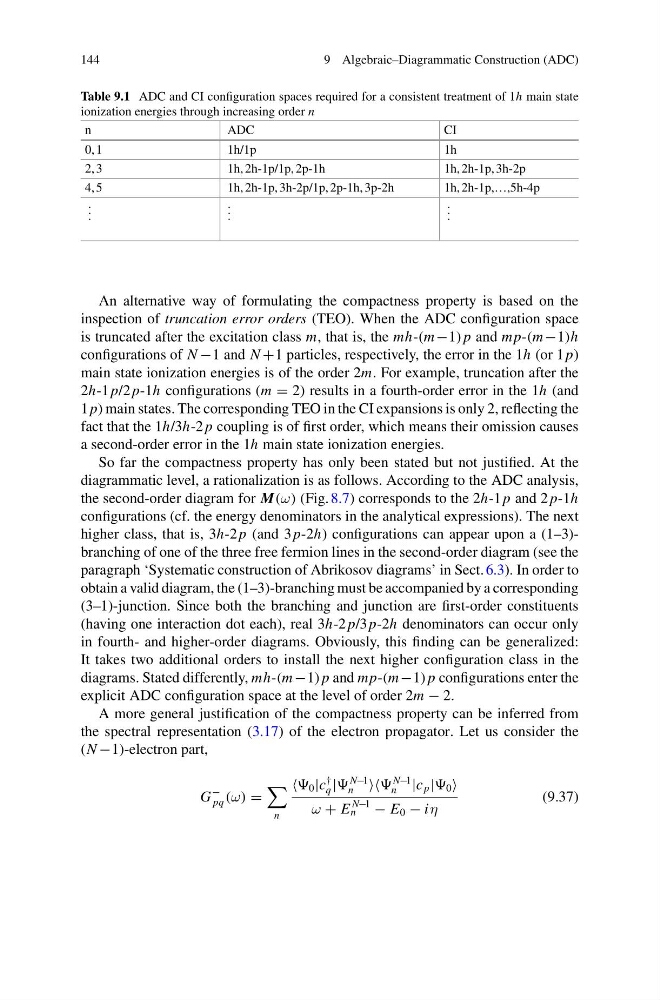
Table 9.1 ADC and CI configuration spaces required for a consistent treatment of 1h main state
ionization energies through increasing order n
n
ADC
CI
0, 1
1h/1p
1h
2, 3
1h, 2h-1p/1p, 2p-1h
1h, 2h-1p, 3h-2p
4, 5
1h, 2h-1p, 3h-2p/1p, 2p-1h, 3p-2h
1h, 2h-1p,…,5h-4p
. . .
. . .
. . .
An alternative way of formulating the compactness property is based on the
inspection of truncation error orders (TEO). When the ADC configuration space
is truncated after the excitation class m, that is, the mh-(m −1) p and mp-(m −1)h
configurations of N −1 and N +1 particles, respectively, the error in the 1h (or 1 p)
main state ionization energies is of the order 2m. For example, truncation after the
2h-1 p/2 p-1h configurations (m = 2) results in a fourth-order error in the 1h (and
1 p) main states. The corresponding TEO in the CI expansions is only 2, reflecting the
fact that the 1h/3h-2 p coupling is of first order, which means their omission causes
a second-order error in the 1h main state ionization energies.
So far the compactness property has only been stated but not justified. At the
diagrammatic level, a rationalization is as follows. According to the ADC analysis,
the second-order diagram for M(ω) (Fig. 8.7) corresponds to the 2h-1 p and 2 p-1h
configurations (cf. the energy denominators in the analytical expressions). The next
higher class, that is, 3h-2 p (and 3 p-2h) configurations can appear upon a (1–3)branching of one of the three free fermion lines in the second-order diagram (see the
paragraph ‘Systematic construction of Abrikosov diagrams’ in Sect. 6.3). In order to
obtain a valid diagram, the (1–3)-branching must be accompanied by a corresponding
(3–1)-junction. Since both the branching and junction are first-order constituents
(having one interaction dot each), real 3h-2 p/3 p-2h denominators can occur only
in fourth- and higher-order diagrams. Obviously, this finding can be generalized:
It takes two additional orders to install the next higher configuration class in the
diagrams. Stated differently, mh-(m −1) p and mp-(m −1) p configurations enter the
explicit ADC configuration space at the level of order 2m − 2.
A more general justification of the compactness property can be inferred from
the spectral representation (3.17) of the electron propagator. Let us consider the
(N −1)-electron part,
G
−
pq (ω) =
n
0 |c
†
q |
N−1
n
N−1
n |c p | 0
ω + E
N−1
n
− E 0 − iη
(9.37)
9 Algebraic–Diagrammatic Construction (ADC)
Table 9.1 ADC and CI configuration spaces required for a consistent treatment of 1h main state
ionization energies through increasing order n
n
ADC
CI
0, 1
1h/1p
1h
2, 3
1h, 2h-1p/1p, 2p-1h
1h, 2h-1p, 3h-2p
4, 5
1h, 2h-1p, 3h-2p/1p, 2p-1h, 3p-2h
1h, 2h-1p,…,5h-4p
. . .
. . .
. . .
An alternative way of formulating the compactness property is based on the
inspection of truncation error orders (TEO). When the ADC configuration space
is truncated after the excitation class m, that is, the mh-(m −1) p and mp-(m −1)h
configurations of N −1 and N +1 particles, respectively, the error in the 1h (or 1 p)
main state ionization energies is of the order 2m. For example, truncation after the
2h-1 p/2 p-1h configurations (m = 2) results in a fourth-order error in the 1h (and
1 p) main states. The corresponding TEO in the CI expansions is only 2, reflecting the
fact that the 1h/3h-2 p coupling is of first order, which means their omission causes
a second-order error in the 1h main state ionization energies.
So far the compactness property has only been stated but not justified. At the
diagrammatic level, a rationalization is as follows. According to the ADC analysis,
the second-order diagram for M(ω) (Fig. 8.7) corresponds to the 2h-1 p and 2 p-1h
configurations (cf. the energy denominators in the analytical expressions). The next
higher class, that is, 3h-2 p (and 3 p-2h) configurations can appear upon a (1–3)branching of one of the three free fermion lines in the second-order diagram (see the
paragraph ‘Systematic construction of Abrikosov diagrams’ in Sect. 6.3). In order to
obtain a valid diagram, the (1–3)-branching must be accompanied by a corresponding
(3–1)-junction. Since both the branching and junction are first-order constituents
(having one interaction dot each), real 3h-2 p/3 p-2h denominators can occur only
in fourth- and higher-order diagrams. Obviously, this finding can be generalized:
It takes two additional orders to install the next higher configuration class in the
diagrams. Stated differently, mh-(m −1) p and mp-(m −1) p configurations enter the
explicit ADC configuration space at the level of order 2m − 2.
A more general justification of the compactness property can be inferred from
the spectral representation (3.17) of the electron propagator. Let us consider the
(N −1)-electron part,
G
−
pq (ω) =
n
0 |c
†
q |
N−1
n
N−1
n |c p | 0
ω + E
N−1
n
− E 0 − iη
(9.37)