

132
8 Self-Energy and the Dyson Equation
ω
εp+Σpp(∞)
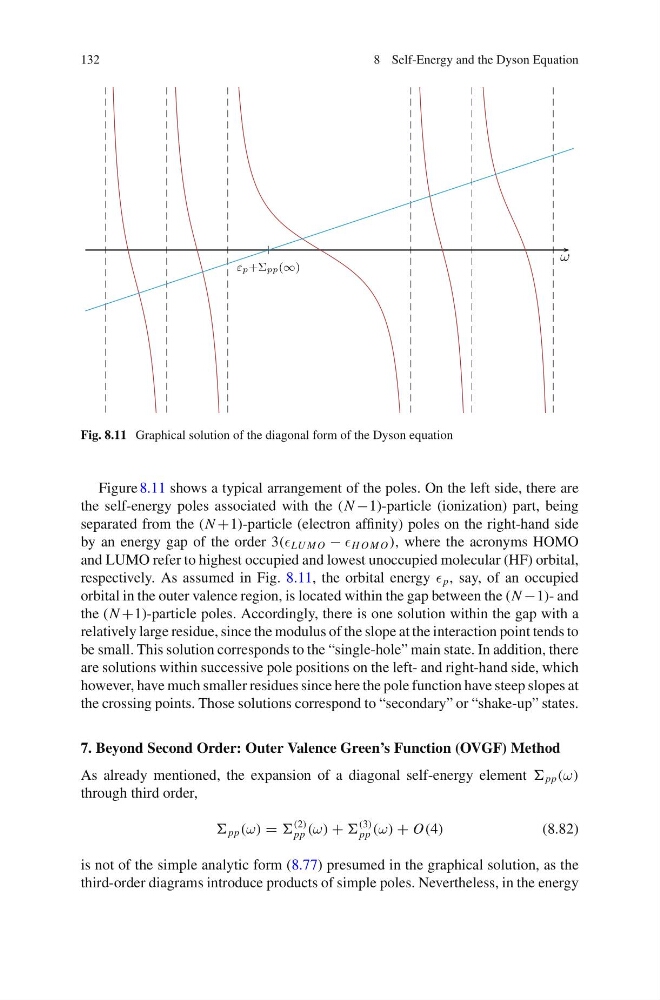
Fig. 8.11 Graphical solution of the diagonal form of the Dyson equation
Figure 8.11 shows a typical arrangement of the poles. On the left side, there are
the self-energy poles associated with the (N −1)-particle (ionization) part, being
separated from the (N +1)-particle (electron affinity) poles on the right-hand side
by an energy gap of the order 3( LU M O − H O M O ), where the acronyms HOMO
and LUMO refer to highest occupied and lowest unoccupied molecular (HF) orbital,
respectively. As assumed in Fig. 8.11, the orbital energy p , say, of an occupied
orbital in the outer valence region, is located within the gap between the (N −1)- and
the (N +1)-particle poles. Accordingly, there is one solution within the gap with a
relatively large residue, since the modulus of the slope at the interaction point tends to
be small. This solution corresponds to the “single-hole” main state. In addition, there
are solutions within successive pole positions on the left- and right-hand side, which
however, have much smaller residues since here the pole function have steep slopes at
the crossing points. Those solutions correspond to “secondary” or “shake-up” states.
7. Beyond Second Order: Outer Valence Green’s Function (OVGF) Method
As already mentioned, the expansion of a diagonal self-energy element pp (ω)
through third order,
pp (ω) =
(2)
pp (ω) +
(3)
pp (ω) + O(4)
(8.82)
is not of the simple analytic form (8.77) presumed in the graphical solution, as the
third-order diagrams introduce products of simple poles. Nevertheless, in the energy
8 Self-Energy and the Dyson Equation
ω
εp+Σpp(∞)
Fig. 8.11 Graphical solution of the diagonal form of the Dyson equation
Figure 8.11 shows a typical arrangement of the poles. On the left side, there are
the self-energy poles associated with the (N −1)-particle (ionization) part, being
separated from the (N +1)-particle (electron affinity) poles on the right-hand side
by an energy gap of the order 3( LU M O − H O M O ), where the acronyms HOMO
and LUMO refer to highest occupied and lowest unoccupied molecular (HF) orbital,
respectively. As assumed in Fig. 8.11, the orbital energy p , say, of an occupied
orbital in the outer valence region, is located within the gap between the (N −1)- and
the (N +1)-particle poles. Accordingly, there is one solution within the gap with a
relatively large residue, since the modulus of the slope at the interaction point tends to
be small. This solution corresponds to the “single-hole” main state. In addition, there
are solutions within successive pole positions on the left- and right-hand side, which
however, have much smaller residues since here the pole function have steep slopes at
the crossing points. Those solutions correspond to “secondary” or “shake-up” states.
7. Beyond Second Order: Outer Valence Green’s Function (OVGF) Method
As already mentioned, the expansion of a diagonal self-energy element pp (ω)
through third order,
pp (ω) =
(2)
pp (ω) +
(3)
pp (ω) + O(4)
(8.82)
is not of the simple analytic form (8.77) presumed in the graphical solution, as the
third-order diagrams introduce products of simple poles. Nevertheless, in the energy