

(Scheme 3.14) with NiCl 2 6H 2 O or CoCl 2 6H 2 O in DMF at room temperature [89].
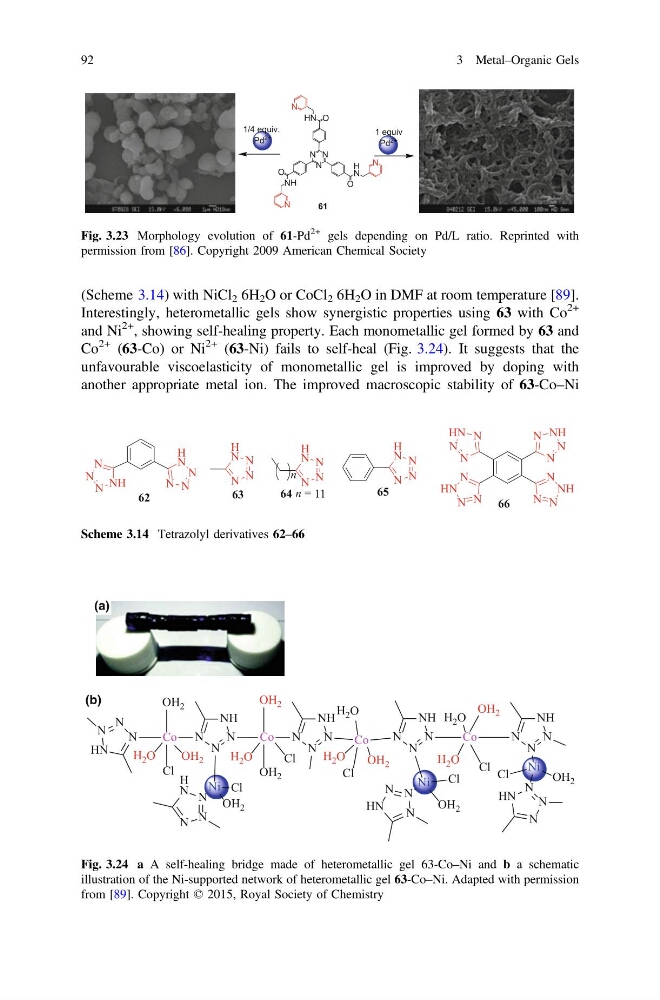
Interestingly, heterometallic gels show synergistic properties using 63 with Co
2+
and Ni
2+ , showing self-healing property. Each monometallic gel formed by 63 and
Co
2+ (63-Co) or Ni
2+ (63-Ni) fails to self-heal (Fig. 3.24). It suggests that the
unfavourable viscoelasticity of monometallic gel is improved by doping with
another appropriate metal ion. The improved macroscopic stability of 63-Co–Ni
NH
O
N
N
N
N
H
N
O
N
HN O
N
1 equiv
Pd
2+
1/4 equiv.
Pd
2+
61
Fig. 3.23 Morphology evolution of 61-Pd
2+ gels depending on Pd/L ratio. Reprinted with
permission from [86]. Copyright 2009 American Chemical Society
N N
N
H
N
N
N
N NH
62
N N
N
H
N
n
64 n = 11
N N
N
H
N
65
N
HN
N
N
N
N
NH
N
N N
NH
N
N
HN
N N 66
N N
N
H
N
63
Scheme 3.14 Tetrazolyl derivatives 62–66
N
N
N
HN
Co N
OH 2
Cl
OH 2
H 2 O
N
N
NH
Co
OH 2
OH 2
H 2 O
Cl
N
N
N
NH
Co
H 2 O
Cl
H 2 O
OH 2
N
N
N
NH
Co
OH 2
Cl
H 2 O
N
N
N
NH
Ni
N
Cl
OH 2
H
N
N N
Ni Cl
OH 2
N
N
HN
N
Ni
Cl
OH 2
N
HN
N
N
H 2 O
(a)
(b)
Fig. 3.24 a A self-healing bridge made of heterometallic gel 63-Co–Ni and b a schematic
illustration of the Ni-supported network of heterometallic gel 63-Co–Ni. Adapted with permission
from [89]. Copyright © 2015, Royal Society of Chemistry
92
3 Metal–Organic Gels
Interestingly, heterometallic gels show synergistic properties using 63 with Co
2+
and Ni
2+ , showing self-healing property. Each monometallic gel formed by 63 and
Co
2+ (63-Co) or Ni
2+ (63-Ni) fails to self-heal (Fig. 3.24). It suggests that the
unfavourable viscoelasticity of monometallic gel is improved by doping with
another appropriate metal ion. The improved macroscopic stability of 63-Co–Ni
NH
O
N
N
N
N
H
N
O
N
HN O
N
1 equiv
Pd
2+
1/4 equiv.
Pd
2+
61
Fig. 3.23 Morphology evolution of 61-Pd
2+ gels depending on Pd/L ratio. Reprinted with
permission from [86]. Copyright 2009 American Chemical Society
N N
N
H
N
N
N
N NH
62
N N
N
H
N
n
64 n = 11
N N
N
H
N
65
N
HN
N
N
N
N
NH
N
N N
NH
N
N
HN
N N 66
N N
N
H
N
63
Scheme 3.14 Tetrazolyl derivatives 62–66
N
N
N
HN
Co N
OH 2
Cl
OH 2
H 2 O
N
N
NH
Co
OH 2
OH 2
H 2 O
Cl
N
N
N
NH
Co
H 2 O
Cl
H 2 O
OH 2
N
N
N
NH
Co
OH 2
Cl
H 2 O
N
N
N
NH
Ni
N
Cl
OH 2
H
N
N N
Ni Cl
OH 2
N
N
HN
N
Ni
Cl
OH 2
N
HN
N
N
H 2 O
(a)
(b)
Fig. 3.24 a A self-healing bridge made of heterometallic gel 63-Co–Ni and b a schematic
illustration of the Ni-supported network of heterometallic gel 63-Co–Ni. Adapted with permission
from [89]. Copyright © 2015, Royal Society of Chemistry
92
3 Metal–Organic Gels