

and the self-assembled nanotube (G43-1) and nanofibre structure (G43-2) can be
obtained at different concentration (Fig. 3.13). When the concentration of 43 is
increasing, G43-2 with entangled fibrillar structure is formed. In G43-1, two 43
molecules are bridged by two silver ions to form an oval-shaped ring, which adopts
face-to-face packing due to p–p stacking of fluorenyl and hydrogen bonding
interactions and finally leads to nanotube structures. The major gelators of G43-2,
linked by silver ions, form the helical coordination polymer chains. Both G43-1 and
G43-2 exhibit thermally reversible sol–gel transition. The gel nanomaterials show
differential antibacterial activity when they are utilized as the antibiotic agents. The
antimicrobial mechanism is that the nanomaterials can destroy the membrane
integrity and induce DNA condensation to finally kill the bacteria.
Huang, Stang and co-workers used hierarchical self-assembly to fabricate
advanced supramolecular materials [46]. Benzo-21-crown-7 (B21C7)-functionalized 120° dipyridyl, ligand 44 has highly directional dipyridyl donors decorated
with a benzo-21-crown-7 moiety (Fig. 3.14). 44 first self-assemble into a hexagonal
metal–organic cycle when mixed with a 120° acceptor 45 driven by coordination.
These discrete hexagons then form a hexagonal-cored supramolecular polymer
network by cross-linking the B21C7 moieties with a bis ammonium salt 46, through
crown ether-based host/guest interactions. SEM of the xerogel shows extended and
interconnected fibres. The gel shows completely reversible thermo- and cationinduced gel–sol transitions.
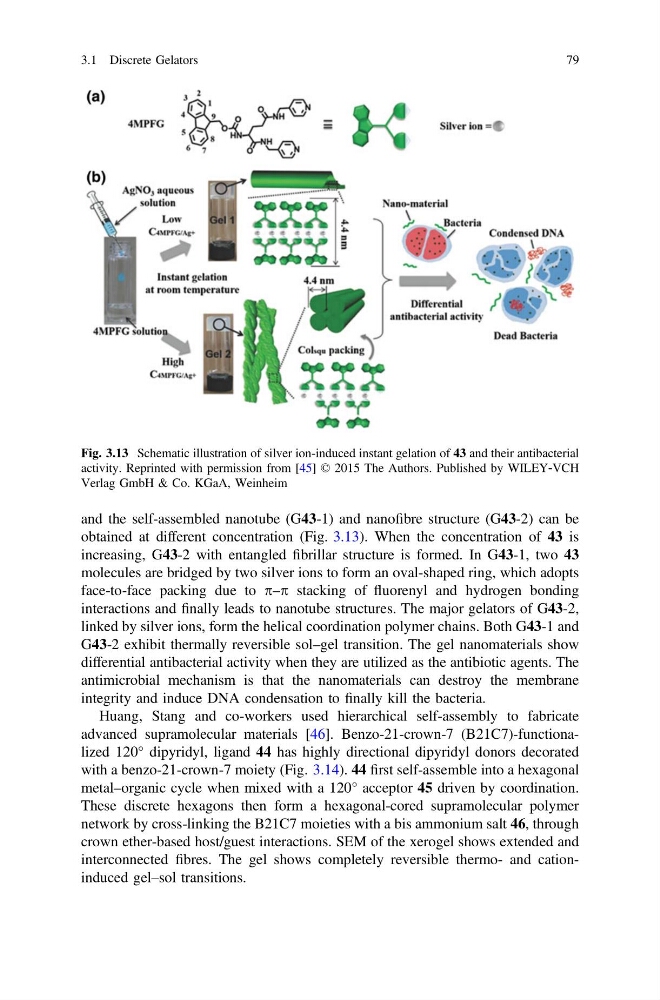
Fig. 3.13 Schematic illustration of silver ion-induced instant gelation of 43 and their antibacterial
activity. Reprinted with permission from [45] © 2015 The Authors. Published by WILEY‐VCH
Verlag GmbH & Co. KGaA, Weinheim
3.1 Discrete Gelators
79
obtained at different concentration (Fig. 3.13). When the concentration of 43 is
increasing, G43-2 with entangled fibrillar structure is formed. In G43-1, two 43
molecules are bridged by two silver ions to form an oval-shaped ring, which adopts
face-to-face packing due to p–p stacking of fluorenyl and hydrogen bonding
interactions and finally leads to nanotube structures. The major gelators of G43-2,
linked by silver ions, form the helical coordination polymer chains. Both G43-1 and
G43-2 exhibit thermally reversible sol–gel transition. The gel nanomaterials show
differential antibacterial activity when they are utilized as the antibiotic agents. The
antimicrobial mechanism is that the nanomaterials can destroy the membrane
integrity and induce DNA condensation to finally kill the bacteria.
Huang, Stang and co-workers used hierarchical self-assembly to fabricate
advanced supramolecular materials [46]. Benzo-21-crown-7 (B21C7)-functionalized 120° dipyridyl, ligand 44 has highly directional dipyridyl donors decorated
with a benzo-21-crown-7 moiety (Fig. 3.14). 44 first self-assemble into a hexagonal
metal–organic cycle when mixed with a 120° acceptor 45 driven by coordination.
These discrete hexagons then form a hexagonal-cored supramolecular polymer
network by cross-linking the B21C7 moieties with a bis ammonium salt 46, through
crown ether-based host/guest interactions. SEM of the xerogel shows extended and
interconnected fibres. The gel shows completely reversible thermo- and cationinduced gel–sol transitions.
Fig. 3.13 Schematic illustration of silver ion-induced instant gelation of 43 and their antibacterial
activity. Reprinted with permission from [45] © 2015 The Authors. Published by WILEY‐VCH
Verlag GmbH & Co. KGaA, Weinheim
3.1 Discrete Gelators
79