

reaction of alkylbipyridinium 5 (Scheme 3.2) and a-CD, followed by heating the
solution to 60 °C, then cooling to ambient temperature forms a gel in 1 h. Complex
6 (Scheme 3.2) also forms gels under similar conditions, but the gelation products
are controlled by the reaction of Pd–N coordination bond of 6. The metallogel from
6 and a-CD exhibits reversible sol–gel transition which was triggered by temperature and concentration. At higher concentrations, rotaxane 6(a-CD) 4 fabricates
polyrotaxane-like fibrous structures, followed by formation of nanoparticles that
trap the water molecules into the gel network (Fig. 3.2).
The gelation occurred when mixing NiCl 2 Á6H 2 O with amines in protic solvents
[7]. The amines have pKa values in the range 7.41–13.6 such as triethylamine, Nmethyl morpholine, 1,8-diazabicycloundec-7-ene, 1,1,3,3-tetramethyl guanidine.
The interactions between NiCl 2 Á6H 2 O and methoxide ions probably lead to the
formation of cis-Ni(OMe) 2 (MeOH) 4 , a thermodynamically stable hexacoordinated
complex. The extensive H-bonding network between free and metal-bound MeOH
and free and metal-bound amines could stabilize the metal–organic gels.
An amphiphilic gelator 7 (Scheme 3.2) functionalized with a triazole fragment
forms organogels in H 2 O-t-BuOH (v:v 1:1) at 80 °C [8]. When Cu
+ is introduced, a
metallogel forms with a decrease in the minimum gelation concentration. PXRD
exhibits that vertically pilled 7 molecules repetite side-to-side horizontally, and
self-assembly of gelator 7 is conducted by intermolecular hydrogen bonding
between the different amide groups (Fig. 3.3). CD spectrum of Cu(I)-7 gels shows
that the coordination geometry of metal centre favours a twist into fibre orientation
leading to a helical orientation. The amphiphilic Cu(I) metal–organic gel exhibits
N
O
O O
O
O
H
N
O
R
2 M = Pd or Pt, R= n-C 16 H 33
N
O
O
O
O O
N
H
O
R
M
Cl
Cl
RO
RO
RO
N M
OR
OR
OR
N
1 M = Pt, Pd R = (CH 2 CH 2 O) 3 CH 3
Cl
Cl
N
H
N
H
N
O
H
N
H
N
N
O
Pt
Cl
Cl
3 R= n-C 12 H 25
R
R
H 3 COOC
H 3 COOC
O
H 3 COOC
H 3 COOC
O
O
N
COOCH 3
COOCH 3
O
COOCH 3
COOCH 3
O
O
N
n
n
Ag
OTf
4 (n = 0, 1, 2)
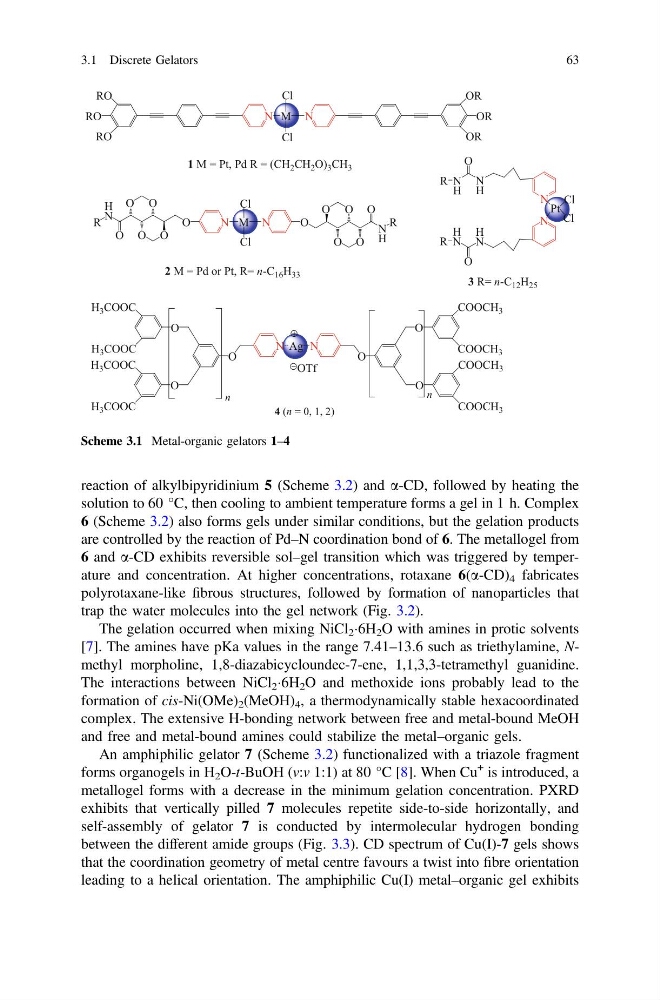
Scheme 3.1 Metal-organic gelators 1–4
3.1 Discrete Gelators
63
solution to 60 °C, then cooling to ambient temperature forms a gel in 1 h. Complex
6 (Scheme 3.2) also forms gels under similar conditions, but the gelation products
are controlled by the reaction of Pd–N coordination bond of 6. The metallogel from
6 and a-CD exhibits reversible sol–gel transition which was triggered by temperature and concentration. At higher concentrations, rotaxane 6(a-CD) 4 fabricates
polyrotaxane-like fibrous structures, followed by formation of nanoparticles that
trap the water molecules into the gel network (Fig. 3.2).
The gelation occurred when mixing NiCl 2 Á6H 2 O with amines in protic solvents
[7]. The amines have pKa values in the range 7.41–13.6 such as triethylamine, Nmethyl morpholine, 1,8-diazabicycloundec-7-ene, 1,1,3,3-tetramethyl guanidine.
The interactions between NiCl 2 Á6H 2 O and methoxide ions probably lead to the
formation of cis-Ni(OMe) 2 (MeOH) 4 , a thermodynamically stable hexacoordinated
complex. The extensive H-bonding network between free and metal-bound MeOH
and free and metal-bound amines could stabilize the metal–organic gels.
An amphiphilic gelator 7 (Scheme 3.2) functionalized with a triazole fragment
forms organogels in H 2 O-t-BuOH (v:v 1:1) at 80 °C [8]. When Cu
+ is introduced, a
metallogel forms with a decrease in the minimum gelation concentration. PXRD
exhibits that vertically pilled 7 molecules repetite side-to-side horizontally, and
self-assembly of gelator 7 is conducted by intermolecular hydrogen bonding
between the different amide groups (Fig. 3.3). CD spectrum of Cu(I)-7 gels shows
that the coordination geometry of metal centre favours a twist into fibre orientation
leading to a helical orientation. The amphiphilic Cu(I) metal–organic gel exhibits
N
O
O O
O
O
H
N
O
R
2 M = Pd or Pt, R= n-C 16 H 33
N
O
O
O
O O
N
H
O
R
M
Cl
Cl
RO
RO
RO
N M
OR
OR
OR
N
1 M = Pt, Pd R = (CH 2 CH 2 O) 3 CH 3
Cl
Cl
N
H
N
H
N
O
H
N
H
N
N
O
Pt
Cl
Cl
3 R= n-C 12 H 25
R
R
H 3 COOC
H 3 COOC
O
H 3 COOC
H 3 COOC
O
O
N
COOCH 3
COOCH 3
O
COOCH 3
COOCH 3
O
O
N
n
n
Ag
OTf
4 (n = 0, 1, 2)
Scheme 3.1 Metal-organic gelators 1–4
3.1 Discrete Gelators
63