

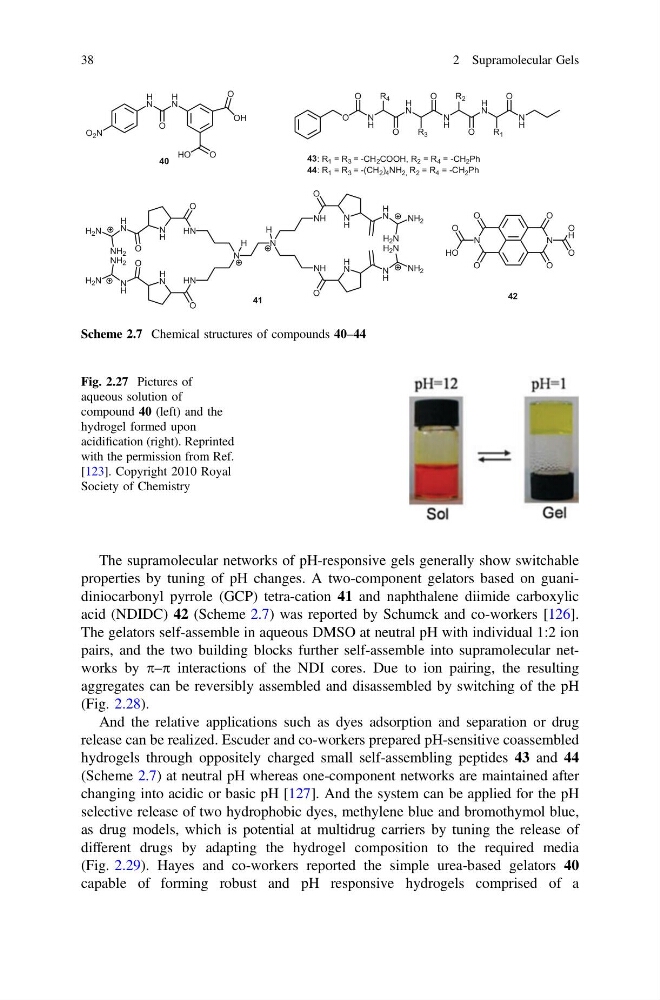
The supramolecular networks of pH-responsive gels generally show switchable
properties by tuning of pH changes. A two-component gelators based on guanidiniocarbonyl pyrrole (GCP) tetra-cation 41 and naphthalene diimide carboxylic
acid (NDIDC) 42 (Scheme 2.7) was reported by Schumck and co-workers [126].
The gelators self-assemble in aqueous DMSO at neutral pH with individual 1:2 ion
pairs, and the two building blocks further self-assemble into supramolecular networks by p–p interactions of the NDI cores. Due to ion pairing, the resulting
aggregates can be reversibly assembled and disassembled by switching of the pH
(Fig. 2.28).
And the relative applications such as dyes adsorption and separation or drug
release can be realized. Escuder and co-workers prepared pH-sensitive coassembled
hydrogels through oppositely charged small self-assembling peptides 43 and 44
(Scheme 2.7) at neutral pH whereas one-component networks are maintained after
changing into acidic or basic pH [127]. And the system can be applied for the pH
selective release of two hydrophobic dyes, methylene blue and bromothymol blue,
as drug models, which is potential at multidrug carriers by tuning the release of
different drugs by adapting the hydrogel composition to the required media
(Fig. 2.29). Hayes and co-workers reported the simple urea-based gelators 40
capable of forming robust and pH responsive hydrogels comprised of a
O
HO
O
OH
H
N
H
N
O
O 2 N
40
O
N
H
H
N
N
H
H
N
N
H
O
R 4
O
R 3
O
R 2
O
R 1
O
43: R 1 = R 3 = -CH 2 COOH, R 2 = R 4 = -CH 2 Ph
44: R 1 = R 3 = -(CH 2 ) 4 NH 2, R 2 = R 4 = -CH 2 Ph
N
NH
NH
O
O
N
H
H
N
H
N
NH 2
H 2 N
N
H
NH 2
H 2 N
N
H
H
HN
HN
O
O
N
H
H
N
N
H
H
N
O
O
H 2 N
NH 2
NH 2
H 2 N
41
N
N
O
O
O
O
O
O
H
O
HO
42
Scheme 2.7 Chemical structures of compounds 40–44
Fig. 2.27 Pictures of
aqueous solution of
compound 40 (left) and the
hydrogel formed upon
acidification (right). Reprinted
with the permission from Ref.
[123]. Copyright 2010 Royal
Society of Chemistry
38
2 Supramolecular Gels
properties by tuning of pH changes. A two-component gelators based on guanidiniocarbonyl pyrrole (GCP) tetra-cation 41 and naphthalene diimide carboxylic
acid (NDIDC) 42 (Scheme 2.7) was reported by Schumck and co-workers [126].
The gelators self-assemble in aqueous DMSO at neutral pH with individual 1:2 ion
pairs, and the two building blocks further self-assemble into supramolecular networks by p–p interactions of the NDI cores. Due to ion pairing, the resulting
aggregates can be reversibly assembled and disassembled by switching of the pH
(Fig. 2.28).
And the relative applications such as dyes adsorption and separation or drug
release can be realized. Escuder and co-workers prepared pH-sensitive coassembled
hydrogels through oppositely charged small self-assembling peptides 43 and 44
(Scheme 2.7) at neutral pH whereas one-component networks are maintained after
changing into acidic or basic pH [127]. And the system can be applied for the pH
selective release of two hydrophobic dyes, methylene blue and bromothymol blue,
as drug models, which is potential at multidrug carriers by tuning the release of
different drugs by adapting the hydrogel composition to the required media
(Fig. 2.29). Hayes and co-workers reported the simple urea-based gelators 40
capable of forming robust and pH responsive hydrogels comprised of a
O
HO
O
OH
H
N
H
N
O
O 2 N
40
O
N
H
H
N
N
H
H
N
N
H
O
R 4
O
R 3
O
R 2
O
R 1
O
43: R 1 = R 3 = -CH 2 COOH, R 2 = R 4 = -CH 2 Ph
44: R 1 = R 3 = -(CH 2 ) 4 NH 2, R 2 = R 4 = -CH 2 Ph
N
NH
NH
O
O
N
H
H
N
H
N
NH 2
H 2 N
N
H
NH 2
H 2 N
N
H
H
HN
HN
O
O
N
H
H
N
N
H
H
N
O
O
H 2 N
NH 2
NH 2
H 2 N
41
N
N
O
O
O
O
O
O
H
O
HO
42
Scheme 2.7 Chemical structures of compounds 40–44
Fig. 2.27 Pictures of
aqueous solution of
compound 40 (left) and the
hydrogel formed upon
acidification (right). Reprinted
with the permission from Ref.
[123]. Copyright 2010 Royal
Society of Chemistry
38
2 Supramolecular Gels