

significant potential for clean energy applications. The excellent catalytic performance of the chalcogels is in correlation with the easy access to organic molecules
resulting from the existence of large pores within the molecular networks.
In addition to HDS catalysis, chalcogels can also be applied in biologically
important nitrogen fixation conventionally catalyzed by the enzyme nitrogenase
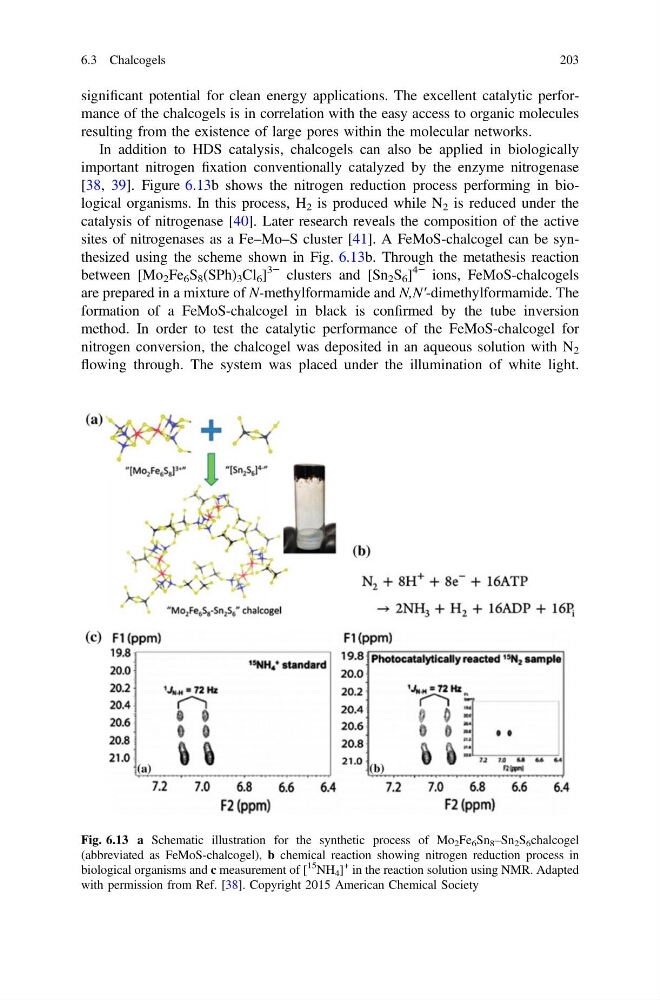
[38, 39]. Figure 6.13b shows the nitrogen reduction process performing in biological organisms. In this process, H 2 is produced while N 2 is reduced under the
catalysis of nitrogenase [40]. Later research reveals the composition of the active
sites of nitrogenases as a Fe–Mo–S cluster [41]. A FeMoS-chalcogel can be synthesized using the scheme shown in Fig. 6.13b. Through the metathesis reaction
between [Mo 2 Fe 6 S 8 (SPh) 3 Cl 6 ]
3− clusters and [Sn 2 S 6 ]
4− ions, FeMoS-chalcogels
are prepared in a mixture of N-methylformamide and N,N′-dimethylformamide. The
formation of a FeMoS-chalcogel in black is confirmed by the tube inversion
method. In order to test the catalytic performance of the FeMoS-chalcogel for
nitrogen conversion, the chalcogel was deposited in an aqueous solution with N 2
flowing through. The system was placed under the illumination of white light.
Fig. 6.13 a Schematic illustration for the synthetic process of Mo 2 Fe 6 Sn 8 –Sn 2 S 6 chalcogel
(abbreviated as FeMoS-chalcogel), b chemical reaction showing nitrogen reduction process in
biological organisms and c measurement of [
15
NH 4 ]
+ in the reaction solution using NMR. Adapted
with permission from Ref. [38]. Copyright 2015 American Chemical Society
6.3 Chalcogels
203
resulting from the existence of large pores within the molecular networks.
In addition to HDS catalysis, chalcogels can also be applied in biologically
important nitrogen fixation conventionally catalyzed by the enzyme nitrogenase
[38, 39]. Figure 6.13b shows the nitrogen reduction process performing in biological organisms. In this process, H 2 is produced while N 2 is reduced under the
catalysis of nitrogenase [40]. Later research reveals the composition of the active
sites of nitrogenases as a Fe–Mo–S cluster [41]. A FeMoS-chalcogel can be synthesized using the scheme shown in Fig. 6.13b. Through the metathesis reaction
between [Mo 2 Fe 6 S 8 (SPh) 3 Cl 6 ]
3− clusters and [Sn 2 S 6 ]
4− ions, FeMoS-chalcogels
are prepared in a mixture of N-methylformamide and N,N′-dimethylformamide. The
formation of a FeMoS-chalcogel in black is confirmed by the tube inversion
method. In order to test the catalytic performance of the FeMoS-chalcogel for
nitrogen conversion, the chalcogel was deposited in an aqueous solution with N 2
flowing through. The system was placed under the illumination of white light.
Fig. 6.13 a Schematic illustration for the synthetic process of Mo 2 Fe 6 Sn 8 –Sn 2 S 6 chalcogel
(abbreviated as FeMoS-chalcogel), b chemical reaction showing nitrogen reduction process in
biological organisms and c measurement of [
15
NH 4 ]
+ in the reaction solution using NMR. Adapted
with permission from Ref. [38]. Copyright 2015 American Chemical Society
6.3 Chalcogels
203