

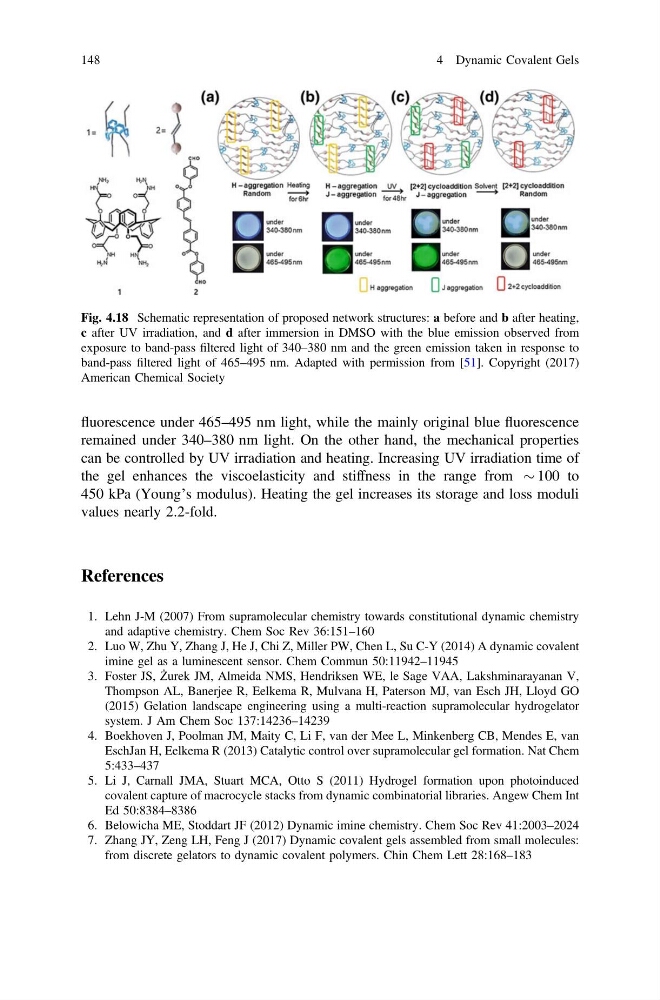
fluorescence under 465–495 nm light, while the mainly original blue fluorescence
remained under 340–380 nm light. On the other hand, the mechanical properties
can be controlled by UV irradiation and heating. Increasing UV irradiation time of
the gel enhances the viscoelasticity and stiffness in the range from $ 100 to
450 kPa (Young’s modulus). Heating the gel increases its storage and loss moduli
values nearly 2.2-fold.
References
1. Lehn J-M (2007) From supramolecular chemistry towards constitutional dynamic chemistry
and adaptive chemistry. Chem Soc Rev 36:151–160
2. Luo W, Zhu Y, Zhang J, He J, Chi Z, Miller PW, Chen L, Su C-Y (2014) A dynamic covalent
imine gel as a luminescent sensor. Chem Commun 50:11942–11945
3. Foster JS, Żurek JM, Almeida NMS, Hendriksen WE, le Sage VAA, Lakshminarayanan V,
Thompson AL, Banerjee R, Eelkema R, Mulvana H, Paterson MJ, van Esch JH, Lloyd GO
(2015) Gelation landscape engineering using a multi-reaction supramolecular hydrogelator
system. J Am Chem Soc 137:14236–14239
4. Boekhoven J, Poolman JM, Maity C, Li F, van der Mee L, Minkenberg CB, Mendes E, van
EschJan H, Eelkema R (2013) Catalytic control over supramolecular gel formation. Nat Chem
5:433–437
5. Li J, Carnall JMA, Stuart MCA, Otto S (2011) Hydrogel formation upon photoinduced
covalent capture of macrocycle stacks from dynamic combinatorial libraries. Angew Chem Int
Ed 50:8384–8386
6. Belowicha ME, Stoddart JF (2012) Dynamic imine chemistry. Chem Soc Rev 41:2003–2024
7. Zhang JY, Zeng LH, Feng J (2017) Dynamic covalent gels assembled from small molecules:
from discrete gelators to dynamic covalent polymers. Chin Chem Lett 28:168–183
Fig. 4.18 Schematic representation of proposed network structures: a before and b after heating,
c after UV irradiation, and d after immersion in DMSO with the blue emission observed from
exposure to band-pass filtered light of 340–380 nm and the green emission taken in response to
band-pass filtered light of 465–495 nm. Adapted with permission from [51]. Copyright (2017)
American Chemical Society
148
4 Dynamic Covalent Gels
remained under 340–380 nm light. On the other hand, the mechanical properties
can be controlled by UV irradiation and heating. Increasing UV irradiation time of
the gel enhances the viscoelasticity and stiffness in the range from $ 100 to
450 kPa (Young’s modulus). Heating the gel increases its storage and loss moduli
values nearly 2.2-fold.
References
1. Lehn J-M (2007) From supramolecular chemistry towards constitutional dynamic chemistry
and adaptive chemistry. Chem Soc Rev 36:151–160
2. Luo W, Zhu Y, Zhang J, He J, Chi Z, Miller PW, Chen L, Su C-Y (2014) A dynamic covalent
imine gel as a luminescent sensor. Chem Commun 50:11942–11945
3. Foster JS, Żurek JM, Almeida NMS, Hendriksen WE, le Sage VAA, Lakshminarayanan V,
Thompson AL, Banerjee R, Eelkema R, Mulvana H, Paterson MJ, van Esch JH, Lloyd GO
(2015) Gelation landscape engineering using a multi-reaction supramolecular hydrogelator
system. J Am Chem Soc 137:14236–14239
4. Boekhoven J, Poolman JM, Maity C, Li F, van der Mee L, Minkenberg CB, Mendes E, van
EschJan H, Eelkema R (2013) Catalytic control over supramolecular gel formation. Nat Chem
5:433–437
5. Li J, Carnall JMA, Stuart MCA, Otto S (2011) Hydrogel formation upon photoinduced
covalent capture of macrocycle stacks from dynamic combinatorial libraries. Angew Chem Int
Ed 50:8384–8386
6. Belowicha ME, Stoddart JF (2012) Dynamic imine chemistry. Chem Soc Rev 41:2003–2024
7. Zhang JY, Zeng LH, Feng J (2017) Dynamic covalent gels assembled from small molecules:
from discrete gelators to dynamic covalent polymers. Chin Chem Lett 28:168–183
Fig. 4.18 Schematic representation of proposed network structures: a before and b after heating,
c after UV irradiation, and d after immersion in DMSO with the blue emission observed from
exposure to band-pass filtered light of 340–380 nm and the green emission taken in response to
band-pass filtered light of 465–495 nm. Adapted with permission from [51]. Copyright (2017)
American Chemical Society
148
4 Dynamic Covalent Gels