

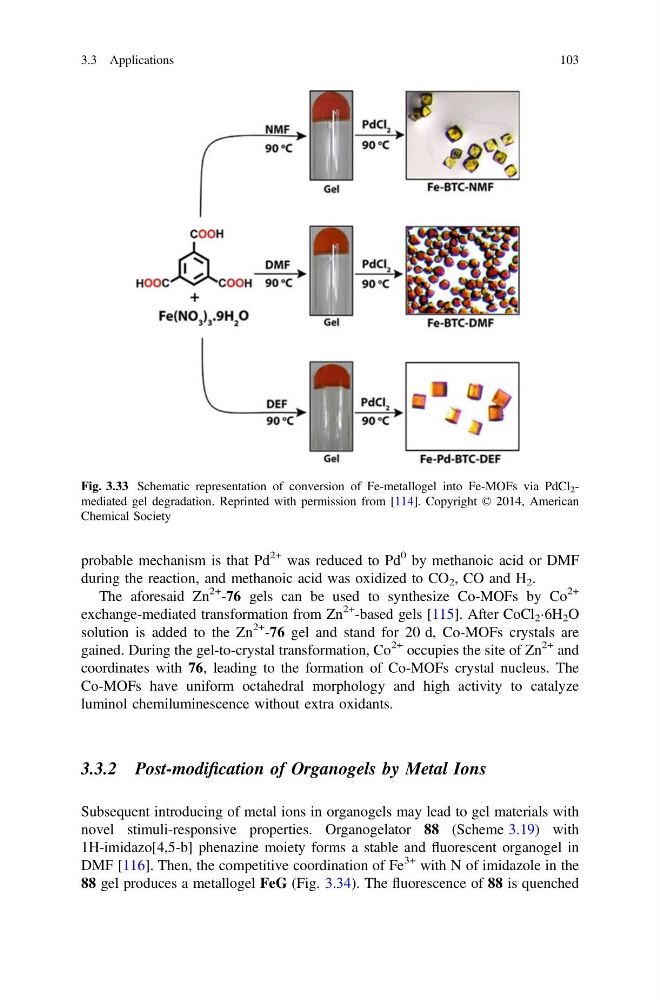
probable mechanism is that Pd
2+ was reduced to Pd
0 by methanoic acid or DMF
during the reaction, and methanoic acid was oxidized to CO 2 , CO and H 2 .
The aforesaid Zn
2+ -76 gels can be used to synthesize Co-MOFs by Co
2+
exchange-mediated transformation from Zn
2+ -based gels [115]. After CoCl 2 Á6H 2 O
solution is added to the Zn
2+ -76 gel and stand for 20 d, Co-MOFs crystals are
gained. During the gel-to-crystal transformation, Co
2+ occupies the site of Zn
2+ and
coordinates with 76, leading to the formation of Co-MOFs crystal nucleus. The
Co-MOFs have uniform octahedral morphology and high activity to catalyze
luminol chemiluminescence without extra oxidants.
3.3.2 Post-modification of Organogels by Metal Ions
Subsequent introducing of metal ions in organogels may lead to gel materials with
novel stimuli-responsive properties. Organogelator 88 (Scheme 3.19) with
1H-imidazo[4,5-b] phenazine moiety forms a stable and fluorescent organogel in
DMF [116]. Then, the competitive coordination of Fe
3+ with N of imidazole in the
88 gel produces a metallogel FeG (Fig. 3.34). The fluorescence of 88 is quenched
Fig. 3.33 Schematic representation of conversion of Fe-metallogel into Fe-MOFs via PdCl 2 -
mediated gel degradation. Reprinted with permission from [114]. Copyright © 2014, American
Chemical Society
3.3 Applications
103
2+ was reduced to Pd
0 by methanoic acid or DMF
during the reaction, and methanoic acid was oxidized to CO 2 , CO and H 2 .
The aforesaid Zn
2+ -76 gels can be used to synthesize Co-MOFs by Co
2+
exchange-mediated transformation from Zn
2+ -based gels [115]. After CoCl 2 Á6H 2 O
solution is added to the Zn
2+ -76 gel and stand for 20 d, Co-MOFs crystals are
gained. During the gel-to-crystal transformation, Co
2+ occupies the site of Zn
2+ and
coordinates with 76, leading to the formation of Co-MOFs crystal nucleus. The
Co-MOFs have uniform octahedral morphology and high activity to catalyze
luminol chemiluminescence without extra oxidants.
3.3.2 Post-modification of Organogels by Metal Ions
Subsequent introducing of metal ions in organogels may lead to gel materials with
novel stimuli-responsive properties. Organogelator 88 (Scheme 3.19) with
1H-imidazo[4,5-b] phenazine moiety forms a stable and fluorescent organogel in
DMF [116]. Then, the competitive coordination of Fe
3+ with N of imidazole in the
88 gel produces a metallogel FeG (Fig. 3.34). The fluorescence of 88 is quenched
Fig. 3.33 Schematic representation of conversion of Fe-metallogel into Fe-MOFs via PdCl 2 -
mediated gel degradation. Reprinted with permission from [114]. Copyright © 2014, American
Chemical Society
3.3 Applications
103