

precursors are used, oligomeric/polymeric aggregates may be formed. If the initially
formed aggregates have a proper solubility in solution, the aggregates may grow in
one direction to form fibres or are interconnected via interactions to form a network
structure, finally leading to gelation.
The instinctive property of solvent is of great importance during the gelation
process. For example, the polarity, viscosity, functional groups of solvents are
usually influential to the framework of the gels. The balance of gelator-solvent and
gelator-gelator interactions is influenced by the polarity, viscosity, as well as the
temperature. Solvents assist the nucleation and growth in the processes of
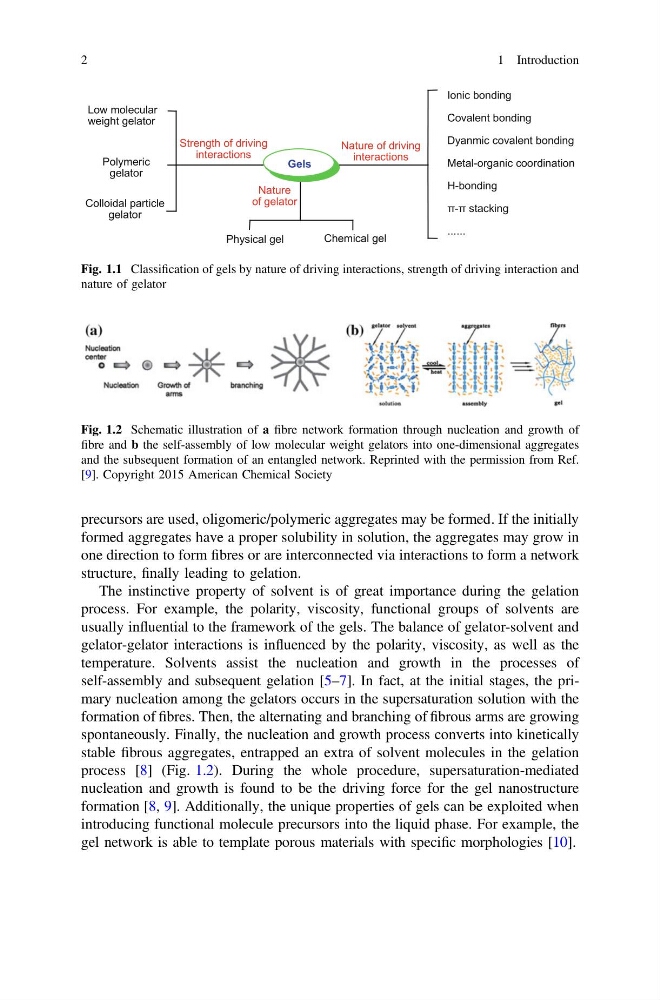
self-assembly and subsequent gelation [5–7]. In fact, at the initial stages, the primary nucleation among the gelators occurs in the supersaturation solution with the
formation of fibres. Then, the alternating and branching of fibrous arms are growing
spontaneously. Finally, the nucleation and growth process converts into kinetically
stable fibrous aggregates, entrapped an extra of solvent molecules in the gelation
process [8] (Fig. 1.2). During the whole procedure, supersaturation-mediated
nucleation and growth is found to be the driving force for the gel nanostructure
formation [8, 9]. Additionally, the unique properties of gels can be exploited when
introducing functional molecule precursors into the liquid phase. For example, the
gel network is able to template porous materials with specific morphologies [10].
Gels
Nature of driving
interactions
Ionic bonding
Covalent bonding
Dyanmic covalent bonding
Metal-organic coordination
H-bonding
π-π stacking
......
Nature
of gelator
Low molecular
weight gelator
Polymeric
gelator
Chemical gel
Physical gel
Strength of driving
interactions
Colloidal particle
gelator
Fig. 1.1 Classification of gels by nature of driving interactions, strength of driving interaction and
nature of gelator
Fig. 1.2 Schematic illustration of a fibre network formation through nucleation and growth of
fibre and b the self-assembly of low molecular weight gelators into one-dimensional aggregates
and the subsequent formation of an entangled network. Reprinted with the permission from Ref.
[9]. Copyright 2015 American Chemical Society
2
1 Introduction
formed aggregates have a proper solubility in solution, the aggregates may grow in
one direction to form fibres or are interconnected via interactions to form a network
structure, finally leading to gelation.
The instinctive property of solvent is of great importance during the gelation
process. For example, the polarity, viscosity, functional groups of solvents are
usually influential to the framework of the gels. The balance of gelator-solvent and
gelator-gelator interactions is influenced by the polarity, viscosity, as well as the
temperature. Solvents assist the nucleation and growth in the processes of
self-assembly and subsequent gelation [5–7]. In fact, at the initial stages, the primary nucleation among the gelators occurs in the supersaturation solution with the
formation of fibres. Then, the alternating and branching of fibrous arms are growing
spontaneously. Finally, the nucleation and growth process converts into kinetically
stable fibrous aggregates, entrapped an extra of solvent molecules in the gelation
process [8] (Fig. 1.2). During the whole procedure, supersaturation-mediated
nucleation and growth is found to be the driving force for the gel nanostructure
formation [8, 9]. Additionally, the unique properties of gels can be exploited when
introducing functional molecule precursors into the liquid phase. For example, the
gel network is able to template porous materials with specific morphologies [10].
Gels
Nature of driving
interactions
Ionic bonding
Covalent bonding
Dyanmic covalent bonding
Metal-organic coordination
H-bonding
π-π stacking
......
Nature
of gelator
Low molecular
weight gelator
Polymeric
gelator
Chemical gel
Physical gel
Strength of driving
interactions
Colloidal particle
gelator
Fig. 1.1 Classification of gels by nature of driving interactions, strength of driving interaction and
nature of gelator
Fig. 1.2 Schematic illustration of a fibre network formation through nucleation and growth of
fibre and b the self-assembly of low molecular weight gelators into one-dimensional aggregates
and the subsequent formation of an entangled network. Reprinted with the permission from Ref.
[9]. Copyright 2015 American Chemical Society
2
1 Introduction