

3.3 The Development of TiO 2 –SiO 2 Mesoporous Materials
In this section, we briefly introduce the research of TiO 2 –SiO 2 mesoporous materials. Although TiO 2 has some important properties, for instance, nontoxicity and
excellent photostability, there are also some drawbacks constraining the performance of TiO 2 in photocatalytic process [37, 38]. To overcome the drawbacks, the
researchers have prepared TiO 2 compounded materials that can provide large number of adsorptive sites by dispersion of TiO 2 species into a porous support with large
surface area. Silica has been widely employed as the carrier, owing to its outstanding
mechanical strength, high inner surface area, and uniform pore size. With the highly
dispersion of TiO 2 into the porous SiO 2 support, the TiO 2 –SiO 2 mixed oxide
photocatalysts have shown significantly enhanced activities compared to pure
TiO 2 . On the one hand, TiO 2 and SiO 2 may be combined together to form a mixture
of the two oxides, with interaction forces other than weak Vander Waals forces. On
the other hand, they can integrate by means of the formation of Ti–O–Si bonds to
form the composite oxides. When combined together through chemical bonding, the
physical–chemical properties of TiO 2 –SiO 2 differ from simple combination of each
phase. In a word, homogeneity or dispersion largely depends on preparation methods
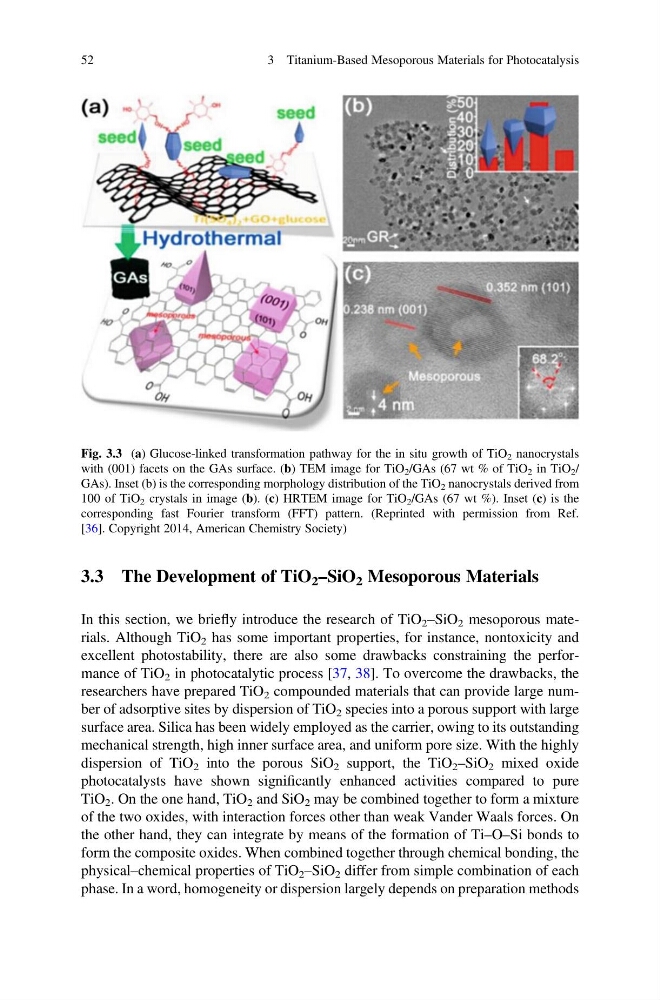
Fig. 3.3 (a) Glucose-linked transformation pathway for the in situ growth of TiO 2 nanocrystals
with (001) facets on the GAs surface. (b) TEM image for TiO 2 /GAs (67 wt % of TiO 2 in TiO 2 /
GAs). Inset (b) is the corresponding morphology distribution of the TiO 2 nanocrystals derived from
100 of TiO 2 crystals in image (b). (c) HRTEM image for TiO 2 /GAs (67 wt %). Inset (c) is the
corresponding fast Fourier transform (FFT) pattern. (Reprinted with permission from Ref.
[36]. Copyright 2014, American Chemistry Society)
52
3 Titanium-Based Mesoporous Materials for Photocatalysis
In this section, we briefly introduce the research of TiO 2 –SiO 2 mesoporous materials. Although TiO 2 has some important properties, for instance, nontoxicity and
excellent photostability, there are also some drawbacks constraining the performance of TiO 2 in photocatalytic process [37, 38]. To overcome the drawbacks, the
researchers have prepared TiO 2 compounded materials that can provide large number of adsorptive sites by dispersion of TiO 2 species into a porous support with large
surface area. Silica has been widely employed as the carrier, owing to its outstanding
mechanical strength, high inner surface area, and uniform pore size. With the highly
dispersion of TiO 2 into the porous SiO 2 support, the TiO 2 –SiO 2 mixed oxide
photocatalysts have shown significantly enhanced activities compared to pure
TiO 2 . On the one hand, TiO 2 and SiO 2 may be combined together to form a mixture
of the two oxides, with interaction forces other than weak Vander Waals forces. On
the other hand, they can integrate by means of the formation of Ti–O–Si bonds to
form the composite oxides. When combined together through chemical bonding, the
physical–chemical properties of TiO 2 –SiO 2 differ from simple combination of each
phase. In a word, homogeneity or dispersion largely depends on preparation methods
Fig. 3.3 (a) Glucose-linked transformation pathway for the in situ growth of TiO 2 nanocrystals
with (001) facets on the GAs surface. (b) TEM image for TiO 2 /GAs (67 wt % of TiO 2 in TiO 2 /
GAs). Inset (b) is the corresponding morphology distribution of the TiO 2 nanocrystals derived from
100 of TiO 2 crystals in image (b). (c) HRTEM image for TiO 2 /GAs (67 wt %). Inset (c) is the
corresponding fast Fourier transform (FFT) pattern. (Reprinted with permission from Ref.
[36]. Copyright 2014, American Chemistry Society)
52
3 Titanium-Based Mesoporous Materials for Photocatalysis