

In general, developing new mesoporous structure, developing new synthetic
methods, improving the crystallinity based on maintaining the structure, and seeking
to optimize the functional structure and so on will continue to be hot spots for
researchers in the future.
3.2 The Development of Mesoporous TiO 2 in Photocatalysis
3.2.1 The Preparation of Mesoporous TiO 2
Highly efficient mesoporous TiO 2 materials have been applied to the development of
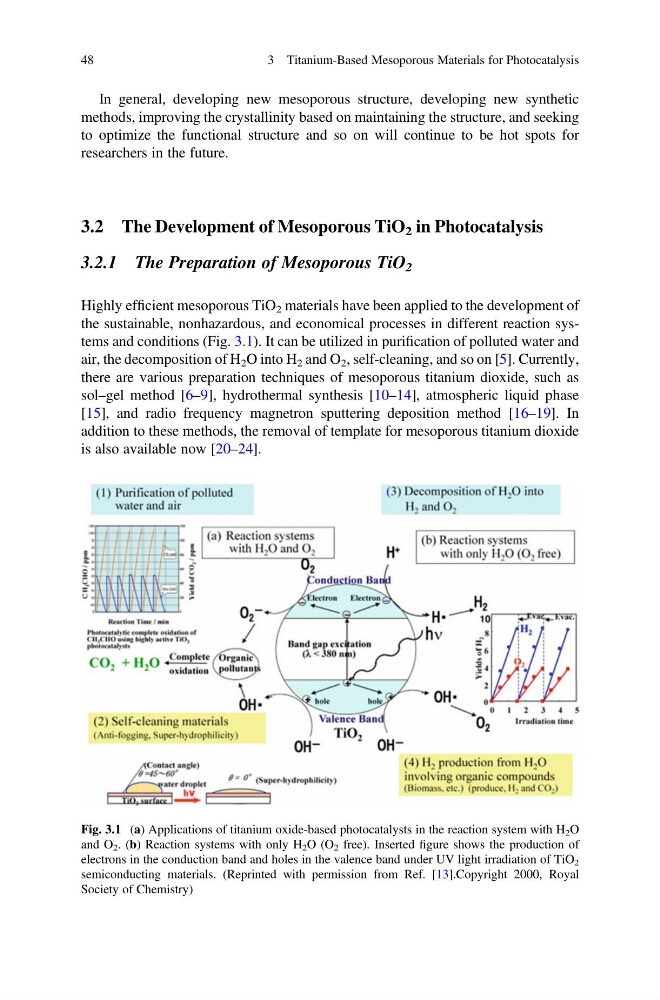
the sustainable, nonhazardous, and economical processes in different reaction systems and conditions (Fig. 3.1). It can be utilized in purification of polluted water and
air, the decomposition of H 2 O into H 2 and O 2 , self-cleaning, and so on [5]. Currently,
there are various preparation techniques of mesoporous titanium dioxide, such as
sol–gel method [6–9], hydrothermal synthesis [10–14], atmospheric liquid phase
[15], and radio frequency magnetron sputtering deposition method [16–19]. In
addition to these methods, the removal of template for mesoporous titanium dioxide
is also available now [20–24].
Fig. 3.1 (a) Applications of titanium oxide-based photocatalysts in the reaction system with H 2 O
and O 2 . (b) Reaction systems with only H 2 O (O 2 free). Inserted figure shows the production of
electrons in the conduction band and holes in the valence band under UV light irradiation of TiO 2
semiconducting materials. (Reprinted with permission from Ref. [13].Copyright 2000, Royal
Society of Chemistry)
48
3 Titanium-Based Mesoporous Materials for Photocatalysis
methods, improving the crystallinity based on maintaining the structure, and seeking
to optimize the functional structure and so on will continue to be hot spots for
researchers in the future.
3.2 The Development of Mesoporous TiO 2 in Photocatalysis
3.2.1 The Preparation of Mesoporous TiO 2
Highly efficient mesoporous TiO 2 materials have been applied to the development of
the sustainable, nonhazardous, and economical processes in different reaction systems and conditions (Fig. 3.1). It can be utilized in purification of polluted water and
air, the decomposition of H 2 O into H 2 and O 2 , self-cleaning, and so on [5]. Currently,
there are various preparation techniques of mesoporous titanium dioxide, such as
sol–gel method [6–9], hydrothermal synthesis [10–14], atmospheric liquid phase
[15], and radio frequency magnetron sputtering deposition method [16–19]. In
addition to these methods, the removal of template for mesoporous titanium dioxide
is also available now [20–24].
Fig. 3.1 (a) Applications of titanium oxide-based photocatalysts in the reaction system with H 2 O
and O 2 . (b) Reaction systems with only H 2 O (O 2 free). Inserted figure shows the production of
electrons in the conduction band and holes in the valence band under UV light irradiation of TiO 2
semiconducting materials. (Reprinted with permission from Ref. [13].Copyright 2000, Royal
Society of Chemistry)
48
3 Titanium-Based Mesoporous Materials for Photocatalysis