

Interestingly, the effective hydrogen evolution from water containing a sacrificial
electron donor under visible light irradiation can be achieved by the Pt-loaded MOFs
constructed from light-harvesting organic linkers. In 2012, Lin et al. [13] prepared
Pt@MOFs by loading Pt NPs in photoactive MOFs, Zr 6 (μ 3 -O) 4 (μ 3 -
OH) 4 (bpdc) 5.94 (L1) 0.06 (3) and Zr 6 (μ 3 -O) 4 (μ 3 -OH) 4 (L 2 ) 6 Á64DMF (4), which were
found to be effective photocatalysts for hydrogen evolution by synergistic photoexcitation of the frameworks and electron injection into the Pt NPs. These two MOFs
were built from two [Ir(ppy) 2 (bpy)]
+
-derived dicarboxylate ligands. Meanwhile, the
radicals, [Ir(ppy) 2 (bpy)], generated in the MOFs by TEA-mediated photoreduction
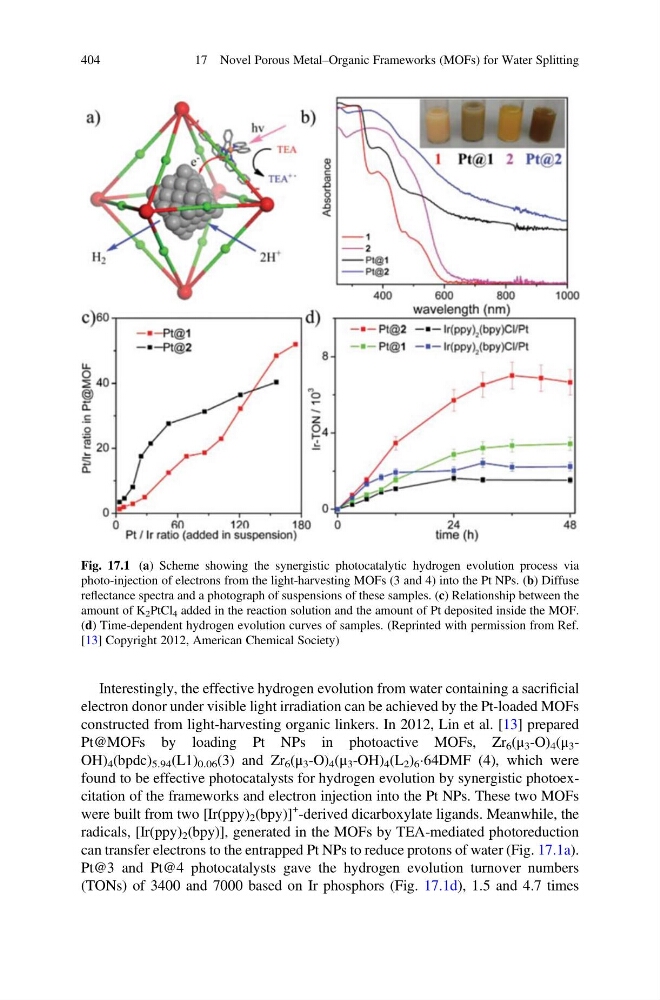
can transfer electrons to the entrapped Pt NPs to reduce protons of water (Fig. 17.1a).
Pt@3 and Pt@4 photocatalysts gave the hydrogen evolution turnover numbers
(TONs) of 3400 and 7000 based on Ir phosphors (Fig. 17.1d), 1.5 and 4.7 times
Fig. 17.1 (a) Scheme showing the synergistic photocatalytic hydrogen evolution process via
photo-injection of electrons from the light-harvesting MOFs (3 and 4) into the Pt NPs. (b) Diffuse
reflectance spectra and a photograph of suspensions of these samples. (c) Relationship between the
amount of K 2 PtCl 4 added in the reaction solution and the amount of Pt deposited inside the MOF.
(d) Time-dependent hydrogen evolution curves of samples. (Reprinted with permission from Ref.
[13] Copyright 2012, American Chemical Society)
404
17 Novel Porous Metal–Organic Frameworks (MOFs) for Water Splitting
electron donor under visible light irradiation can be achieved by the Pt-loaded MOFs
constructed from light-harvesting organic linkers. In 2012, Lin et al. [13] prepared
Pt@MOFs by loading Pt NPs in photoactive MOFs, Zr 6 (μ 3 -O) 4 (μ 3 -
OH) 4 (bpdc) 5.94 (L1) 0.06 (3) and Zr 6 (μ 3 -O) 4 (μ 3 -OH) 4 (L 2 ) 6 Á64DMF (4), which were
found to be effective photocatalysts for hydrogen evolution by synergistic photoexcitation of the frameworks and electron injection into the Pt NPs. These two MOFs
were built from two [Ir(ppy) 2 (bpy)]
+
-derived dicarboxylate ligands. Meanwhile, the
radicals, [Ir(ppy) 2 (bpy)], generated in the MOFs by TEA-mediated photoreduction
can transfer electrons to the entrapped Pt NPs to reduce protons of water (Fig. 17.1a).
Pt@3 and Pt@4 photocatalysts gave the hydrogen evolution turnover numbers
(TONs) of 3400 and 7000 based on Ir phosphors (Fig. 17.1d), 1.5 and 4.7 times
Fig. 17.1 (a) Scheme showing the synergistic photocatalytic hydrogen evolution process via
photo-injection of electrons from the light-harvesting MOFs (3 and 4) into the Pt NPs. (b) Diffuse
reflectance spectra and a photograph of suspensions of these samples. (c) Relationship between the
amount of K 2 PtCl 4 added in the reaction solution and the amount of Pt deposited inside the MOF.
(d) Time-dependent hydrogen evolution curves of samples. (Reprinted with permission from Ref.
[13] Copyright 2012, American Chemical Society)
404
17 Novel Porous Metal–Organic Frameworks (MOFs) for Water Splitting