

O 2 , new peaks at 943, 838 and 1250–1120 cm
À1 appeared together with intensity
changes in other bands. Investigations of influences of the solution pH, the presence
or absence of hole and electron scavengers, and isotopic exchange between H 2 O and
D 2 O on the spectral changes have revealed that the primary step of photocatalytic O 2
reduction is the formation of the surface peroxo species, giving the 943 cm
À1 band,
probably with the surface superoxo species as a precursor, in neutral and acidic
solutions. The surface peroxo species is then transformed to the surface
hydroperoxo, TiOOH, giving the 838 and 1250–1120 cm
À1 bands, by protonation
in the dark.
To enhance the detection sensitivity, surface-enhanced IR absorption (SEIRA)
has been utilized for molecules adsorbed on a thin noble metal (Au, Ag) film with
abundant free electron. When SEIRA spectroscopy (SEIRAS) is carried out in ATR
configurations, it has a great advantage that IR measurements can be carried out even
in an aqueous solution, because an IR beam hardly passes through the solution. For
example, SEIRAS was applied to in situ observation of surface species formed
during the photocatalytic decomposition of acetic acid over bare TiO 2 [18],
Au/TiO 2 , and Au/Pt/TiO 2 films, on which an Au island film was deposited. For a
gas-phase reaction, an evacuable IR cell was used, which was connected to a
pumping and gas handling system. SEIRAS measurements were carried out in a
backside reflection mode, in which an IR beam from FTIR was introduced from the
CaF 2 side of the sample at the incident angle of ca. 50
and reflected at the interface
between the TiO 2 and Au films. The reflected IR beam was collimated to an external
MCT detector at liquid nitrogen temperature. SEIRA spectra were recorded with the
resolution of 4 cm
À1 . The adsorption states of acetic acid were determined in both
the liquid and gas phase, and molecular adsorption was found to be dominant in the
gas phase. Pt deposition on the TiO 2 film led to the formation of adsorbed methyl
during the photodecomposition of gas-phase acetic acid, indicative of the formation
of methyl radical as a reaction intermediate. The addition of gas-phase water to the
system led to a significant increase in the coverage of adsorbed methyl as a result of
enhancement in the reaction rate as reported before. Since the metal films used in
SEIRAS are discontinuous and island-structure, SEIRAS can detect chemical species, which exist not only on the metal films but also in the vicinity of the metal
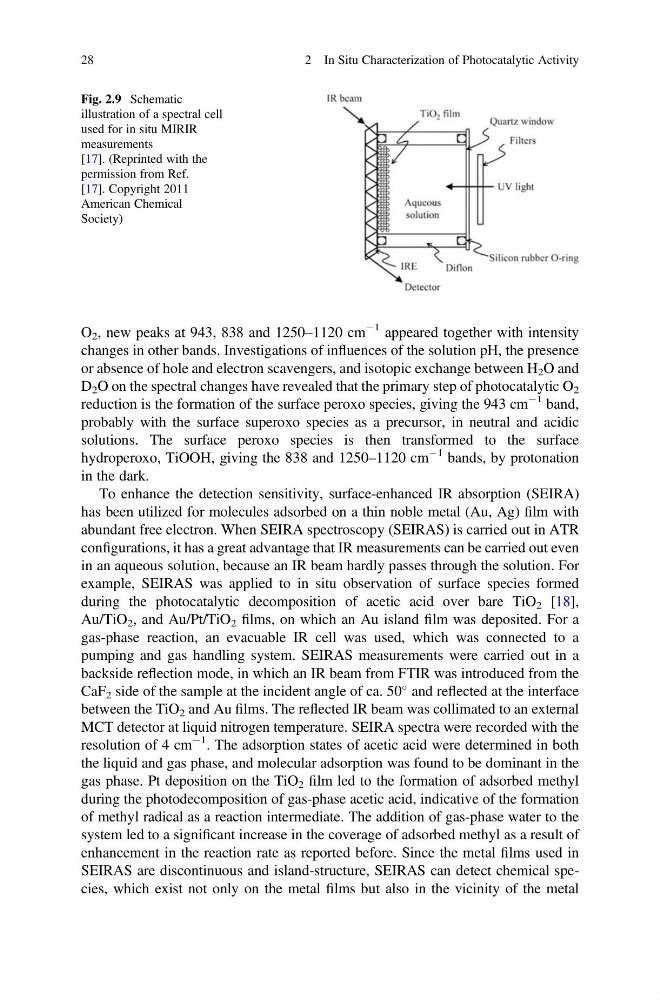
Fig. 2.9 Schematic
illustration of a spectral cell
used for in situ MIRIR
measurements
[17]. (Reprinted with the
permission from Ref.
[17]. Copyright 2011
American Chemical
Society)
28
2 In Situ Characterization of Photocatalytic Activity
À1 appeared together with intensity
changes in other bands. Investigations of influences of the solution pH, the presence
or absence of hole and electron scavengers, and isotopic exchange between H 2 O and
D 2 O on the spectral changes have revealed that the primary step of photocatalytic O 2
reduction is the formation of the surface peroxo species, giving the 943 cm
À1 band,
probably with the surface superoxo species as a precursor, in neutral and acidic
solutions. The surface peroxo species is then transformed to the surface
hydroperoxo, TiOOH, giving the 838 and 1250–1120 cm
À1 bands, by protonation
in the dark.
To enhance the detection sensitivity, surface-enhanced IR absorption (SEIRA)
has been utilized for molecules adsorbed on a thin noble metal (Au, Ag) film with
abundant free electron. When SEIRA spectroscopy (SEIRAS) is carried out in ATR
configurations, it has a great advantage that IR measurements can be carried out even
in an aqueous solution, because an IR beam hardly passes through the solution. For
example, SEIRAS was applied to in situ observation of surface species formed
during the photocatalytic decomposition of acetic acid over bare TiO 2 [18],
Au/TiO 2 , and Au/Pt/TiO 2 films, on which an Au island film was deposited. For a
gas-phase reaction, an evacuable IR cell was used, which was connected to a
pumping and gas handling system. SEIRAS measurements were carried out in a
backside reflection mode, in which an IR beam from FTIR was introduced from the
CaF 2 side of the sample at the incident angle of ca. 50
and reflected at the interface
between the TiO 2 and Au films. The reflected IR beam was collimated to an external
MCT detector at liquid nitrogen temperature. SEIRA spectra were recorded with the
resolution of 4 cm
À1 . The adsorption states of acetic acid were determined in both
the liquid and gas phase, and molecular adsorption was found to be dominant in the
gas phase. Pt deposition on the TiO 2 film led to the formation of adsorbed methyl
during the photodecomposition of gas-phase acetic acid, indicative of the formation
of methyl radical as a reaction intermediate. The addition of gas-phase water to the
system led to a significant increase in the coverage of adsorbed methyl as a result of
enhancement in the reaction rate as reported before. Since the metal films used in
SEIRAS are discontinuous and island-structure, SEIRAS can detect chemical species, which exist not only on the metal films but also in the vicinity of the metal
Fig. 2.9 Schematic
illustration of a spectral cell
used for in situ MIRIR
measurements
[17]. (Reprinted with the
permission from Ref.
[17]. Copyright 2011
American Chemical
Society)
28
2 In Situ Characterization of Photocatalytic Activity