

with ZIF-67@LDH nanoboxes and NaH 2 PO 2 at 300
C. The element mapping
images further confirm the successful phosphidation (Fig. 16.6h–k).
Fu et al. [50] successfully prepared Ni 2 P nanoparticles via this phosphating
reaction with Ni(OH) 2 nanoparticles. In this process, Ni
2+ can easily be reduced to
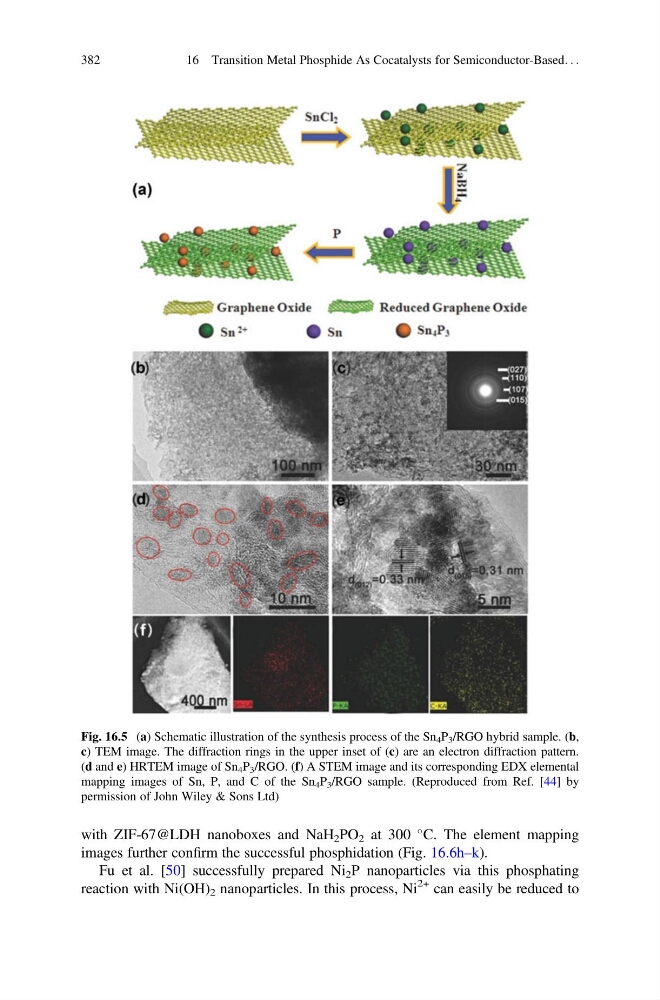
Fig. 16.5 (a) Schematic illustration of the synthesis process of the Sn 4 P 3 /RGO hybrid sample. (b,
c) TEM image. The diffraction rings in the upper inset of (c) are an electron diffraction pattern.
(d and e) HRTEM image of Sn 4 P 3 /RGO. (f) A STEM image and its corresponding EDX elemental
mapping images of Sn, P, and C of the Sn 4 P 3 /RGO sample. (Reproduced from Ref. [44] by
permission of John Wiley & Sons Ltd)
382
16 Transition Metal Phosphide As Cocatalysts for Semiconductor-Based. . .
C. The element mapping
images further confirm the successful phosphidation (Fig. 16.6h–k).
Fu et al. [50] successfully prepared Ni 2 P nanoparticles via this phosphating
reaction with Ni(OH) 2 nanoparticles. In this process, Ni
2+ can easily be reduced to
Fig. 16.5 (a) Schematic illustration of the synthesis process of the Sn 4 P 3 /RGO hybrid sample. (b,
c) TEM image. The diffraction rings in the upper inset of (c) are an electron diffraction pattern.
(d and e) HRTEM image of Sn 4 P 3 /RGO. (f) A STEM image and its corresponding EDX elemental
mapping images of Sn, P, and C of the Sn 4 P 3 /RGO sample. (Reproduced from Ref. [44] by
permission of John Wiley & Sons Ltd)
382
16 Transition Metal Phosphide As Cocatalysts for Semiconductor-Based. . .