

16.2.2 Inorganic Phosphorus Sources
Except for these organophosphorus sources, some inorganic phosphorus precursors,
such as white phosphorus (WP) [42] and red phosphorus (RP) [43, 44], have been
widely studied in liquid phase synthesis of TMPs. Du et al. [45] prepared CdS/Ni 2 P
composites through two-step hydrothermal method, in which Cd(CH 3 COO) 2 and
thioacetamide are used as cadmium and sulfur source and WP and Ni(NO 3 ) 2 as
phosphorus and nickel source, respectively. After hydrothermal treatment, Ni 2 P
nanoparticles can be formed and loaded on the surface of CdS. Due to its low
water solubility, some solvents, such as ethylenediamine and carbon disulfide, will
be selected to dissolve WP. Furthermore, WP can react with metal salt under
hydrothermal condition at relatively low temperature (ca. 140–180
C) to form
TMPs with various morphologies. What we should note in the reaction in the
presence of WP is that it needs to be treated in a glovebox due to its low flash
point and high toxicity.
Compared with WP, RP is a relatively safe and inexpensive phosphorus source.
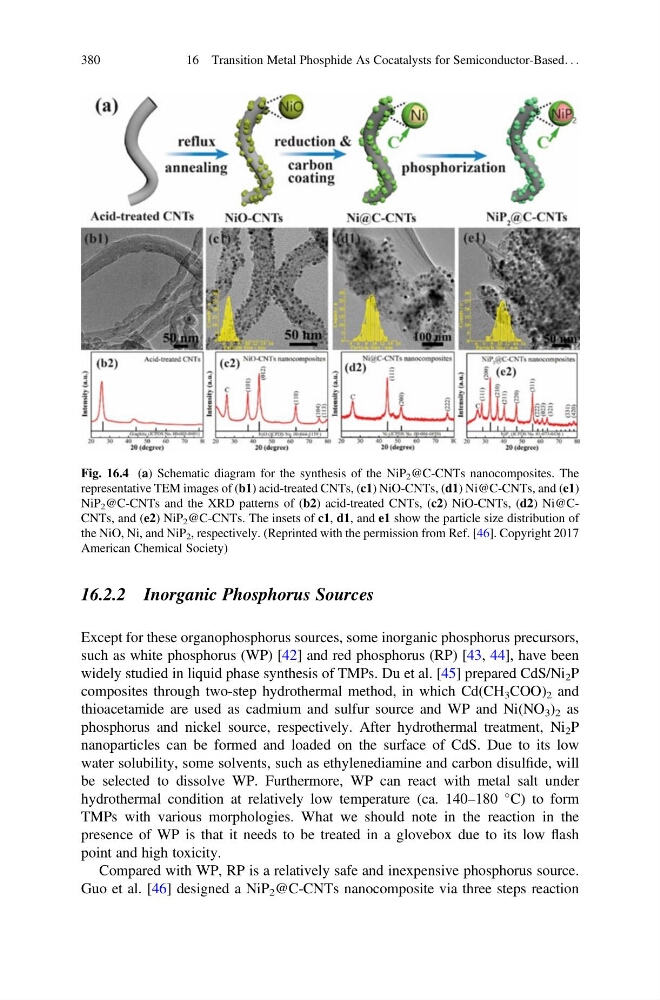
Guo et al. [46] designed a NiP 2 @C-CNTs nanocomposite via three steps reaction
Fig. 16.4 (a) Schematic diagram for the synthesis of the NiP 2 @C-CNTs nanocomposites. The
representative TEM images of (b1) acid-treated CNTs, (c1) NiO-CNTs, (d1) Ni@C-CNTs, and (e1)
NiP 2 @C-CNTs and the XRD patterns of (b2) acid-treated CNTs, (c2) NiO-CNTs, (d2) Ni@CCNTs, and (e2) NiP 2 @C-CNTs. The insets of c1, d1, and e1 show the particle size distribution of
the NiO, Ni, and NiP 2 , respectively. (Reprinted with the permission from Ref. [46]. Copyright 2017
American Chemical Society)
380
16 Transition Metal Phosphide As Cocatalysts for Semiconductor-Based. . .
Except for these organophosphorus sources, some inorganic phosphorus precursors,
such as white phosphorus (WP) [42] and red phosphorus (RP) [43, 44], have been
widely studied in liquid phase synthesis of TMPs. Du et al. [45] prepared CdS/Ni 2 P
composites through two-step hydrothermal method, in which Cd(CH 3 COO) 2 and
thioacetamide are used as cadmium and sulfur source and WP and Ni(NO 3 ) 2 as
phosphorus and nickel source, respectively. After hydrothermal treatment, Ni 2 P
nanoparticles can be formed and loaded on the surface of CdS. Due to its low
water solubility, some solvents, such as ethylenediamine and carbon disulfide, will
be selected to dissolve WP. Furthermore, WP can react with metal salt under
hydrothermal condition at relatively low temperature (ca. 140–180
C) to form
TMPs with various morphologies. What we should note in the reaction in the
presence of WP is that it needs to be treated in a glovebox due to its low flash
point and high toxicity.
Compared with WP, RP is a relatively safe and inexpensive phosphorus source.
Guo et al. [46] designed a NiP 2 @C-CNTs nanocomposite via three steps reaction
Fig. 16.4 (a) Schematic diagram for the synthesis of the NiP 2 @C-CNTs nanocomposites. The
representative TEM images of (b1) acid-treated CNTs, (c1) NiO-CNTs, (d1) Ni@C-CNTs, and (e1)
NiP 2 @C-CNTs and the XRD patterns of (b2) acid-treated CNTs, (c2) NiO-CNTs, (d2) Ni@CCNTs, and (e2) NiP 2 @C-CNTs. The insets of c1, d1, and e1 show the particle size distribution of
the NiO, Ni, and NiP 2 , respectively. (Reprinted with the permission from Ref. [46]. Copyright 2017
American Chemical Society)
380
16 Transition Metal Phosphide As Cocatalysts for Semiconductor-Based. . .