

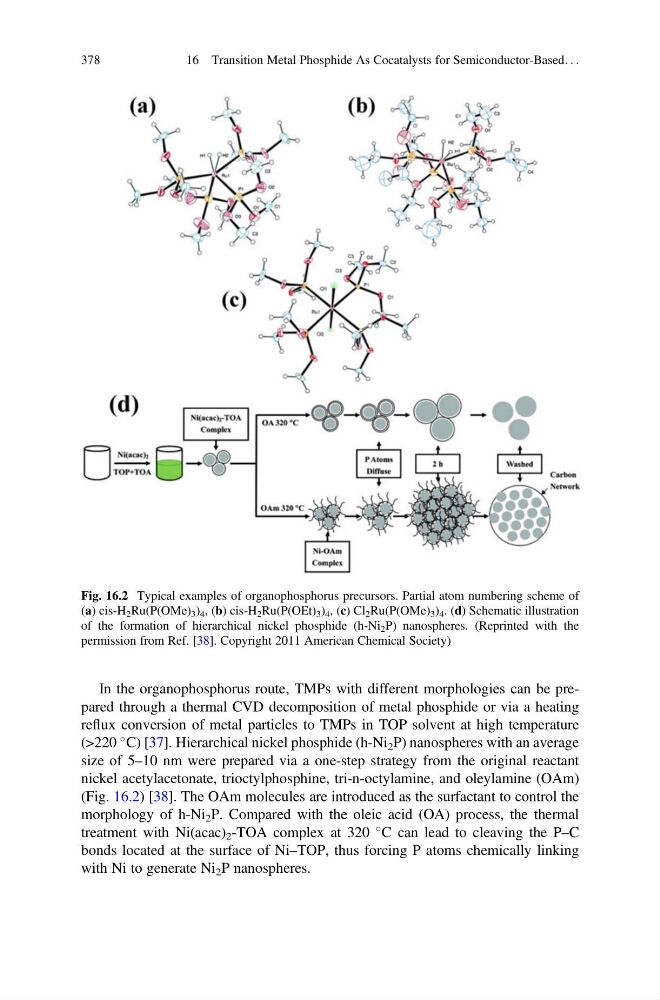
In the organophosphorus route, TMPs with different morphologies can be prepared through a thermal CVD decomposition of metal phosphide or via a heating
reflux conversion of metal particles to TMPs in TOP solvent at high temperature
(>220
C) [37]. Hierarchical nickel phosphide (h-Ni 2 P) nanospheres with an average
size of 5–10 nm were prepared via a one-step strategy from the original reactant
nickel acetylacetonate, trioctylphosphine, tri-n-octylamine, and oleylamine (OAm)
(Fig. 16.2) [38]. The OAm molecules are introduced as the surfactant to control the
morphology of h-Ni 2 P. Compared with the oleic acid (OA) process, the thermal
treatment with Ni(acac) 2 -TOA complex at 320
C can lead to cleaving the P–C
bonds located at the surface of Ni–TOP, thus forcing P atoms chemically linking
with Ni to generate Ni 2 P nanospheres.
Fig. 16.2 Typical examples of organophosphorus precursors. Partial atom numbering scheme of
(a) cis-H 2 Ru(P(OMe) 3 ) 4 , (b) cis-H 2 Ru(P(OEt) 3 ) 4 , (c) Cl 2 Ru(P(OMe) 3 ) 4 . (d) Schematic illustration
of the formation of hierarchical nickel phosphide (h-Ni 2 P) nanospheres. (Reprinted with the
permission from Ref. [38]. Copyright 2011 American Chemical Society)
378
16 Transition Metal Phosphide As Cocatalysts for Semiconductor-Based. . .
reflux conversion of metal particles to TMPs in TOP solvent at high temperature
(>220
C) [37]. Hierarchical nickel phosphide (h-Ni 2 P) nanospheres with an average
size of 5–10 nm were prepared via a one-step strategy from the original reactant
nickel acetylacetonate, trioctylphosphine, tri-n-octylamine, and oleylamine (OAm)
(Fig. 16.2) [38]. The OAm molecules are introduced as the surfactant to control the
morphology of h-Ni 2 P. Compared with the oleic acid (OA) process, the thermal
treatment with Ni(acac) 2 -TOA complex at 320
C can lead to cleaving the P–C
bonds located at the surface of Ni–TOP, thus forcing P atoms chemically linking
with Ni to generate Ni 2 P nanospheres.
Fig. 16.2 Typical examples of organophosphorus precursors. Partial atom numbering scheme of
(a) cis-H 2 Ru(P(OMe) 3 ) 4 , (b) cis-H 2 Ru(P(OEt) 3 ) 4 , (c) Cl 2 Ru(P(OMe) 3 ) 4 . (d) Schematic illustration
of the formation of hierarchical nickel phosphide (h-Ni 2 P) nanospheres. (Reprinted with the
permission from Ref. [38]. Copyright 2011 American Chemical Society)
378
16 Transition Metal Phosphide As Cocatalysts for Semiconductor-Based. . .