

bandgap semiconductors [18], dye sensitization [19], vacancy introduction [20], and
surface plasmon enhancement [21]. On the other hand, in order to obtain high
efficiency of photo-generated charge separation, various semiconductor
heterojunctions have been designed [22]. Up to now, much research work has
been investigated to optimize the first two steps in the process of photocatalytic
hydrogen evolution. However, much less achievements have been done to improve
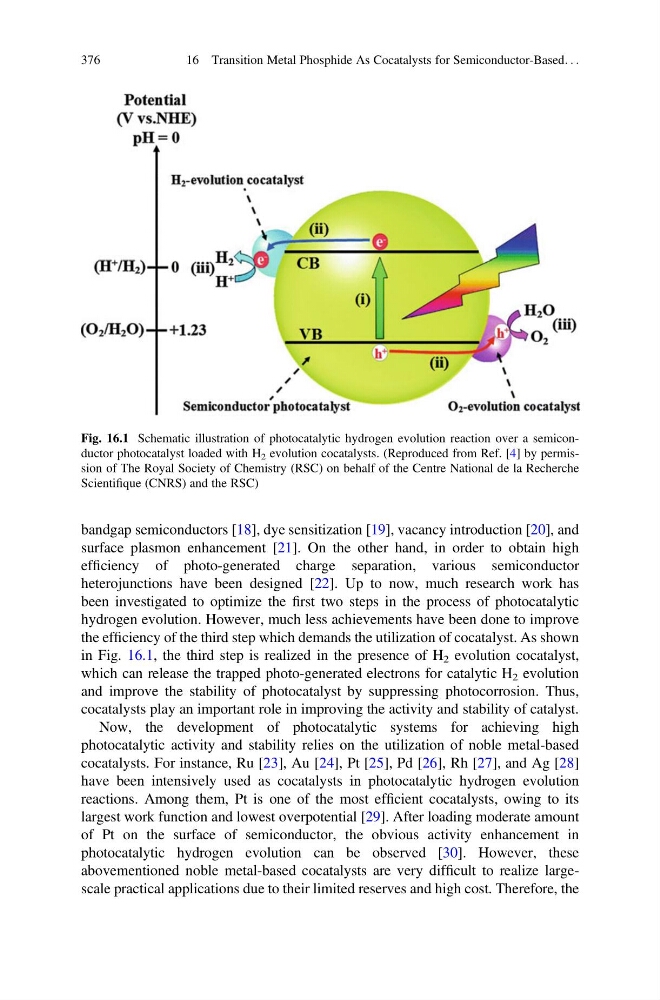
the efficiency of the third step which demands the utilization of cocatalyst. As shown
in Fig. 16.1, the third step is realized in the presence of H 2 evolution cocatalyst,
which can release the trapped photo-generated electrons for catalytic H 2 evolution
and improve the stability of photocatalyst by suppressing photocorrosion. Thus,
cocatalysts play an important role in improving the activity and stability of catalyst.
Now, the development of photocatalytic systems for achieving high
photocatalytic activity and stability relies on the utilization of noble metal-based
cocatalysts. For instance, Ru [23], Au [24], Pt [25], Pd [26], Rh [27], and Ag [28]
have been intensively used as cocatalysts in photocatalytic hydrogen evolution
reactions. Among them, Pt is one of the most efficient cocatalysts, owing to its
largest work function and lowest overpotential [29]. After loading moderate amount
of Pt on the surface of semiconductor, the obvious activity enhancement in
photocatalytic hydrogen evolution can be observed [30]. However, these
abovementioned noble metal-based cocatalysts are very difficult to realize largescale practical applications due to their limited reserves and high cost. Therefore, the
Fig. 16.1 Schematic illustration of photocatalytic hydrogen evolution reaction over a semiconductor photocatalyst loaded with H 2 evolution cocatalysts. (Reproduced from Ref. [4] by permission of The Royal Society of Chemistry (RSC) on behalf of the Centre National de la Recherche
Scientifique (CNRS) and the RSC)
376
16 Transition Metal Phosphide As Cocatalysts for Semiconductor-Based. . .
surface plasmon enhancement [21]. On the other hand, in order to obtain high
efficiency of photo-generated charge separation, various semiconductor
heterojunctions have been designed [22]. Up to now, much research work has
been investigated to optimize the first two steps in the process of photocatalytic
hydrogen evolution. However, much less achievements have been done to improve
the efficiency of the third step which demands the utilization of cocatalyst. As shown
in Fig. 16.1, the third step is realized in the presence of H 2 evolution cocatalyst,
which can release the trapped photo-generated electrons for catalytic H 2 evolution
and improve the stability of photocatalyst by suppressing photocorrosion. Thus,
cocatalysts play an important role in improving the activity and stability of catalyst.
Now, the development of photocatalytic systems for achieving high
photocatalytic activity and stability relies on the utilization of noble metal-based
cocatalysts. For instance, Ru [23], Au [24], Pt [25], Pd [26], Rh [27], and Ag [28]
have been intensively used as cocatalysts in photocatalytic hydrogen evolution
reactions. Among them, Pt is one of the most efficient cocatalysts, owing to its
largest work function and lowest overpotential [29]. After loading moderate amount
of Pt on the surface of semiconductor, the obvious activity enhancement in
photocatalytic hydrogen evolution can be observed [30]. However, these
abovementioned noble metal-based cocatalysts are very difficult to realize largescale practical applications due to their limited reserves and high cost. Therefore, the
Fig. 16.1 Schematic illustration of photocatalytic hydrogen evolution reaction over a semiconductor photocatalyst loaded with H 2 evolution cocatalysts. (Reproduced from Ref. [4] by permission of The Royal Society of Chemistry (RSC) on behalf of the Centre National de la Recherche
Scientifique (CNRS) and the RSC)
376
16 Transition Metal Phosphide As Cocatalysts for Semiconductor-Based. . .