

14.2.1 Soft-Template Method
Soft-template method generally uses surfactant, amphiphilic polymer, or other
organic molecules as the templates. The mesophase was usually formed by the
self-assembly of the template and the used precursor in the reaction solution system.
Weibin Fan et al. synthesized MCN material with bimodal pore distribution using
a surfactant Triton X-100 as the soft template through the polymerization and
carbonization of the melamine and glutaraldehyde precursors. The sizes of the
mesopores in the as-prepared product were centered at 3.8 nm and 10–40 nm
[25]. Hongjian Yan et al. developed a novel method to synthesize MCN by using
the block polymer Pluronic P123 as the soft template and melamine as the precursor.
Firstly, the melamine and Pluronic P123 were simultaneously dispersed in the
distilled water. After those processes, including the perfusion, addition of sulfuric
acid solution, drying, and the high-temperature calcination, the MCN materials with
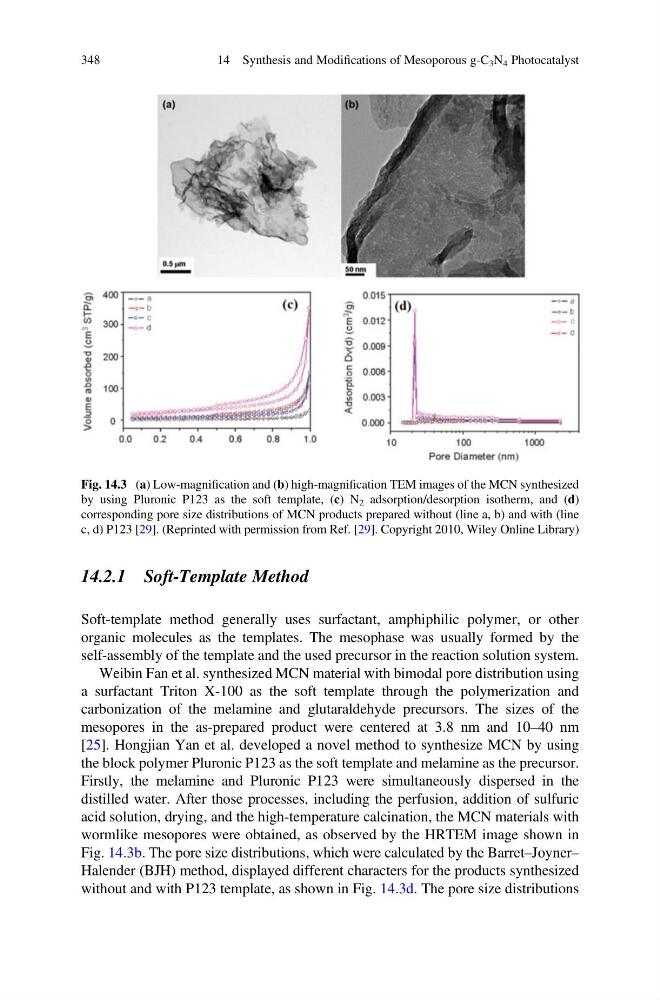
wormlike mesopores were obtained, as observed by the HRTEM image shown in
Fig. 14.3b. The pore size distributions, which were calculated by the Barret–Joyner–
Halender (BJH) method, displayed different characters for the products synthesized
without and with P123 template, as shown in Fig. 14.3d. The pore size distributions
Fig. 14.3 (a) Low-magnification and (b) high-magnification TEM images of the MCN synthesized
by using Pluronic P123 as the soft template, (c) N 2 adsorption/desorption isotherm, and (d)
corresponding pore size distributions of MCN products prepared without (line a, b) and with (line
c, d) P123 [29]. (Reprinted with permission from Ref. [29]. Copyright 2010, Wiley Online Library)
348
14 Synthesis and Modifications of Mesoporous g-C 3 N 4 Photocatalyst
Soft-template method generally uses surfactant, amphiphilic polymer, or other
organic molecules as the templates. The mesophase was usually formed by the
self-assembly of the template and the used precursor in the reaction solution system.
Weibin Fan et al. synthesized MCN material with bimodal pore distribution using
a surfactant Triton X-100 as the soft template through the polymerization and
carbonization of the melamine and glutaraldehyde precursors. The sizes of the
mesopores in the as-prepared product were centered at 3.8 nm and 10–40 nm
[25]. Hongjian Yan et al. developed a novel method to synthesize MCN by using
the block polymer Pluronic P123 as the soft template and melamine as the precursor.
Firstly, the melamine and Pluronic P123 were simultaneously dispersed in the
distilled water. After those processes, including the perfusion, addition of sulfuric
acid solution, drying, and the high-temperature calcination, the MCN materials with
wormlike mesopores were obtained, as observed by the HRTEM image shown in
Fig. 14.3b. The pore size distributions, which were calculated by the Barret–Joyner–
Halender (BJH) method, displayed different characters for the products synthesized
without and with P123 template, as shown in Fig. 14.3d. The pore size distributions
Fig. 14.3 (a) Low-magnification and (b) high-magnification TEM images of the MCN synthesized
by using Pluronic P123 as the soft template, (c) N 2 adsorption/desorption isotherm, and (d)
corresponding pore size distributions of MCN products prepared without (line a, b) and with (line
c, d) P123 [29]. (Reprinted with permission from Ref. [29]. Copyright 2010, Wiley Online Library)
348
14 Synthesis and Modifications of Mesoporous g-C 3 N 4 Photocatalyst