

2. Dissolution and Recrystallization Processes
1D AgBr nanowires and nanorods can also be prepared by the two-step processes:
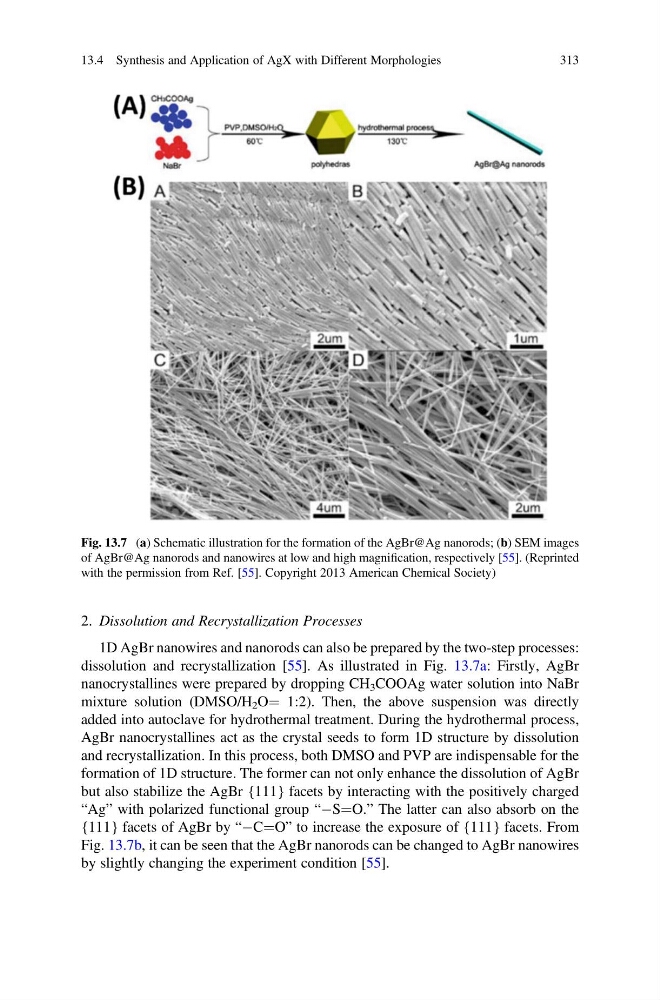
dissolution and recrystallization [55]. As illustrated in Fig. 13.7a: Firstly, AgBr
nanocrystallines were prepared by dropping CH 3 COOAg water solution into NaBr
mixture solution (DMSO/H 2 O¼ 1:2). Then, the above suspension was directly
added into autoclave for hydrothermal treatment. During the hydrothermal process,
AgBr nanocrystallines act as the crystal seeds to form 1D structure by dissolution
and recrystallization. In this process, both DMSO and PVP are indispensable for the
formation of 1D structure. The former can not only enhance the dissolution of AgBr
but also stabilize the AgBr {111} facets by interacting with the positively charged
“Ag” with polarized functional group “ÀS¼O.” The latter can also absorb on the
{111} facets of AgBr by “ÀC¼O” to increase the exposure of {111} facets. From
Fig. 13.7b, it can be seen that the AgBr nanorods can be changed to AgBr nanowires
by slightly changing the experiment condition [55].
Fig. 13.7 (a) Schematic illustration for the formation of the AgBr@Ag nanorods; (b) SEM images
of AgBr@Ag nanorods and nanowires at low and high magnification, respectively [55]. (Reprinted
with the permission from Ref. [55]. Copyright 2013 American Chemical Society)
13.4 Synthesis and Application of AgX with Different Morphologies
313
1D AgBr nanowires and nanorods can also be prepared by the two-step processes:
dissolution and recrystallization [55]. As illustrated in Fig. 13.7a: Firstly, AgBr
nanocrystallines were prepared by dropping CH 3 COOAg water solution into NaBr
mixture solution (DMSO/H 2 O¼ 1:2). Then, the above suspension was directly
added into autoclave for hydrothermal treatment. During the hydrothermal process,
AgBr nanocrystallines act as the crystal seeds to form 1D structure by dissolution
and recrystallization. In this process, both DMSO and PVP are indispensable for the
formation of 1D structure. The former can not only enhance the dissolution of AgBr
but also stabilize the AgBr {111} facets by interacting with the positively charged
“Ag” with polarized functional group “ÀS¼O.” The latter can also absorb on the
{111} facets of AgBr by “ÀC¼O” to increase the exposure of {111} facets. From
Fig. 13.7b, it can be seen that the AgBr nanorods can be changed to AgBr nanowires
by slightly changing the experiment condition [55].
Fig. 13.7 (a) Schematic illustration for the formation of the AgBr@Ag nanorods; (b) SEM images
of AgBr@Ag nanorods and nanowires at low and high magnification, respectively [55]. (Reprinted
with the permission from Ref. [55]. Copyright 2013 American Chemical Society)
13.4 Synthesis and Application of AgX with Different Morphologies
313