

added into the reaction system to oxide Ag
0 and release Ag
+ . The released Ag
+ ions
further react with X
À ions immediately to form AgX particles in situ. The advantage
of this synthesis strategy is easily combining AgX with other semiconductors or
substrates, because it is much easier to form Ag
0 on the surface of other materials
than to directly form AgX.
13.3.3 Ion Exchange
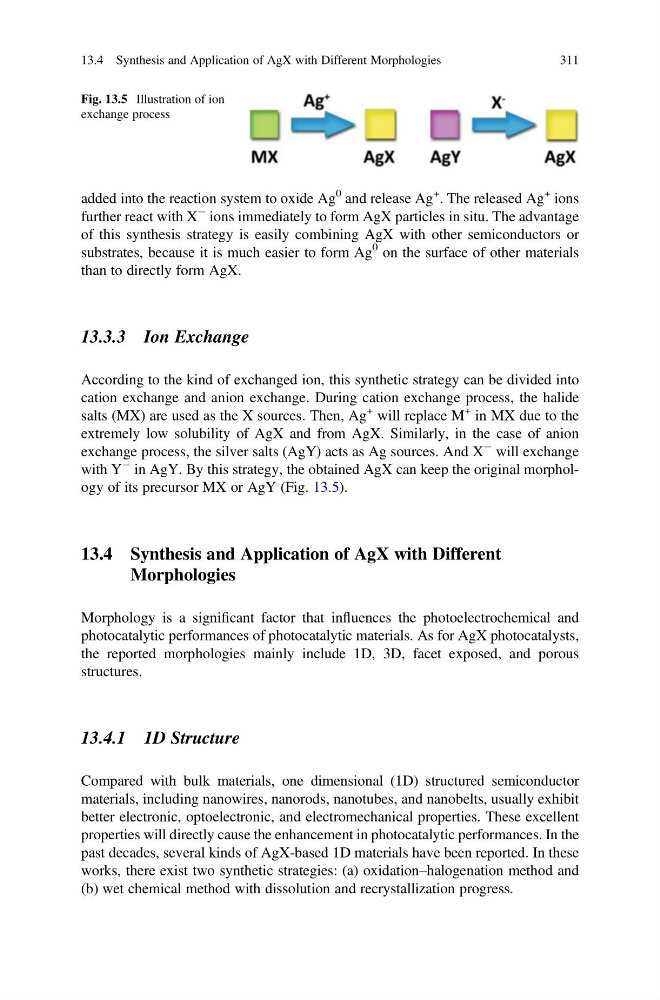
According to the kind of exchanged ion, this synthetic strategy can be divided into
cation exchange and anion exchange. During cation exchange process, the halide
salts (MX) are used as the X sources. Then, Ag
+ will replace M
+ in MX due to the
extremely low solubility of AgX and from AgX. Similarly, in the case of anion
exchange process, the silver salts (AgY) acts as Ag sources. And X
À will exchange
with Y
À in AgY. By this strategy, the obtained AgX can keep the original morphology of its precursor MX or AgY (Fig. 13.5).
13.4 Synthesis and Application of AgX with Different
Morphologies
Morphology is a significant factor that influences the photoelectrochemical and
photocatalytic performances of photocatalytic materials. As for AgX photocatalysts,
the reported morphologies mainly include 1D, 3D, facet exposed, and porous
structures.
13.4.1 1D Structure
Compared with bulk materials, one dimensional (1D) structured semiconductor
materials, including nanowires, nanorods, nanotubes, and nanobelts, usually exhibit
better electronic, optoelectronic, and electromechanical properties. These excellent
properties will directly cause the enhancement in photocatalytic performances. In the
past decades, several kinds of AgX-based 1D materials have been reported. In these
works, there exist two synthetic strategies: (a) oxidation–halogenation method and
(b) wet chemical method with dissolution and recrystallization progress.
Fig. 13.5 Illustration of ion
exchange process
13.4 Synthesis and Application of AgX with Different Morphologies
311
0 and release Ag
+ . The released Ag
+ ions
further react with X
À ions immediately to form AgX particles in situ. The advantage
of this synthesis strategy is easily combining AgX with other semiconductors or
substrates, because it is much easier to form Ag
0 on the surface of other materials
than to directly form AgX.
13.3.3 Ion Exchange
According to the kind of exchanged ion, this synthetic strategy can be divided into
cation exchange and anion exchange. During cation exchange process, the halide
salts (MX) are used as the X sources. Then, Ag
+ will replace M
+ in MX due to the
extremely low solubility of AgX and from AgX. Similarly, in the case of anion
exchange process, the silver salts (AgY) acts as Ag sources. And X
À will exchange
with Y
À in AgY. By this strategy, the obtained AgX can keep the original morphology of its precursor MX or AgY (Fig. 13.5).
13.4 Synthesis and Application of AgX with Different
Morphologies
Morphology is a significant factor that influences the photoelectrochemical and
photocatalytic performances of photocatalytic materials. As for AgX photocatalysts,
the reported morphologies mainly include 1D, 3D, facet exposed, and porous
structures.
13.4.1 1D Structure
Compared with bulk materials, one dimensional (1D) structured semiconductor
materials, including nanowires, nanorods, nanotubes, and nanobelts, usually exhibit
better electronic, optoelectronic, and electromechanical properties. These excellent
properties will directly cause the enhancement in photocatalytic performances. In the
past decades, several kinds of AgX-based 1D materials have been reported. In these
works, there exist two synthetic strategies: (a) oxidation–halogenation method and
(b) wet chemical method with dissolution and recrystallization progress.
Fig. 13.5 Illustration of ion
exchange process
13.4 Synthesis and Application of AgX with Different Morphologies
311