

of researching Ag/AgX plasmonic photocatalysts. So far, a large number of
researches involved in AgX have been carried out, including the morphology
control, establishment of heterojunction or Z-scheme structure, and combining
with recoverable material.
In this chapter, we will firstly introduce the properties and synthesis strategies of
AgX materials and the preparation and characteristic of AgX with different morphologies. After that, the AgX-based heterojunction and Z-scheme structures will be
classified by different composites and band structure, and each type will be presented
detailedly. Finally, the present researches of recoverable AgX materials will be
introduced.
13.2 Properties of AgX
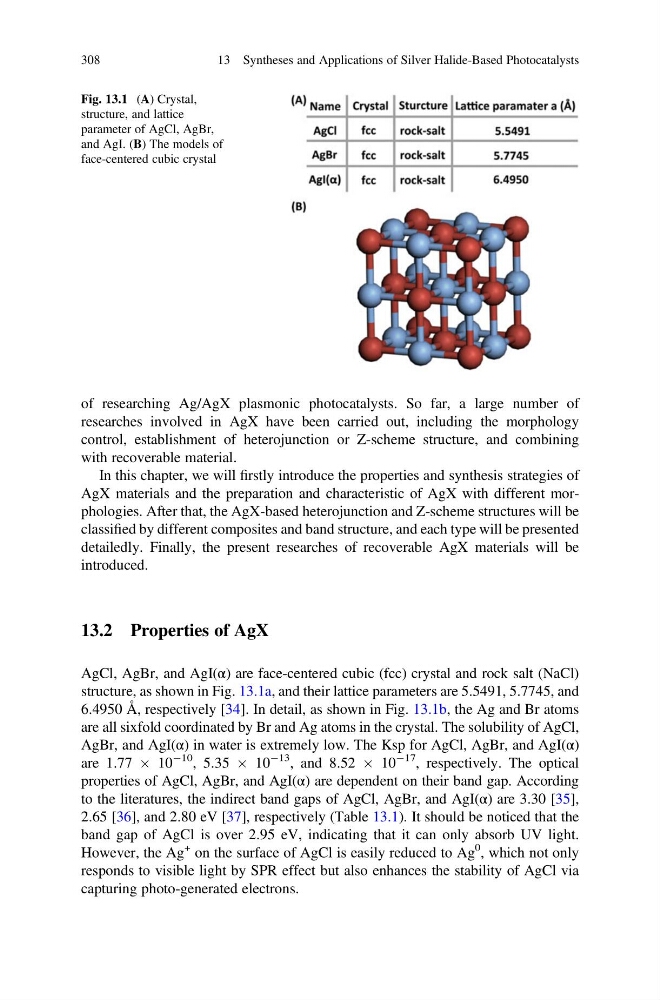
AgCl, AgBr, and AgI(α) are face-centered cubic (fcc) crystal and rock salt (NaCl)
structure, as shown in Fig. 13.1a, and their lattice parameters are 5.5491, 5.7745, and
6.4950 Å, respectively [34]. In detail, as shown in Fig. 13.1b, the Ag and Br atoms
are all sixfold coordinated by Br and Ag atoms in the crystal. The solubility of AgCl,
AgBr, and AgI(α) in water is extremely low. The Ksp for AgCl, AgBr, and AgI(α)
are 1.77 Â 10
À10 , 5.35 Â 10
À13 , and 8.52 Â 10
À17
, respectively. The optical
properties of AgCl, AgBr, and AgI(α) are dependent on their band gap. According
to the literatures, the indirect band gaps of AgCl, AgBr, and AgI(α) are 3.30 [35],
2.65 [36], and 2.80 eV [37], respectively (Table 13.1). It should be noticed that the
band gap of AgCl is over 2.95 eV, indicating that it can only absorb UV light.
However, the Ag
+ on the surface of AgCl is easily reduced to Ag
0 , which not only
responds to visible light by SPR effect but also enhances the stability of AgCl via
capturing photo-generated electrons.
Fig. 13.1 (A) Crystal,
structure, and lattice
parameter of AgCl, AgBr,
and AgI. (B) The models of
face-centered cubic crystal
308
13 Syntheses and Applications of Silver Halide-Based Photocatalysts
researches involved in AgX have been carried out, including the morphology
control, establishment of heterojunction or Z-scheme structure, and combining
with recoverable material.
In this chapter, we will firstly introduce the properties and synthesis strategies of
AgX materials and the preparation and characteristic of AgX with different morphologies. After that, the AgX-based heterojunction and Z-scheme structures will be
classified by different composites and band structure, and each type will be presented
detailedly. Finally, the present researches of recoverable AgX materials will be
introduced.
13.2 Properties of AgX
AgCl, AgBr, and AgI(α) are face-centered cubic (fcc) crystal and rock salt (NaCl)
structure, as shown in Fig. 13.1a, and their lattice parameters are 5.5491, 5.7745, and
6.4950 Å, respectively [34]. In detail, as shown in Fig. 13.1b, the Ag and Br atoms
are all sixfold coordinated by Br and Ag atoms in the crystal. The solubility of AgCl,
AgBr, and AgI(α) in water is extremely low. The Ksp for AgCl, AgBr, and AgI(α)
are 1.77 Â 10
À10 , 5.35 Â 10
À13 , and 8.52 Â 10
À17
, respectively. The optical
properties of AgCl, AgBr, and AgI(α) are dependent on their band gap. According
to the literatures, the indirect band gaps of AgCl, AgBr, and AgI(α) are 3.30 [35],
2.65 [36], and 2.80 eV [37], respectively (Table 13.1). It should be noticed that the
band gap of AgCl is over 2.95 eV, indicating that it can only absorb UV light.
However, the Ag
+ on the surface of AgCl is easily reduced to Ag
0 , which not only
responds to visible light by SPR effect but also enhances the stability of AgCl via
capturing photo-generated electrons.
Fig. 13.1 (A) Crystal,
structure, and lattice
parameter of AgCl, AgBr,
and AgI. (B) The models of
face-centered cubic crystal
308
13 Syntheses and Applications of Silver Halide-Based Photocatalysts