

(denoted as TiO 2 -Pd NRs-s). The obtained TiO 2 -Pd NRs-s show a lower TiO 2 -Pd
interface to Pd volume but higher edge to volume ratio compared with TiO 2 -Pd
NSs-s. Consequently, the TiO 2 -Pd NRs-s show a higher CO2PR activity but lower
HER yield (lower electron transfer ability). As a result, the density of edge sites of Pd
is highly related with the CO2PR performance which is reasonable to assume as the
active sites. To verify the roles of metal active sites in CO2PR more specifically,
with the assistance of DFT calculation, Gao et al. [69] report a step-by-step CO 2
photoreduction over single-atom Pt or Pd supported on g-C 3 N 4 . The calculated
relative binding energy between Pd and Pt within C 3 N 4 sixfold cavity proved the
existence of charge transfer and strong interaction between the metal and support.
Two possible product pathways, HCOOH and CH3OH, are studied for Pd/C 3 N 4 .
The calculated desorption energy barrier for the key intermediate HCOOH* on
Pd/C3N4 is 0.46 eV, which is much lower than the formation of HCHO*, suggesting
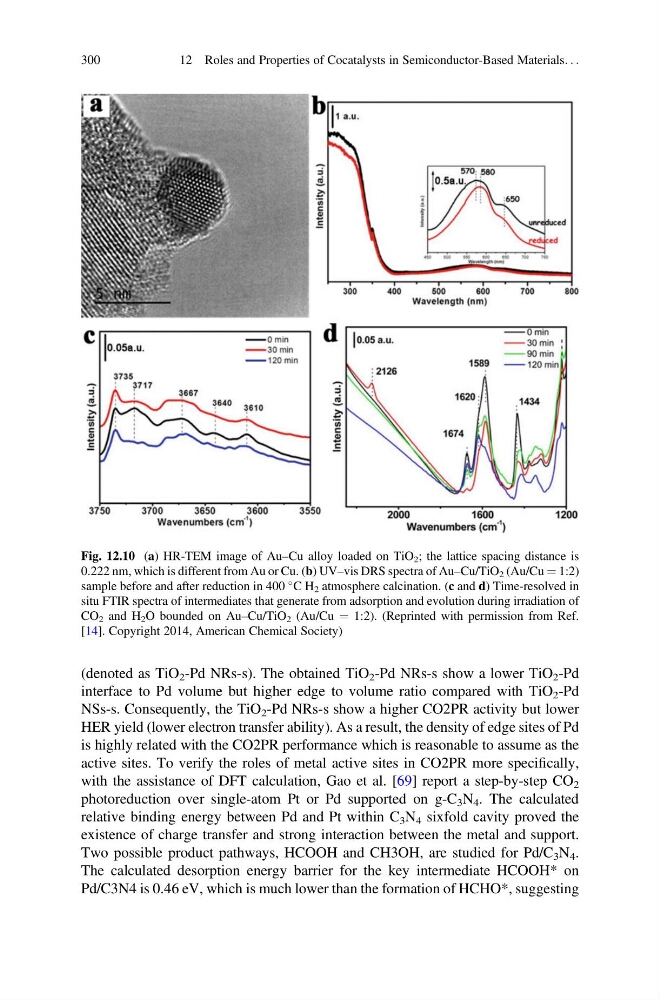
Fig. 12.10 (a) HR-TEM image of Au–Cu alloy loaded on TiO 2 ; the lattice spacing distance is
0.222 nm, which is different from Au or Cu. (b) UV–vis DRS spectra of Au–Cu/TiO 2 (Au/Cu ¼ 1:2)
sample before and after reduction in 400
C H 2 atmosphere calcination. (c and d) Time-resolved in
situ FTIR spectra of intermediates that generate from adsorption and evolution during irradiation of
CO 2 and H 2 O bounded on Au–Cu/TiO 2 (Au/Cu ¼ 1:2). (Reprinted with permission from Ref.
[14]. Copyright 2014, American Chemical Society)
300
12 Roles and Properties of Cocatalysts in Semiconductor-Based Materials. . .
interface to Pd volume but higher edge to volume ratio compared with TiO 2 -Pd
NSs-s. Consequently, the TiO 2 -Pd NRs-s show a higher CO2PR activity but lower
HER yield (lower electron transfer ability). As a result, the density of edge sites of Pd
is highly related with the CO2PR performance which is reasonable to assume as the
active sites. To verify the roles of metal active sites in CO2PR more specifically,
with the assistance of DFT calculation, Gao et al. [69] report a step-by-step CO 2
photoreduction over single-atom Pt or Pd supported on g-C 3 N 4 . The calculated
relative binding energy between Pd and Pt within C 3 N 4 sixfold cavity proved the
existence of charge transfer and strong interaction between the metal and support.
Two possible product pathways, HCOOH and CH3OH, are studied for Pd/C 3 N 4 .
The calculated desorption energy barrier for the key intermediate HCOOH* on
Pd/C3N4 is 0.46 eV, which is much lower than the formation of HCHO*, suggesting
Fig. 12.10 (a) HR-TEM image of Au–Cu alloy loaded on TiO 2 ; the lattice spacing distance is
0.222 nm, which is different from Au or Cu. (b) UV–vis DRS spectra of Au–Cu/TiO 2 (Au/Cu ¼ 1:2)
sample before and after reduction in 400
C H 2 atmosphere calcination. (c and d) Time-resolved in
situ FTIR spectra of intermediates that generate from adsorption and evolution during irradiation of
CO 2 and H 2 O bounded on Au–Cu/TiO 2 (Au/Cu ¼ 1:2). (Reprinted with permission from Ref.
[14]. Copyright 2014, American Chemical Society)
300
12 Roles and Properties of Cocatalysts in Semiconductor-Based Materials. . .