

12.4.3 Surface Active Sites in CO 2 Photoreduction
For better understanding the roles of cocatalysts in CO2PR, the identification of the
active sites in cocatalysts and the study of reaction mechanism are very important.
Only in this way can we develop photocatalysts with both high performance and
selectivity in CO2PR. In order to investigate the active facet of Pd in CO 2 photoreduction, Bai et al. [15] synthesized Pd cube NPs (exposed mainly (100) facets) and
Pd tetrahedron NPs (exposed mainly (111) facets) and deposit them on C 3 N 4 layer
separately. The size of Pd with different shapes is all around 4–6 nm; however, the
activity was quite different, and the selectivity toward CO2PR of Pd
nanotetrahedrons/C 3 N 4 is obviously higher than Pd nanocubes/C 3 N 4 . Deep understanding of the shape-dependent selectivity of Pd was investigated by first-principle
theory. Firstly, the adsorption energy for CO 2 and H 2 O on Pd (111) is 0.23 eV and
0.37 eV and for Pd (100) is 0.064 and 0.554 eV, which indicates the CO 2 and H 2 O
tend to adsorb on Pd (111) and Pd (100), respectively. Secondly, when accepting two
electrons, the Pd (111) shows a lower CO 2 activation energy barrier compared with
Pd (100). This result reflects that the Pd (111) is the active site for CO 2 reduction and
Pd (100) is more active for H 2 O reduction. Generally, the active sites of supported
metal catalysts rely on two factors: surface geometric structure and electronic
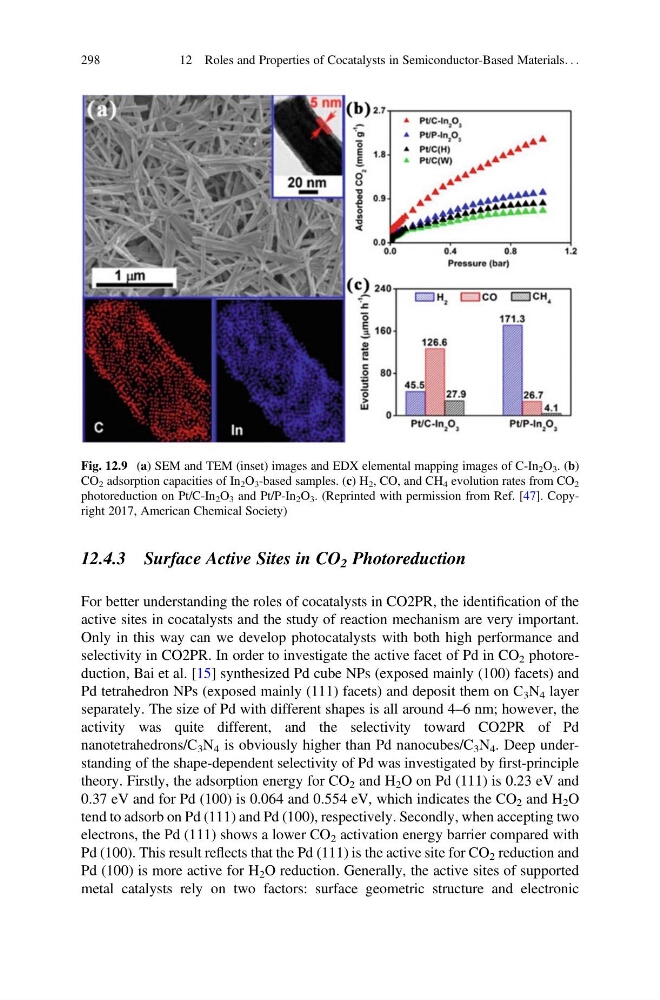
Fig. 12.9 (a) SEM and TEM (inset) images and EDX elemental mapping images of C-In 2 O 3 . (b)
CO 2 adsorption capacities of In 2 O 3 -based samples. (c) H 2 , CO, and CH 4 evolution rates from CO 2
photoreduction on Pt/C-In 2 O 3 and Pt/P-In 2 O 3 . (Reprinted with permission from Ref. [47]. Copyright 2017, American Chemical Society)
298
12 Roles and Properties of Cocatalysts in Semiconductor-Based Materials. . .
For better understanding the roles of cocatalysts in CO2PR, the identification of the
active sites in cocatalysts and the study of reaction mechanism are very important.
Only in this way can we develop photocatalysts with both high performance and
selectivity in CO2PR. In order to investigate the active facet of Pd in CO 2 photoreduction, Bai et al. [15] synthesized Pd cube NPs (exposed mainly (100) facets) and
Pd tetrahedron NPs (exposed mainly (111) facets) and deposit them on C 3 N 4 layer
separately. The size of Pd with different shapes is all around 4–6 nm; however, the
activity was quite different, and the selectivity toward CO2PR of Pd
nanotetrahedrons/C 3 N 4 is obviously higher than Pd nanocubes/C 3 N 4 . Deep understanding of the shape-dependent selectivity of Pd was investigated by first-principle
theory. Firstly, the adsorption energy for CO 2 and H 2 O on Pd (111) is 0.23 eV and
0.37 eV and for Pd (100) is 0.064 and 0.554 eV, which indicates the CO 2 and H 2 O
tend to adsorb on Pd (111) and Pd (100), respectively. Secondly, when accepting two
electrons, the Pd (111) shows a lower CO 2 activation energy barrier compared with
Pd (100). This result reflects that the Pd (111) is the active site for CO 2 reduction and
Pd (100) is more active for H 2 O reduction. Generally, the active sites of supported
metal catalysts rely on two factors: surface geometric structure and electronic
Fig. 12.9 (a) SEM and TEM (inset) images and EDX elemental mapping images of C-In 2 O 3 . (b)
CO 2 adsorption capacities of In 2 O 3 -based samples. (c) H 2 , CO, and CH 4 evolution rates from CO 2
photoreduction on Pt/C-In 2 O 3 and Pt/P-In 2 O 3 . (Reprinted with permission from Ref. [47]. Copyright 2017, American Chemical Society)
298
12 Roles and Properties of Cocatalysts in Semiconductor-Based Materials. . .