

In most semiconductor-based CO2PR reactions, H 2 O is selected as the sole
electron donor, in this case, the H 2 O oxidation reaction to release H protons and
O 2 ; hydrogen evolution reaction (HER) to generate H 2 has also two major steps:
Eqs. 12.6 and 12.7:
2H 2 O þ 4h
þ
! 4H
þ
þ O 2
E redox
0
¼ À0:82V
ð12:6Þ
2H
þ
þ 2e
À
! H 2
E redox
0
¼ À0:41V
ð12:7Þ
Owing to the complexity of CO 2 reduction reaction that involved multi-electrons
and protons’ participation and various intermediates’ adsorption/desorption processes, the deep understanding of the CO 2 reduction is still unclear both experimentally and theoretically. To date, researchers have proposed two classic CO 2 reduction
pathways which are called formaldehyde pathway (also known as multiple protoncoupled electron transfer) and carbene pathway (also known as deoxygenation path),
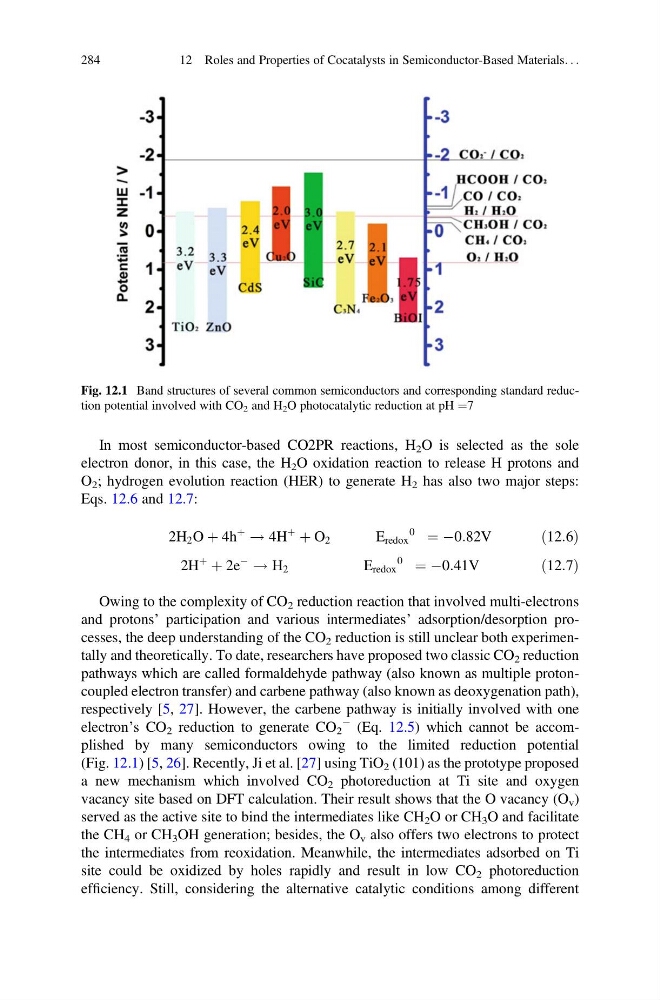
respectively [5, 27]. However, the carbene pathway is initially involved with one
electron’s CO 2 reduction to generate CO 2
À (Eq. 12.5) which cannot be accomplished by many semiconductors owing to the limited reduction potential
(Fig. 12.1) [5, 26]. Recently, Ji et al. [27] using TiO 2 (101) as the prototype proposed
a new mechanism which involved CO 2 photoreduction at Ti site and oxygen
vacancy site based on DFT calculation. Their result shows that the O vacancy (O v )
served as the active site to bind the intermediates like CH 2 O or CH 3 O and facilitate
the CH 4 or CH 3 OH generation; besides, the O v also offers two electrons to protect
the intermediates from reoxidation. Meanwhile, the intermediates adsorbed on Ti
site could be oxidized by holes rapidly and result in low CO 2 photoreduction
efficiency. Still, considering the alternative catalytic conditions among different
Fig. 12.1 Band structures of several common semiconductors and corresponding standard reduction potential involved with CO 2 and H 2 O photocatalytic reduction at pH ¼7
284
12 Roles and Properties of Cocatalysts in Semiconductor-Based Materials. . .
electron donor, in this case, the H 2 O oxidation reaction to release H protons and
O 2 ; hydrogen evolution reaction (HER) to generate H 2 has also two major steps:
Eqs. 12.6 and 12.7:
2H 2 O þ 4h
þ
! 4H
þ
þ O 2
E redox
0
¼ À0:82V
ð12:6Þ
2H
þ
þ 2e
À
! H 2
E redox
0
¼ À0:41V
ð12:7Þ
Owing to the complexity of CO 2 reduction reaction that involved multi-electrons
and protons’ participation and various intermediates’ adsorption/desorption processes, the deep understanding of the CO 2 reduction is still unclear both experimentally and theoretically. To date, researchers have proposed two classic CO 2 reduction
pathways which are called formaldehyde pathway (also known as multiple protoncoupled electron transfer) and carbene pathway (also known as deoxygenation path),
respectively [5, 27]. However, the carbene pathway is initially involved with one
electron’s CO 2 reduction to generate CO 2
À (Eq. 12.5) which cannot be accomplished by many semiconductors owing to the limited reduction potential
(Fig. 12.1) [5, 26]. Recently, Ji et al. [27] using TiO 2 (101) as the prototype proposed
a new mechanism which involved CO 2 photoreduction at Ti site and oxygen
vacancy site based on DFT calculation. Their result shows that the O vacancy (O v )
served as the active site to bind the intermediates like CH 2 O or CH 3 O and facilitate
the CH 4 or CH 3 OH generation; besides, the O v also offers two electrons to protect
the intermediates from reoxidation. Meanwhile, the intermediates adsorbed on Ti
site could be oxidized by holes rapidly and result in low CO 2 photoreduction
efficiency. Still, considering the alternative catalytic conditions among different
Fig. 12.1 Band structures of several common semiconductors and corresponding standard reduction potential involved with CO 2 and H 2 O photocatalytic reduction at pH ¼7
284
12 Roles and Properties of Cocatalysts in Semiconductor-Based Materials. . .