

11.2.8 Noble Metal
Degradation of phenol with a small excess of H 2 O 2 can be achieved by using gold
nanoparticles supported on Fenton-treated diamond nanoparticles (Au/OH-npD) as a
highly selective (at least 79%) and efficient (turnover number: 321,000) catalyst for
the Fenton reaction at room temperature [27]. The catalytic activity of Au/OH-npD
for the Fenton degradation of phenol with hydrogen peroxide can be increased over
one order of magnitude by irradiation at 532 nm [28]. Moreover, there is a linear
relationship between the initial reaction rate and the incident photon flux. This
photo-enhancement allows promoting Fenton activity at pH 8 in which the catalytic
activity of Au/OH-npD is negligible. The same photo enhancement activity for the
Fenton degradation of phenol was observed for other supported gold catalysts
including those that do not exhibit microsecond transients in the nanosecond laser
flash photolysis (Au/TiO 2 and Au/SiO 2 ) due to their lifetime shorter than microseconds. It is proposed that the photo enhancement should be a general phenomenon in
gold catalysis for those reaction mechanisms involving positive and/or negative gold
species.
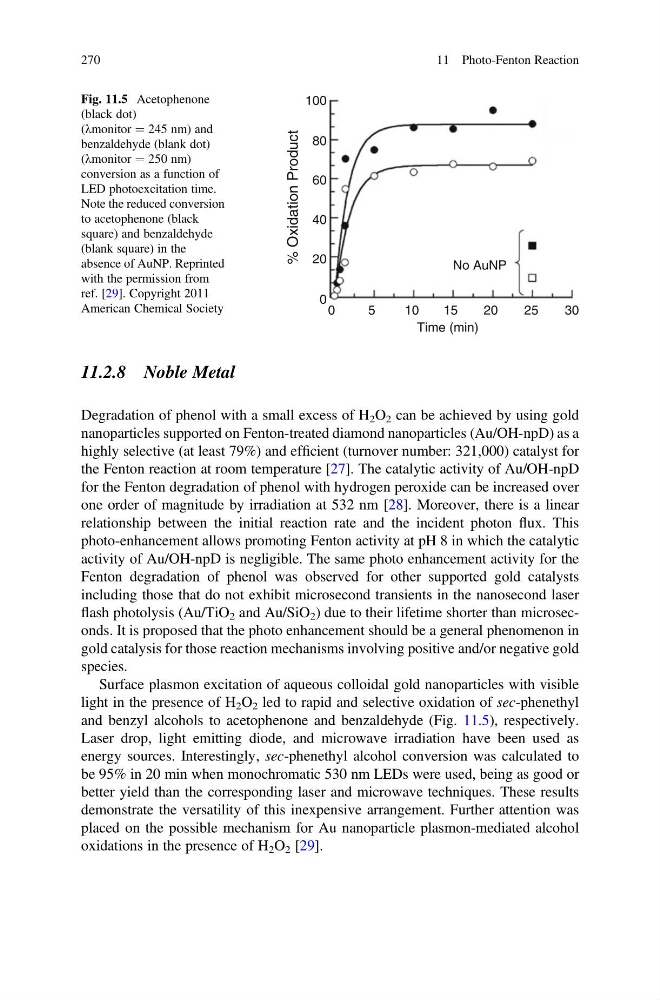
Surface plasmon excitation of aqueous colloidal gold nanoparticles with visible
light in the presence of H 2 O 2 led to rapid and selective oxidation of sec-phenethyl
and benzyl alcohols to acetophenone and benzaldehyde (Fig. 11.5), respectively.
Laser drop, light emitting diode, and microwave irradiation have been used as
energy sources. Interestingly, sec-phenethyl alcohol conversion was calculated to
be 95% in 20 min when monochromatic 530 nm LEDs were used, being as good or
better yield than the corresponding laser and microwave techniques. These results
demonstrate the versatility of this inexpensive arrangement. Further attention was
placed on the possible mechanism for Au nanoparticle plasmon-mediated alcohol
oxidations in the presence of H 2 O 2 [29].
100
80
60
40
20
% Oxidation Product
0
0
5
10
15
20
No AuNP
25
30
Time (min)
Fig. 11.5 Acetophenone
(black dot)
(λmonitor ¼ 245 nm) and
benzaldehyde (blank dot)
(λmonitor ¼ 250 nm)
conversion as a function of
LED photoexcitation time.
Note the reduced conversion
to acetophenone (black
square) and benzaldehyde
(blank square) in the
absence of AuNP. Reprinted
with the permission from
ref. [29]. Copyright 2011
American Chemical Society
270
11 Photo-Fenton Reaction
Degradation of phenol with a small excess of H 2 O 2 can be achieved by using gold
nanoparticles supported on Fenton-treated diamond nanoparticles (Au/OH-npD) as a
highly selective (at least 79%) and efficient (turnover number: 321,000) catalyst for
the Fenton reaction at room temperature [27]. The catalytic activity of Au/OH-npD
for the Fenton degradation of phenol with hydrogen peroxide can be increased over
one order of magnitude by irradiation at 532 nm [28]. Moreover, there is a linear
relationship between the initial reaction rate and the incident photon flux. This
photo-enhancement allows promoting Fenton activity at pH 8 in which the catalytic
activity of Au/OH-npD is negligible. The same photo enhancement activity for the
Fenton degradation of phenol was observed for other supported gold catalysts
including those that do not exhibit microsecond transients in the nanosecond laser
flash photolysis (Au/TiO 2 and Au/SiO 2 ) due to their lifetime shorter than microseconds. It is proposed that the photo enhancement should be a general phenomenon in
gold catalysis for those reaction mechanisms involving positive and/or negative gold
species.
Surface plasmon excitation of aqueous colloidal gold nanoparticles with visible
light in the presence of H 2 O 2 led to rapid and selective oxidation of sec-phenethyl
and benzyl alcohols to acetophenone and benzaldehyde (Fig. 11.5), respectively.
Laser drop, light emitting diode, and microwave irradiation have been used as
energy sources. Interestingly, sec-phenethyl alcohol conversion was calculated to
be 95% in 20 min when monochromatic 530 nm LEDs were used, being as good or
better yield than the corresponding laser and microwave techniques. These results
demonstrate the versatility of this inexpensive arrangement. Further attention was
placed on the possible mechanism for Au nanoparticle plasmon-mediated alcohol
oxidations in the presence of H 2 O 2 [29].
100
80
60
40
20
% Oxidation Product
0
0
5
10
15
20
No AuNP
25
30
Time (min)
Fig. 11.5 Acetophenone
(black dot)
(λmonitor ¼ 245 nm) and
benzaldehyde (blank dot)
(λmonitor ¼ 250 nm)
conversion as a function of
LED photoexcitation time.
Note the reduced conversion
to acetophenone (black
square) and benzaldehyde
(blank square) in the
absence of AuNP. Reprinted
with the permission from
ref. [29]. Copyright 2011
American Chemical Society
270
11 Photo-Fenton Reaction