

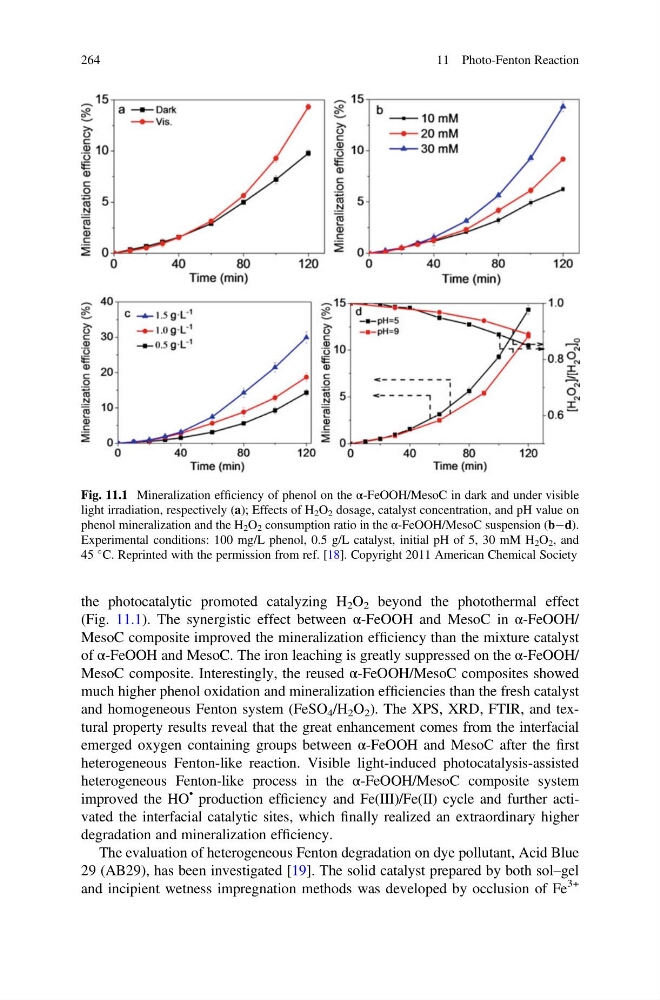
the photocatalytic promoted catalyzing H 2 O 2 beyond the photothermal effect
(Fig. 11.1). The synergistic effect between α-FeOOH and MesoC in α-FeOOH/
MesoC composite improved the mineralization efficiency than the mixture catalyst
of α-FeOOH and MesoC. The iron leaching is greatly suppressed on the α-FeOOH/
MesoC composite. Interestingly, the reused α-FeOOH/MesoC composites showed
much higher phenol oxidation and mineralization efficiencies than the fresh catalyst
and homogeneous Fenton system (FeSO 4 /H 2 O 2 ). The XPS, XRD, FTIR, and textural property results reveal that the great enhancement comes from the interfacial
emerged oxygen containing groups between α-FeOOH and MesoC after the first
heterogeneous Fenton-like reaction. Visible light-induced photocatalysis-assisted
heterogeneous Fenton-like process in the α-FeOOH/MesoC composite system
improved the HO
• production efficiency and Fe(III)/Fe(II) cycle and further activated the interfacial catalytic sites, which finally realized an extraordinary higher
degradation and mineralization efficiency.
The evaluation of heterogeneous Fenton degradation on dye pollutant, Acid Blue
29 (AB29), has been investigated [19]. The solid catalyst prepared by both sol–gel
and incipient wetness impregnation methods was developed by occlusion of Fe
3+
Fig. 11.1 Mineralization efficiency of phenol on the α-FeOOH/MesoC in dark and under visible
light irradiation, respectively (a); Effects of H 2 O 2 dosage, catalyst concentration, and pH value on
phenol mineralization and the H 2 O 2 consumption ratio in the α-FeOOH/MesoC suspension (bÀd).
Experimental conditions: 100 mg/L phenol, 0.5 g/L catalyst, initial pH of 5, 30 mM H 2 O 2 , and
45
C. Reprinted with the permission from ref. [18]. Copyright 2011 American Chemical Society
264
11 Photo-Fenton Reaction
(Fig. 11.1). The synergistic effect between α-FeOOH and MesoC in α-FeOOH/
MesoC composite improved the mineralization efficiency than the mixture catalyst
of α-FeOOH and MesoC. The iron leaching is greatly suppressed on the α-FeOOH/
MesoC composite. Interestingly, the reused α-FeOOH/MesoC composites showed
much higher phenol oxidation and mineralization efficiencies than the fresh catalyst
and homogeneous Fenton system (FeSO 4 /H 2 O 2 ). The XPS, XRD, FTIR, and textural property results reveal that the great enhancement comes from the interfacial
emerged oxygen containing groups between α-FeOOH and MesoC after the first
heterogeneous Fenton-like reaction. Visible light-induced photocatalysis-assisted
heterogeneous Fenton-like process in the α-FeOOH/MesoC composite system
improved the HO
• production efficiency and Fe(III)/Fe(II) cycle and further activated the interfacial catalytic sites, which finally realized an extraordinary higher
degradation and mineralization efficiency.
The evaluation of heterogeneous Fenton degradation on dye pollutant, Acid Blue
29 (AB29), has been investigated [19]. The solid catalyst prepared by both sol–gel
and incipient wetness impregnation methods was developed by occlusion of Fe
3+
Fig. 11.1 Mineralization efficiency of phenol on the α-FeOOH/MesoC in dark and under visible
light irradiation, respectively (a); Effects of H 2 O 2 dosage, catalyst concentration, and pH value on
phenol mineralization and the H 2 O 2 consumption ratio in the α-FeOOH/MesoC suspension (bÀd).
Experimental conditions: 100 mg/L phenol, 0.5 g/L catalyst, initial pH of 5, 30 mM H 2 O 2 , and
45
C. Reprinted with the permission from ref. [18]. Copyright 2011 American Chemical Society
264
11 Photo-Fenton Reaction