

Besides, α-FeOOH and β-FeOOH [48] are also explored to apply as catalyst for
water purification.
ZnFe 2 O 4 has a narrow bandgap of 1.9 eV so that it can absorb visible light up to
653 nm, which tremendously enhances the utilization of sunlight. ZnFe 2 O 4 has great
potential to be used as a high-performance photocatalyst to deal with water organic
pollution owing to its high catalytic capability, low cost, and simple magnetic
separation. Besides, graphene is utilized as support material and electron acceptor
for ZnFe 2 O 4 . The nanosized ZnFe 2 O 4 particles that grew on graphene have high
surface area and low electron–hole recombination due to its suitable short diameter.
The photo-generated electrons are rapidly transferred to graphene so that the holes
are preserved to react with H 2 O 2 and H 2 O to generate hydroxyl radicals for decomposition of dye pollution. Furthermore, both the aggregation of ZnFe 2 O 4 and the
stack of graphene sheets were prevented. Yang et al. [72] reported a novel strategy to
synthesize G-ZnFe 2 O 4 composite through interface engineering. They used
graphene as barrier to control the growth of ZnFe 2 O 4 , channels to transport photogenerated electrons, and vessels to inhibit the recombination of electrons and holes.
The results showed that the G-ZnFe 2 O 4 catalyst had an ultrafast degradation rate of
methyl blue, which was 20 times higher than the previous reported spinel-based
photocatalysts, 4 times higher than that of the TiO 2 -based photocatalysts, and
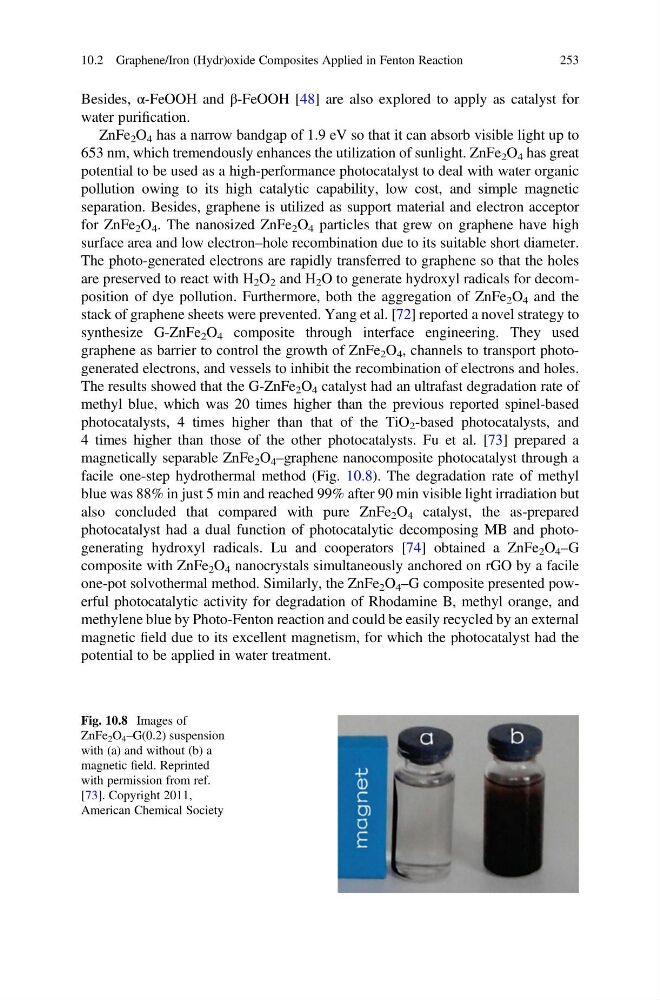
4 times higher than those of the other photocatalysts. Fu et al. [73] prepared a
magnetically separable ZnFe 2 O 4 –graphene nanocomposite photocatalyst through a
facile one-step hydrothermal method (Fig. 10.8). The degradation rate of methyl
blue was 88% in just 5 min and reached 99% after 90 min visible light irradiation but
also concluded that compared with pure ZnFe 2 O 4 catalyst, the as-prepared
photocatalyst had a dual function of photocatalytic decomposing MB and photogenerating hydroxyl radicals. Lu and cooperators [74] obtained a ZnFe 2 O 4 –G
composite with ZnFe 2 O 4 nanocrystals simultaneously anchored on rGO by a facile
one-pot solvothermal method. Similarly, the ZnFe 2 O 4 –G composite presented powerful photocatalytic activity for degradation of Rhodamine B, methyl orange, and
methylene blue by Photo-Fenton reaction and could be easily recycled by an external
magnetic field due to its excellent magnetism, for which the photocatalyst had the
potential to be applied in water treatment.
Fig. 10.8 Images of
ZnFe 2 O 4 –G(0.2) suspension
with (a) and without (b) a
magnetic field. Reprinted
with permission from ref.
[73]. Copyright 2011,
American Chemical Society
10.2 Graphene/Iron (Hydr)oxide Composites Applied in Fenton Reaction
253
water purification.
ZnFe 2 O 4 has a narrow bandgap of 1.9 eV so that it can absorb visible light up to
653 nm, which tremendously enhances the utilization of sunlight. ZnFe 2 O 4 has great
potential to be used as a high-performance photocatalyst to deal with water organic
pollution owing to its high catalytic capability, low cost, and simple magnetic
separation. Besides, graphene is utilized as support material and electron acceptor
for ZnFe 2 O 4 . The nanosized ZnFe 2 O 4 particles that grew on graphene have high
surface area and low electron–hole recombination due to its suitable short diameter.
The photo-generated electrons are rapidly transferred to graphene so that the holes
are preserved to react with H 2 O 2 and H 2 O to generate hydroxyl radicals for decomposition of dye pollution. Furthermore, both the aggregation of ZnFe 2 O 4 and the
stack of graphene sheets were prevented. Yang et al. [72] reported a novel strategy to
synthesize G-ZnFe 2 O 4 composite through interface engineering. They used
graphene as barrier to control the growth of ZnFe 2 O 4 , channels to transport photogenerated electrons, and vessels to inhibit the recombination of electrons and holes.
The results showed that the G-ZnFe 2 O 4 catalyst had an ultrafast degradation rate of
methyl blue, which was 20 times higher than the previous reported spinel-based
photocatalysts, 4 times higher than that of the TiO 2 -based photocatalysts, and
4 times higher than those of the other photocatalysts. Fu et al. [73] prepared a
magnetically separable ZnFe 2 O 4 –graphene nanocomposite photocatalyst through a
facile one-step hydrothermal method (Fig. 10.8). The degradation rate of methyl
blue was 88% in just 5 min and reached 99% after 90 min visible light irradiation but
also concluded that compared with pure ZnFe 2 O 4 catalyst, the as-prepared
photocatalyst had a dual function of photocatalytic decomposing MB and photogenerating hydroxyl radicals. Lu and cooperators [74] obtained a ZnFe 2 O 4 –G
composite with ZnFe 2 O 4 nanocrystals simultaneously anchored on rGO by a facile
one-pot solvothermal method. Similarly, the ZnFe 2 O 4 –G composite presented powerful photocatalytic activity for degradation of Rhodamine B, methyl orange, and
methylene blue by Photo-Fenton reaction and could be easily recycled by an external
magnetic field due to its excellent magnetism, for which the photocatalyst had the
potential to be applied in water treatment.
Fig. 10.8 Images of
ZnFe 2 O 4 –G(0.2) suspension
with (a) and without (b) a
magnetic field. Reprinted
with permission from ref.
[73]. Copyright 2011,
American Chemical Society
10.2 Graphene/Iron (Hydr)oxide Composites Applied in Fenton Reaction
253