

more efficient use of the light source and therefore offers an improved catalytic
activity. The hollow and yolk–shell structures with smaller inner spheres show lower
activity due to the reduced light reflection efficiency.
Qian et al. designed TiO 2 -coated multilayered SnO 2 hollow microspheres (MHS)
for dye-sensitized solar cells [16]. Multilayered spherical SnO 2 –C composite was
first formed through a condensation polymerization and carbonization of sucrose
accompanied by hydrolysis of SnCl 4 in the hydrothermal reaction. Then, hollow
SnO 2 were obtained by removal of carbon via calcination. Compared to TiO 2 , SnO 2
has higher electron mobility and larger bandgap. However, SnO 2 -based DSSCs
generally have lower conversion efficiencies than TiO 2 , which are attributed to a
faster interfacial electron recombination and lower trapping density. On the other
hand, SnO 2 has a lower isoelectric point (pH ¼ 4–5) than anatase TiO2 (pH ¼ 6–7),
which leads to less adsorption of the dye with acidic carboxyl groups. To solve these
problems, coating a thin layer of an isolating oxide, such as TiO 2 , ZnO, Al2O3, or
MgO, has been adopted to improve the conversion efficiency of SnO 2
photoelectrodes. TiO 2 –SnO 2 multilayered hollow microspheres (SnO 2 MHSs)
were synthesized by two steps (Fig. 9.8). First, SnO 2 MHSs were prepared by a
chemically induced self-assembly reaction of aqueous sucrose–SnCl 4 solution under
hydrothermal condition. The second step was to coat TiO 2 nanocrystallites onto the
SnO 2 MHSs by impregnating in TiCl4 and then hydrolyzing TiCl 4 to form a surface
layer of TiO 2 .
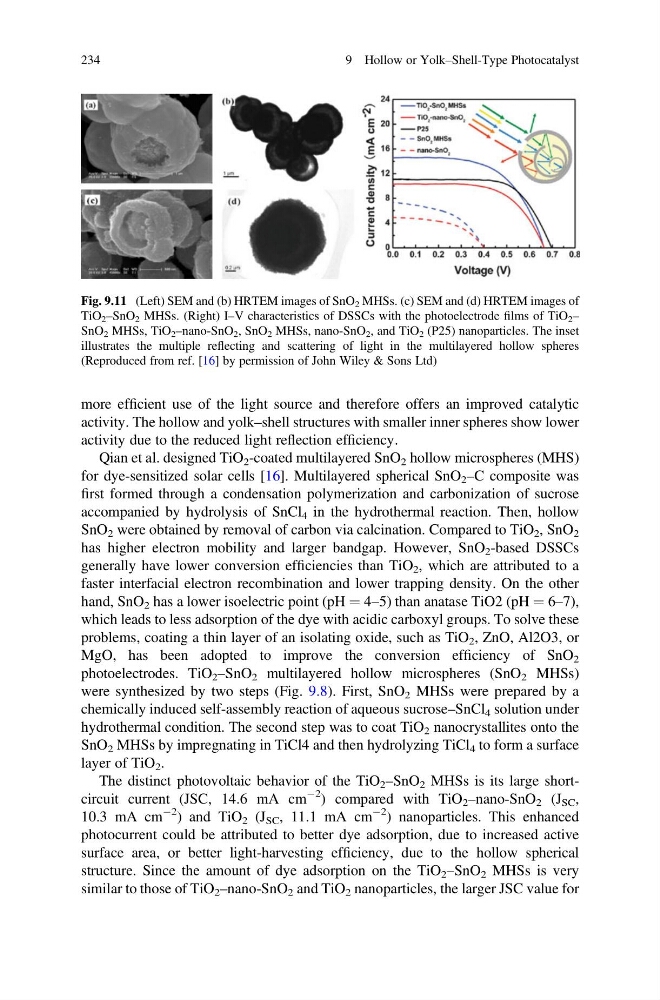
The distinct photovoltaic behavior of the TiO 2 –SnO 2 MHSs is its large shortcircuit current (JSC, 14.6 mA cm
À2 ) compared with TiO 2 –nano-SnO 2 (J SC ,
10.3 mA cm
À2 ) and TiO 2 (J SC , 11.1 mA cm
À2 ) nanoparticles. This enhanced
photocurrent could be attributed to better dye adsorption, due to increased active
surface area, or better light-harvesting efficiency, due to the hollow spherical
structure. Since the amount of dye adsorption on the TiO 2 –SnO 2 MHSs is very
similar to those of TiO 2 –nano-SnO 2 and TiO 2 nanoparticles, the larger JSC value for
Fig. 9.11 (Left) SEM and (b) HRTEM images of SnO 2 MHSs. (c) SEM and (d) HRTEM images of
TiO 2 –SnO 2 MHSs. (Right) I–V characteristics of DSSCs with the photoelectrode films of TiO 2 –
SnO 2 MHSs, TiO 2 –nano-SnO 2 , SnO 2 MHSs, nano-SnO 2 , and TiO 2 (P25) nanoparticles. The inset
illustrates the multiple reflecting and scattering of light in the multilayered hollow spheres
(Reproduced from ref. [16] by permission of John Wiley & Sons Ltd)
234
9 Hollow or Yolk–Shell-Type Photocatalyst
activity. The hollow and yolk–shell structures with smaller inner spheres show lower
activity due to the reduced light reflection efficiency.
Qian et al. designed TiO 2 -coated multilayered SnO 2 hollow microspheres (MHS)
for dye-sensitized solar cells [16]. Multilayered spherical SnO 2 –C composite was
first formed through a condensation polymerization and carbonization of sucrose
accompanied by hydrolysis of SnCl 4 in the hydrothermal reaction. Then, hollow
SnO 2 were obtained by removal of carbon via calcination. Compared to TiO 2 , SnO 2
has higher electron mobility and larger bandgap. However, SnO 2 -based DSSCs
generally have lower conversion efficiencies than TiO 2 , which are attributed to a
faster interfacial electron recombination and lower trapping density. On the other
hand, SnO 2 has a lower isoelectric point (pH ¼ 4–5) than anatase TiO2 (pH ¼ 6–7),
which leads to less adsorption of the dye with acidic carboxyl groups. To solve these
problems, coating a thin layer of an isolating oxide, such as TiO 2 , ZnO, Al2O3, or
MgO, has been adopted to improve the conversion efficiency of SnO 2
photoelectrodes. TiO 2 –SnO 2 multilayered hollow microspheres (SnO 2 MHSs)
were synthesized by two steps (Fig. 9.8). First, SnO 2 MHSs were prepared by a
chemically induced self-assembly reaction of aqueous sucrose–SnCl 4 solution under
hydrothermal condition. The second step was to coat TiO 2 nanocrystallites onto the
SnO 2 MHSs by impregnating in TiCl4 and then hydrolyzing TiCl 4 to form a surface
layer of TiO 2 .
The distinct photovoltaic behavior of the TiO 2 –SnO 2 MHSs is its large shortcircuit current (JSC, 14.6 mA cm
À2 ) compared with TiO 2 –nano-SnO 2 (J SC ,
10.3 mA cm
À2 ) and TiO 2 (J SC , 11.1 mA cm
À2 ) nanoparticles. This enhanced
photocurrent could be attributed to better dye adsorption, due to increased active
surface area, or better light-harvesting efficiency, due to the hollow spherical
structure. Since the amount of dye adsorption on the TiO 2 –SnO 2 MHSs is very
similar to those of TiO 2 –nano-SnO 2 and TiO 2 nanoparticles, the larger JSC value for
Fig. 9.11 (Left) SEM and (b) HRTEM images of SnO 2 MHSs. (c) SEM and (d) HRTEM images of
TiO 2 –SnO 2 MHSs. (Right) I–V characteristics of DSSCs with the photoelectrode films of TiO 2 –
SnO 2 MHSs, TiO 2 –nano-SnO 2 , SnO 2 MHSs, nano-SnO 2 , and TiO 2 (P25) nanoparticles. The inset
illustrates the multiple reflecting and scattering of light in the multilayered hollow spheres
(Reproduced from ref. [16] by permission of John Wiley & Sons Ltd)
234
9 Hollow or Yolk–Shell-Type Photocatalyst