

doped TiO 2 photocatalysts were prepared by combining sol–gel method with hydrothermal treatment [106], Fe was found to exist in trivalent ionic state and substitute
Ti
4+ in TiO 2 , and its concentration was found to decrease from the surface to the
deep bulk of TiO 2 . As a result, the synthetic method of Fe doping in TiO 2 has a
significant influence on the doping structures and concentration. In addition to iron,
chromium and vanadium are also widely used as dopant elements into TiO 2 . Due to
the excitation of 3d electron of Cr
3+ to the conduction band (CB) of TiO 2 , Cr–TiO 2
always shows a good ability for absorbing the visible light to induce the
photodegradation of XRG [15]. V
4+ ions are also successfully incorporated into
TiO 2 by flame spray pyrolysis (FSP) technique [24], sol–gel [26, 111], and other
chemical methods [25]. V-doping into TiO 2 leads to change the bandgap of TiO 2 ,
leading to an extension of the absorption regions to visible light region, resulting in
the improvement of the visible light-driven photocatalytic activity of TiO 2 [26].
The second type is the rare-earth metal doping, and the lanthanide-doped TiO 2
have been accounted for the majority [21, 22, 112–114]. Sun et al. [112] investigated
the effects of substitutional La doped on the electronic structures and photocatalytic
activity of TiO 2 by the density function theory (DFT) calculation method. Their
calculation results indicated that the enhanced absorption in the visible light region
for La–TiO 2 was attributed to the adsorptive of La doping rather than the substitutional La. Differently, Anandan et al. [115] believed that the rapid mineralization of
monocrotophos over La-doped TiO 2 under the light irradiation could be associated
with the suppression of the electrons and holes recombination by La
3+ doped into
TiO 2 and generation of more number of •OH radicals by oxidation of holes.
Recently, Zhang and coworkers have studied some other lanthanide metals such as
Eu-, Yb-, and Sm-doped TiO 2 and their photocatalytic activities under the visible
light irradiation [116–118]. Samarium-doped TiO 2 (Sm–TiO 2 ) was successfully
prepared via a chemical coprecipitation method. The curve in the Sm 3d XPS
spectrum was found to fit into two peaks [118]. The peak at 1084.3 eV corresponds
to the bond of Sm–O. And another peak at 1082.2 eV corresponds to the bond of
Sm–O–Ti. Although the ionic radius of Sm
3+ (1.08 Å) is bigger than the ionic radius
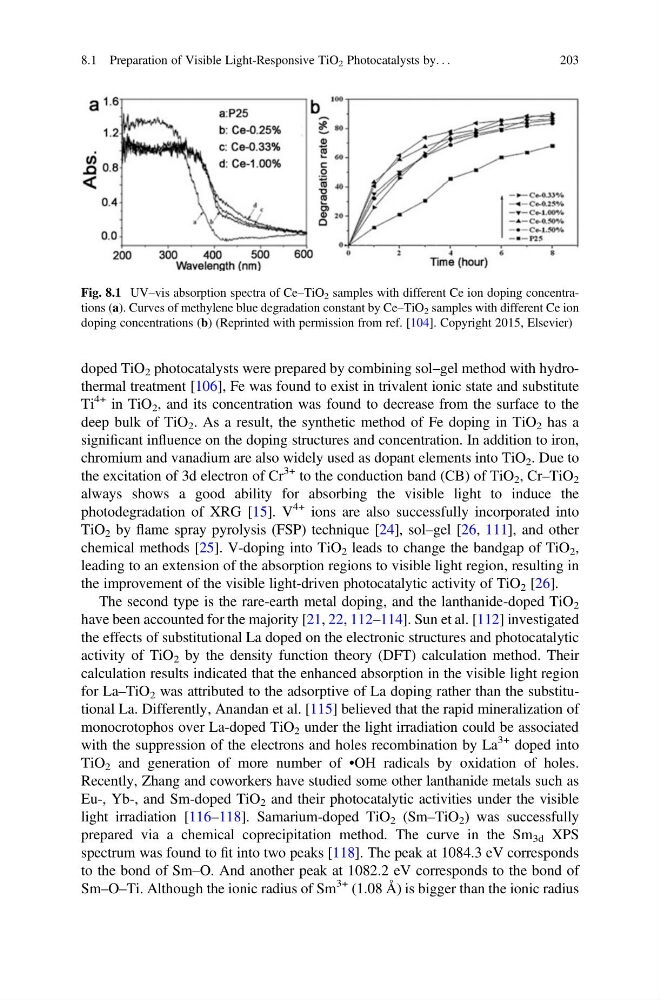
Fig. 8.1 UV–vis absorption spectra of Ce–TiO 2 samples with different Ce ion doping concentrations (a). Curves of methylene blue degradation constant by Ce–TiO 2 samples with different Ce ion
doping concentrations (b) (Reprinted with permission from ref. [104]. Copyright 2015, Elsevier)
8.1 Preparation of Visible Light-Responsive TiO 2 Photocatalysts by. . .
203
Ti
4+ in TiO 2 , and its concentration was found to decrease from the surface to the
deep bulk of TiO 2 . As a result, the synthetic method of Fe doping in TiO 2 has a
significant influence on the doping structures and concentration. In addition to iron,
chromium and vanadium are also widely used as dopant elements into TiO 2 . Due to
the excitation of 3d electron of Cr
3+ to the conduction band (CB) of TiO 2 , Cr–TiO 2
always shows a good ability for absorbing the visible light to induce the
photodegradation of XRG [15]. V
4+ ions are also successfully incorporated into
TiO 2 by flame spray pyrolysis (FSP) technique [24], sol–gel [26, 111], and other
chemical methods [25]. V-doping into TiO 2 leads to change the bandgap of TiO 2 ,
leading to an extension of the absorption regions to visible light region, resulting in
the improvement of the visible light-driven photocatalytic activity of TiO 2 [26].
The second type is the rare-earth metal doping, and the lanthanide-doped TiO 2
have been accounted for the majority [21, 22, 112–114]. Sun et al. [112] investigated
the effects of substitutional La doped on the electronic structures and photocatalytic
activity of TiO 2 by the density function theory (DFT) calculation method. Their
calculation results indicated that the enhanced absorption in the visible light region
for La–TiO 2 was attributed to the adsorptive of La doping rather than the substitutional La. Differently, Anandan et al. [115] believed that the rapid mineralization of
monocrotophos over La-doped TiO 2 under the light irradiation could be associated
with the suppression of the electrons and holes recombination by La
3+ doped into
TiO 2 and generation of more number of •OH radicals by oxidation of holes.
Recently, Zhang and coworkers have studied some other lanthanide metals such as
Eu-, Yb-, and Sm-doped TiO 2 and their photocatalytic activities under the visible
light irradiation [116–118]. Samarium-doped TiO 2 (Sm–TiO 2 ) was successfully
prepared via a chemical coprecipitation method. The curve in the Sm 3d XPS
spectrum was found to fit into two peaks [118]. The peak at 1084.3 eV corresponds
to the bond of Sm–O. And another peak at 1082.2 eV corresponds to the bond of
Sm–O–Ti. Although the ionic radius of Sm
3+ (1.08 Å) is bigger than the ionic radius
Fig. 8.1 UV–vis absorption spectra of Ce–TiO 2 samples with different Ce ion doping concentrations (a). Curves of methylene blue degradation constant by Ce–TiO 2 samples with different Ce ion
doping concentrations (b) (Reprinted with permission from ref. [104]. Copyright 2015, Elsevier)
8.1 Preparation of Visible Light-Responsive TiO 2 Photocatalysts by. . .
203