

instable, leading to form brookite (Fig. 6.2c). The above results are consistent with
the previous literature [87].
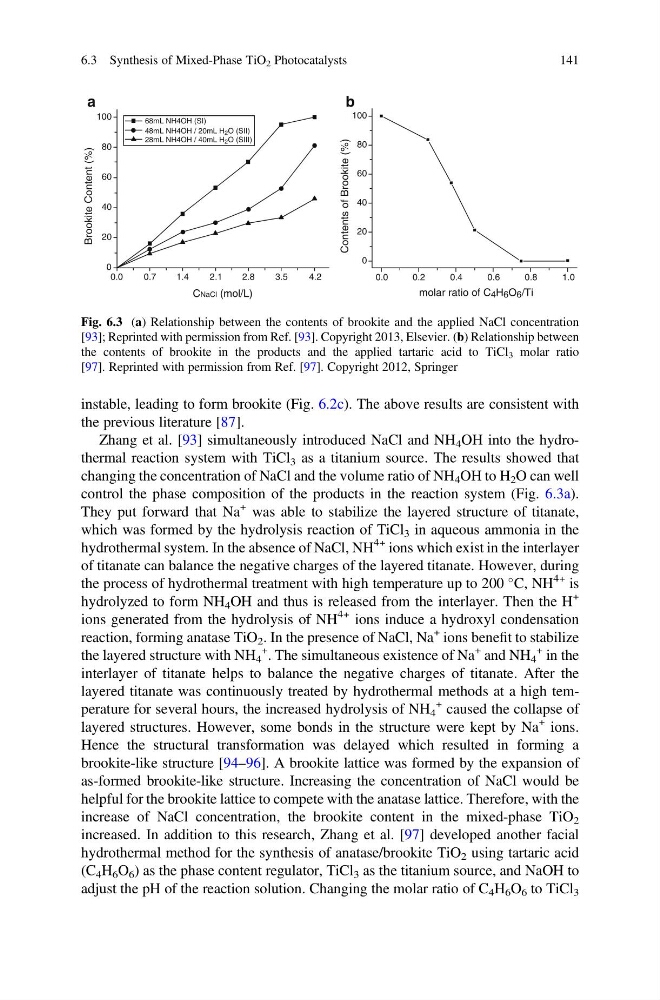
Zhang et al. [93] simultaneously introduced NaCl and NH 4 OH into the hydrothermal reaction system with TiCl 3 as a titanium source. The results showed that
changing the concentration of NaCl and the volume ratio of NH 4 OH to H 2 O can well
control the phase composition of the products in the reaction system (Fig. 6.3a).
They put forward that Na
+ was able to stabilize the layered structure of titanate,
which was formed by the hydrolysis reaction of TiCl 3 in aqueous ammonia in the
hydrothermal system. In the absence of NaCl, NH
4+ ions which exist in the interlayer
of titanate can balance the negative charges of the layered titanate. However, during
the process of hydrothermal treatment with high temperature up to 200
C, NH
4+ is
hydrolyzed to form NH 4 OH and thus is released from the interlayer. Then the H
+
ions generated from the hydrolysis of NH
4+ ions induce a hydroxyl condensation
reaction, forming anatase TiO 2 . In the presence of NaCl, Na
+ ions benefit to stabilize
the layered structure with NH 4
+
. The simultaneous existence of Na
+ and NH 4
+ in the
interlayer of titanate helps to balance the negative charges of titanate. After the
layered titanate was continuously treated by hydrothermal methods at a high temperature for several hours, the increased hydrolysis of NH 4
+ caused the collapse of
layered structures. However, some bonds in the structure were kept by Na
+ ions.
Hence the structural transformation was delayed which resulted in forming a
brookite-like structure [94–96]. A brookite lattice was formed by the expansion of
as-formed brookite-like structure. Increasing the concentration of NaCl would be
helpful for the brookite lattice to compete with the anatase lattice. Therefore, with the
increase of NaCl concentration, the brookite content in the mixed-phase TiO 2
increased. In addition to this research, Zhang et al. [97] developed another facial
hydrothermal method for the synthesis of anatase/brookite TiO 2 using tartaric acid
(C 4 H 6 O 6 ) as the phase content regulator, TiCl 3 as the titanium source, and NaOH to
adjust the pH of the reaction solution. Changing the molar ratio of C 4 H 6 O 6 to TiCl 3
100
80
60
40
20
0
1.4
2.1
2.8
3.5
4.2
0.0
0.2
0.4
0.6
0.8
1.0
0
20
40
60
80
100
CNaCl (mol/L)
molar ratio of C 4H6O6/Ti
Brookite Content (%)
Contents of Brookite (%)
68mL NH4OH (SI)
48mL NH4OH / 20mL H2O (SII)
28mL NH4OH / 40mL H 2O (SIII)
0.0
0.7
a
b
Fig. 6.3 (a) Relationship between the contents of brookite and the applied NaCl concentration
[93]; Reprinted with permission from Ref. [93]. Copyright 2013, Elsevier. (b) Relationship between
the contents of brookite in the products and the applied tartaric acid to TiCl 3 molar ratio
[97]. Reprinted with permission from Ref. [97]. Copyright 2012, Springer
6.3 Synthesis of Mixed-Phase TiO 2 Photocatalysts
141
the previous literature [87].
Zhang et al. [93] simultaneously introduced NaCl and NH 4 OH into the hydrothermal reaction system with TiCl 3 as a titanium source. The results showed that
changing the concentration of NaCl and the volume ratio of NH 4 OH to H 2 O can well
control the phase composition of the products in the reaction system (Fig. 6.3a).
They put forward that Na
+ was able to stabilize the layered structure of titanate,
which was formed by the hydrolysis reaction of TiCl 3 in aqueous ammonia in the
hydrothermal system. In the absence of NaCl, NH
4+ ions which exist in the interlayer
of titanate can balance the negative charges of the layered titanate. However, during
the process of hydrothermal treatment with high temperature up to 200
C, NH
4+ is
hydrolyzed to form NH 4 OH and thus is released from the interlayer. Then the H
+
ions generated from the hydrolysis of NH
4+ ions induce a hydroxyl condensation
reaction, forming anatase TiO 2 . In the presence of NaCl, Na
+ ions benefit to stabilize
the layered structure with NH 4
+
. The simultaneous existence of Na
+ and NH 4
+ in the
interlayer of titanate helps to balance the negative charges of titanate. After the
layered titanate was continuously treated by hydrothermal methods at a high temperature for several hours, the increased hydrolysis of NH 4
+ caused the collapse of
layered structures. However, some bonds in the structure were kept by Na
+ ions.
Hence the structural transformation was delayed which resulted in forming a
brookite-like structure [94–96]. A brookite lattice was formed by the expansion of
as-formed brookite-like structure. Increasing the concentration of NaCl would be
helpful for the brookite lattice to compete with the anatase lattice. Therefore, with the
increase of NaCl concentration, the brookite content in the mixed-phase TiO 2
increased. In addition to this research, Zhang et al. [97] developed another facial
hydrothermal method for the synthesis of anatase/brookite TiO 2 using tartaric acid
(C 4 H 6 O 6 ) as the phase content regulator, TiCl 3 as the titanium source, and NaOH to
adjust the pH of the reaction solution. Changing the molar ratio of C 4 H 6 O 6 to TiCl 3
100
80
60
40
20
0
1.4
2.1
2.8
3.5
4.2
0.0
0.2
0.4
0.6
0.8
1.0
0
20
40
60
80
100
CNaCl (mol/L)
molar ratio of C 4H6O6/Ti
Brookite Content (%)
Contents of Brookite (%)
68mL NH4OH (SI)
48mL NH4OH / 20mL H2O (SII)
28mL NH4OH / 40mL H 2O (SIII)
0.0
0.7
a
b
Fig. 6.3 (a) Relationship between the contents of brookite and the applied NaCl concentration
[93]; Reprinted with permission from Ref. [93]. Copyright 2013, Elsevier. (b) Relationship between
the contents of brookite in the products and the applied tartaric acid to TiCl 3 molar ratio
[97]. Reprinted with permission from Ref. [97]. Copyright 2012, Springer
6.3 Synthesis of Mixed-Phase TiO 2 Photocatalysts
141