

6.2 Phases of TiO 2
TiO 2 possesses eight types of crystal phases, which are rutile, anatase, brookite,
TiO 2 -B, TiO 2 -R, TiO 2 -H, TiO 2 -II, and TiO 2 -III [58]. Among them, rutile, anatase,
and brookite have been researched mostly for applications because they are naturally
occurring oxides of titanium at atmospheric pressure [59, 60]. The other five phases
have also been investigated [61–64]; however, because they are usually formed at
high pressure, there is minor significance for practical research and applications.
Therefore, in this chapter, we mainly focus on the three phases of rutile, anatase, and
brookite.
6.2.1 Structure Properties of Rutile, Anatase, and Brookite
The three kinds of TiO 2 phases possess different crystallographic properties, as
shown in Table 6.1 [65].
In their structures, TiO 6 octahedron exists in a more or less tortuous configuration
formed by the fundamental building block made up of a titanium atom surrounded
by six oxygen atoms. In the structures of the three kinds of TiO 2 phase, the stacking
of the TiO 6 octahedra causes threefold coordinated oxygen atoms. As shown in
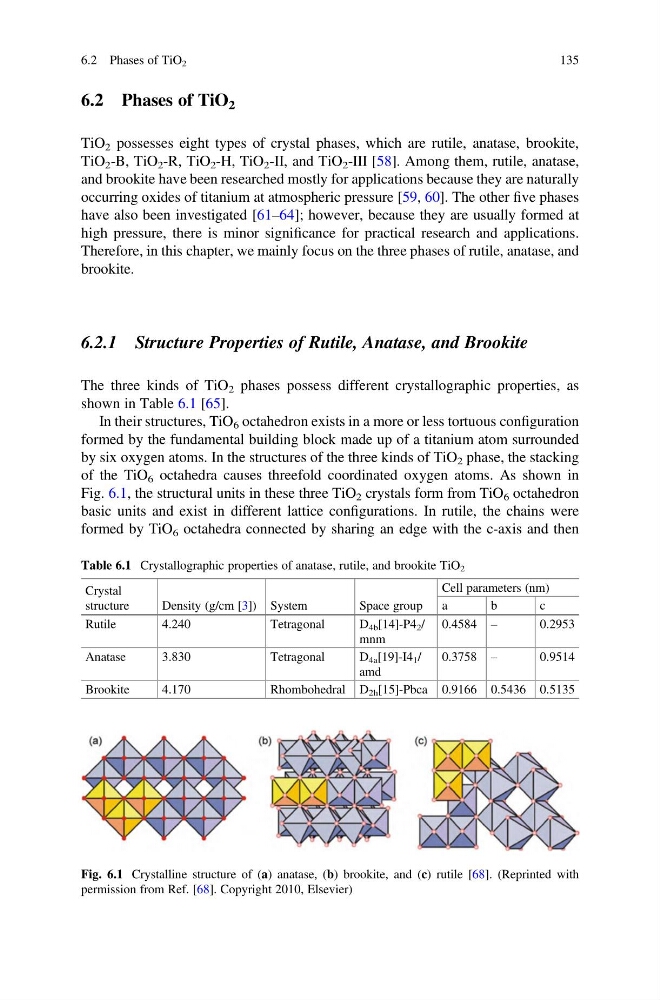
Fig. 6.1, the structural units in these three TiO 2 crystals form from TiO 6 octahedron
basic units and exist in different lattice configurations. In rutile, the chains were
formed by TiO 6 octahedra connected by sharing an edge with the c-axis and then
Table 6.1 Crystallographic properties of anatase, rutile, and brookite TiO 2
Crystal
structure
Density (g/cm [3]) System
Space group
Cell parameters (nm)
a
b
c
Rutile
4.240
Tetragonal
D 4b [14]-P4 2 /
mnm
0.4584 –
0.2953
Anatase
3.830
Tetragonal
D 4a [19]-I4 1 /
amd
0.3758 –
0.9514
Brookite
4.170
Rhombohedral D 2h [15]-Pbca 0.9166 0.5436 0.5135
Fig. 6.1 Crystalline structure of (a) anatase, (b) brookite, and (c) rutile [68]. (Reprinted with
permission from Ref. [68]. Copyright 2010, Elsevier)
6.2 Phases of TiO 2
135
TiO 2 possesses eight types of crystal phases, which are rutile, anatase, brookite,
TiO 2 -B, TiO 2 -R, TiO 2 -H, TiO 2 -II, and TiO 2 -III [58]. Among them, rutile, anatase,
and brookite have been researched mostly for applications because they are naturally
occurring oxides of titanium at atmospheric pressure [59, 60]. The other five phases
have also been investigated [61–64]; however, because they are usually formed at
high pressure, there is minor significance for practical research and applications.
Therefore, in this chapter, we mainly focus on the three phases of rutile, anatase, and
brookite.
6.2.1 Structure Properties of Rutile, Anatase, and Brookite
The three kinds of TiO 2 phases possess different crystallographic properties, as
shown in Table 6.1 [65].
In their structures, TiO 6 octahedron exists in a more or less tortuous configuration
formed by the fundamental building block made up of a titanium atom surrounded
by six oxygen atoms. In the structures of the three kinds of TiO 2 phase, the stacking
of the TiO 6 octahedra causes threefold coordinated oxygen atoms. As shown in
Fig. 6.1, the structural units in these three TiO 2 crystals form from TiO 6 octahedron
basic units and exist in different lattice configurations. In rutile, the chains were
formed by TiO 6 octahedra connected by sharing an edge with the c-axis and then
Table 6.1 Crystallographic properties of anatase, rutile, and brookite TiO 2
Crystal
structure
Density (g/cm [3]) System
Space group
Cell parameters (nm)
a
b
c
Rutile
4.240
Tetragonal
D 4b [14]-P4 2 /
mnm
0.4584 –
0.2953
Anatase
3.830
Tetragonal
D 4a [19]-I4 1 /
amd
0.3758 –
0.9514
Brookite
4.170
Rhombohedral D 2h [15]-Pbca 0.9166 0.5436 0.5135
Fig. 6.1 Crystalline structure of (a) anatase, (b) brookite, and (c) rutile [68]. (Reprinted with
permission from Ref. [68]. Copyright 2010, Elsevier)
6.2 Phases of TiO 2
135