

5.3 Applications in Photocatalysis
TiO 2 /graphene composites have been widely used for the photodegradation of
organic pollutants in recent years, but they have also been applied in many other
fields, including hydrogen production and CO 2 photoreduction, which are related
with the protection of the environment.
5.3.1 Photodegradation of Organic Pollutants
Nowadays, water and air are considered as the most valuable human resources which
have attracted much more attentions than before. Especially with the speeding up of
the industrial process, a large amount of waste water and gasses are directly
discharged into the rivers and atmosphere, which will induce the accumulation of
large amounts of toxic organic compounds in our daily lives. And in these organic
pollutants, some compounds are very difficult to be degraded by the ordinary
processing methods. The photocatalytic technology is an ideal method to degrade
these organic compounds by using the inexhaustible solar light energy.
In our group, we also chose some organic dyes as the simulated pollutant
molecules, which were photodegraded by the TiO 2 /graphene composites, such as
methylene blue, methyl orange, and rhodamine B solutions. For instance, we
successfully prepared the graphene nanoribbons and used it for the photodegradation
of rhodamine B under the solar light irradiation [68]. We found that the bandgap of
the graphene could be adjusted by changing the morphology of graphene and the
nanosized graphene exhibited a semiconductor property and showed a good
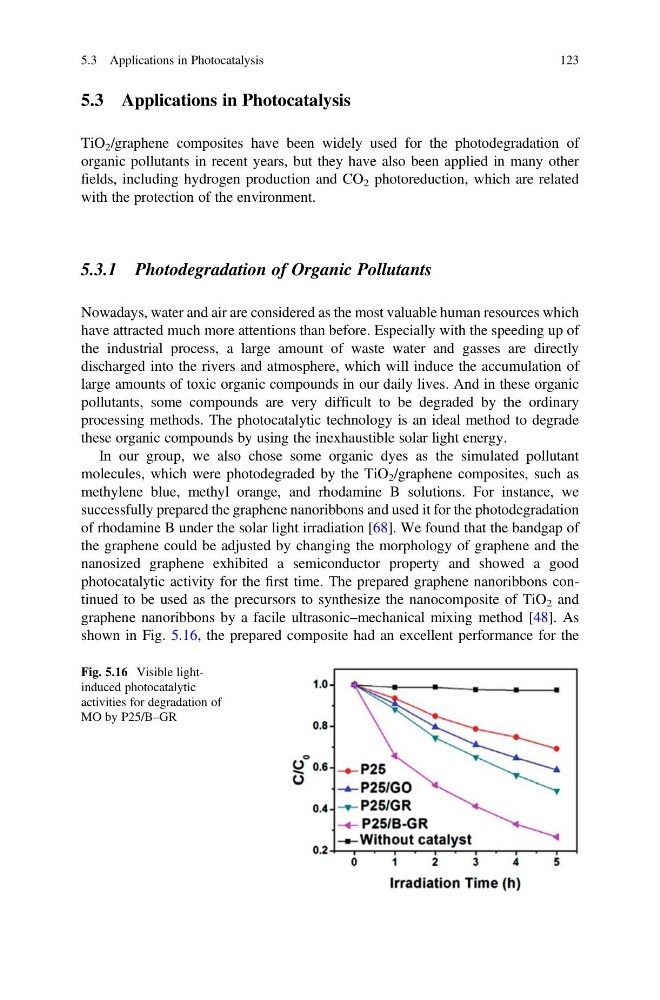
photocatalytic activity for the first time. The prepared graphene nanoribbons continued to be used as the precursors to synthesize the nanocomposite of TiO 2 and
graphene nanoribbons by a facile ultrasonic–mechanical mixing method [48]. As
shown in Fig. 5.16, the prepared composite had an excellent performance for the
Fig. 5.16 Visible lightinduced photocatalytic
activities for degradation of
MO by P25/B–GR
5.3 Applications in Photocatalysis
123
TiO 2 /graphene composites have been widely used for the photodegradation of
organic pollutants in recent years, but they have also been applied in many other
fields, including hydrogen production and CO 2 photoreduction, which are related
with the protection of the environment.
5.3.1 Photodegradation of Organic Pollutants
Nowadays, water and air are considered as the most valuable human resources which
have attracted much more attentions than before. Especially with the speeding up of
the industrial process, a large amount of waste water and gasses are directly
discharged into the rivers and atmosphere, which will induce the accumulation of
large amounts of toxic organic compounds in our daily lives. And in these organic
pollutants, some compounds are very difficult to be degraded by the ordinary
processing methods. The photocatalytic technology is an ideal method to degrade
these organic compounds by using the inexhaustible solar light energy.
In our group, we also chose some organic dyes as the simulated pollutant
molecules, which were photodegraded by the TiO 2 /graphene composites, such as
methylene blue, methyl orange, and rhodamine B solutions. For instance, we
successfully prepared the graphene nanoribbons and used it for the photodegradation
of rhodamine B under the solar light irradiation [68]. We found that the bandgap of
the graphene could be adjusted by changing the morphology of graphene and the
nanosized graphene exhibited a semiconductor property and showed a good
photocatalytic activity for the first time. The prepared graphene nanoribbons continued to be used as the precursors to synthesize the nanocomposite of TiO 2 and
graphene nanoribbons by a facile ultrasonic–mechanical mixing method [48]. As
shown in Fig. 5.16, the prepared composite had an excellent performance for the
Fig. 5.16 Visible lightinduced photocatalytic
activities for degradation of
MO by P25/B–GR
5.3 Applications in Photocatalysis
123