

used the GO as the substrate for the TiO 2 growth to obtain a TiO 2 /GO hybrid. The
functional groups of hydroxyl and carboxyl on GO provided reactive and anchoring
sites for nucleation and growth of nanomaterials. In 2012, the TiO 2 spheres were
compounded with the graphene by a hydrothermal method to prepare core–shell-like
TiO 2 /graphene composites by Park and his coworkers [43]. They successfully
synthesized the graphene–anatase TiO 2 hybrid NPs by wrapping amorphous TiO 2
NPs with GO, during which APTMS-modified TiO 2 spheres were chosen as the
precursor followed by a one-step GO reduction and TiO 2 crystallization via a
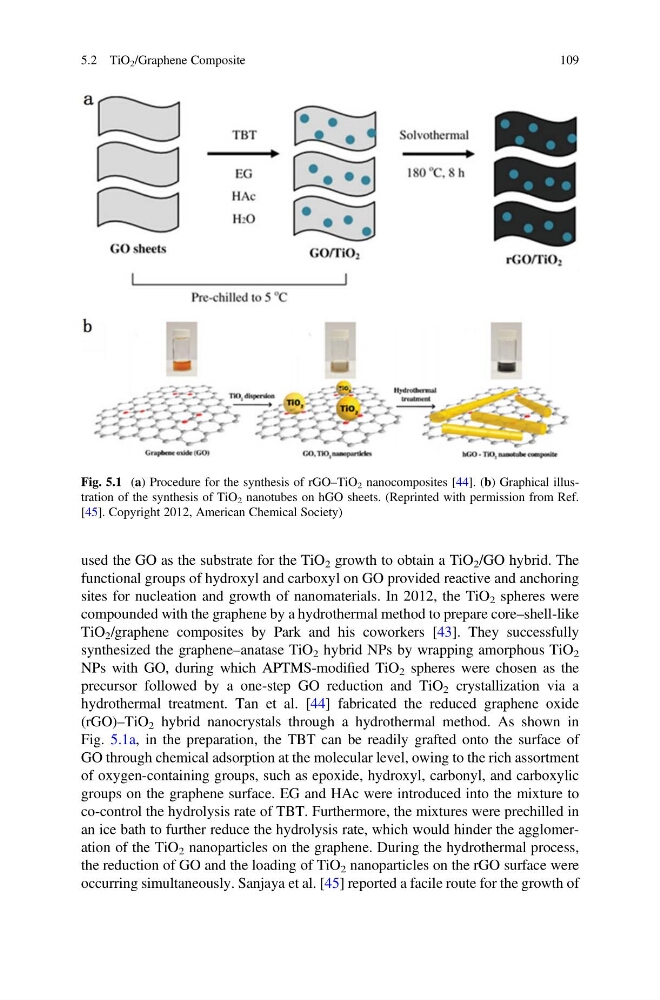
hydrothermal treatment. Tan et al. [44] fabricated the reduced graphene oxide
(rGO)–TiO 2 hybrid nanocrystals through a hydrothermal method. As shown in
Fig. 5.1a, in the preparation, the TBT can be readily grafted onto the surface of
GO through chemical adsorption at the molecular level, owing to the rich assortment
of oxygen-containing groups, such as epoxide, hydroxyl, carbonyl, and carboxylic
groups on the graphene surface. EG and HAc were introduced into the mixture to
co-control the hydrolysis rate of TBT. Furthermore, the mixtures were prechilled in
an ice bath to further reduce the hydrolysis rate, which would hinder the agglomeration of the TiO 2 nanoparticles on the graphene. During the hydrothermal process,
the reduction of GO and the loading of TiO 2 nanoparticles on the rGO surface were
occurring simultaneously. Sanjaya et al. [45] reported a facile route for the growth of
Fig. 5.1 (a) Procedure for the synthesis of rGO–TiO 2 nanocomposites [44]. (b) Graphical illustration of the synthesis of TiO 2 nanotubes on hGO sheets. (Reprinted with permission from Ref.
[45]. Copyright 2012, American Chemical Society)
5.2 TiO 2 /Graphene Composite
109
functional groups of hydroxyl and carboxyl on GO provided reactive and anchoring
sites for nucleation and growth of nanomaterials. In 2012, the TiO 2 spheres were
compounded with the graphene by a hydrothermal method to prepare core–shell-like
TiO 2 /graphene composites by Park and his coworkers [43]. They successfully
synthesized the graphene–anatase TiO 2 hybrid NPs by wrapping amorphous TiO 2
NPs with GO, during which APTMS-modified TiO 2 spheres were chosen as the
precursor followed by a one-step GO reduction and TiO 2 crystallization via a
hydrothermal treatment. Tan et al. [44] fabricated the reduced graphene oxide
(rGO)–TiO 2 hybrid nanocrystals through a hydrothermal method. As shown in
Fig. 5.1a, in the preparation, the TBT can be readily grafted onto the surface of
GO through chemical adsorption at the molecular level, owing to the rich assortment
of oxygen-containing groups, such as epoxide, hydroxyl, carbonyl, and carboxylic
groups on the graphene surface. EG and HAc were introduced into the mixture to
co-control the hydrolysis rate of TBT. Furthermore, the mixtures were prechilled in
an ice bath to further reduce the hydrolysis rate, which would hinder the agglomeration of the TiO 2 nanoparticles on the graphene. During the hydrothermal process,
the reduction of GO and the loading of TiO 2 nanoparticles on the rGO surface were
occurring simultaneously. Sanjaya et al. [45] reported a facile route for the growth of
Fig. 5.1 (a) Procedure for the synthesis of rGO–TiO 2 nanocomposites [44]. (b) Graphical illustration of the synthesis of TiO 2 nanotubes on hGO sheets. (Reprinted with permission from Ref.
[45]. Copyright 2012, American Chemical Society)
5.2 TiO 2 /Graphene Composite
109