

5.2.1 First Hyperpolarizability Surface
The results of ab initio calculations of the induced first hyperpolarizability tensor
Db abc as functions of R are given in this section in the same way as before. The six
configurations of the CH 4 –N 2 complex, which are the most discussed ones by
researchers (see [50–55]), are considered here. The configurations of the complex
and their parameters are also the same as used in Chap. 3 (Figs. 3.6 and 3.7, and
Table 3.3). The ab initio and long-range analytical functions of the independent
tensor components of Db abc are given in Fig. 5.1. The multipole moments and
higher polarizabilities of the CH 4 and N 2 molecules calculated at the CCSD(T)/
aug-cc-pVTZ level of theory [49] were used to calculate the values of Db abc by
means of Eqs. (5.1.15) and (5.2.1). These molecular parameters are given in
Table 5.2 to be compared with known ones (Table 5.1).
The analysis of Fig. (5.1) shows that the analytical description of Db abc may be
effectively used for R > 11 a.u. Naturally, for shorter R the analytical values of
Db abc are noticeably differ from ab initio values due to exchange interactions
appeared in this range. It is also noticeable that the exchange interaction is the most
important for the Db xxx component. Such behavior of Db xxx is consistent with results
of the asymptotic model of exchange interactions for van der Waals complexes [54,
60]. The strong anisotropy of the exchange effects was also observed for the case of
collision-induced dipole moments and dipole polarizabilities in ion-atom pairs [61].
5.2.2 First Hyperpolarizability of the Most Stable
Configuration
As it was noted in Chaps. 3 and 4 the dipole moment modulus and the polarizability
tensor invariants practically do not change for the family of the most stable configurations [52]. We can expect, that the first-hyperpolarizability tensor invariants
which are important for description of interaction-induced hyper-Rayleigh scattering, also change weakly for all most stable configurations.
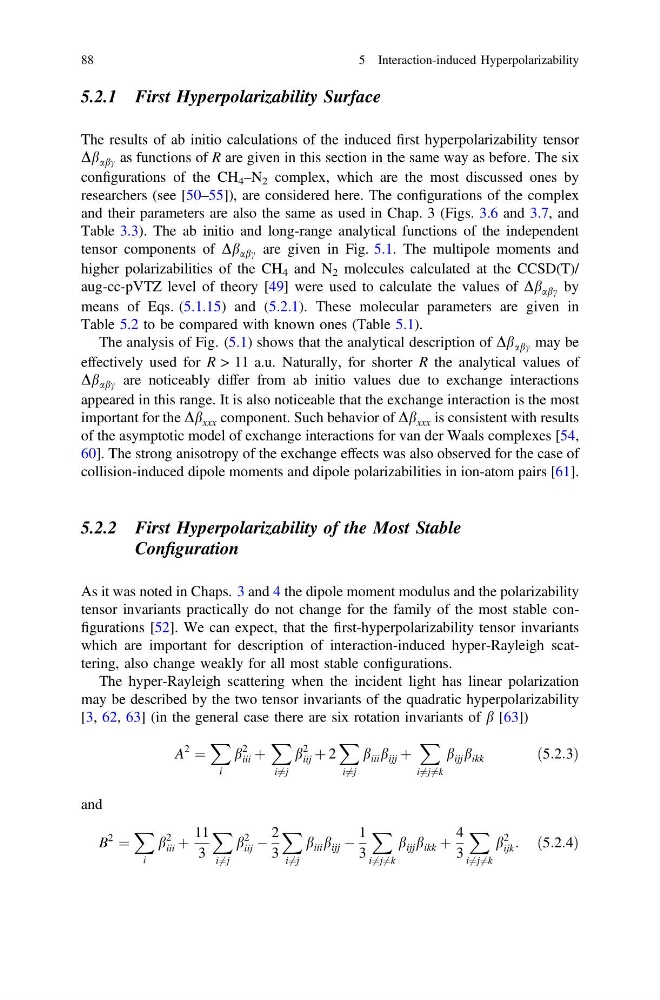
The hyper-Rayleigh scattering when the incident light has linear polarization
may be described by the two tensor invariants of the quadratic hyperpolarizability
[3, 62, 63] (in the general case there are six rotation invariants of b [63])
A
2
¼
X
i
b
2
iii þ
X
i6 ¼j
b
2
iij þ 2
X
i6 ¼j
b iii b ijj þ
X
i6 ¼j6 ¼k
b ijj b ikk
ð5:2:3Þ
and
B
2
¼
X
i
b
2
iii þ
11
3
X
i6 ¼j
b
2
iij À
2
3
X
i6 ¼j
b iii b ijj À
1
3
X
i6 ¼j6 ¼k
b ijj b ikk þ
4
3
X
i6 ¼j6 ¼k
b
2
ijk : ð5:2:4Þ
88
5 Interaction-induced Hyperpolarizability
The results of ab initio calculations of the induced first hyperpolarizability tensor
Db abc as functions of R are given in this section in the same way as before. The six
configurations of the CH 4 –N 2 complex, which are the most discussed ones by
researchers (see [50–55]), are considered here. The configurations of the complex
and their parameters are also the same as used in Chap. 3 (Figs. 3.6 and 3.7, and
Table 3.3). The ab initio and long-range analytical functions of the independent
tensor components of Db abc are given in Fig. 5.1. The multipole moments and
higher polarizabilities of the CH 4 and N 2 molecules calculated at the CCSD(T)/
aug-cc-pVTZ level of theory [49] were used to calculate the values of Db abc by
means of Eqs. (5.1.15) and (5.2.1). These molecular parameters are given in
Table 5.2 to be compared with known ones (Table 5.1).
The analysis of Fig. (5.1) shows that the analytical description of Db abc may be
effectively used for R > 11 a.u. Naturally, for shorter R the analytical values of
Db abc are noticeably differ from ab initio values due to exchange interactions
appeared in this range. It is also noticeable that the exchange interaction is the most
important for the Db xxx component. Such behavior of Db xxx is consistent with results
of the asymptotic model of exchange interactions for van der Waals complexes [54,
60]. The strong anisotropy of the exchange effects was also observed for the case of
collision-induced dipole moments and dipole polarizabilities in ion-atom pairs [61].
5.2.2 First Hyperpolarizability of the Most Stable
Configuration
As it was noted in Chaps. 3 and 4 the dipole moment modulus and the polarizability
tensor invariants practically do not change for the family of the most stable configurations [52]. We can expect, that the first-hyperpolarizability tensor invariants
which are important for description of interaction-induced hyper-Rayleigh scattering, also change weakly for all most stable configurations.
The hyper-Rayleigh scattering when the incident light has linear polarization
may be described by the two tensor invariants of the quadratic hyperpolarizability
[3, 62, 63] (in the general case there are six rotation invariants of b [63])
A
2
¼
X
i
b
2
iii þ
X
i6 ¼j
b
2
iij þ 2
X
i6 ¼j
b iii b ijj þ
X
i6 ¼j6 ¼k
b ijj b ikk
ð5:2:3Þ
and
B
2
¼
X
i
b
2
iii þ
11
3
X
i6 ¼j
b
2
iij À
2
3
X
i6 ¼j
b iii b ijj À
1
3
X
i6 ¼j6 ¼k
b ijj b ikk þ
4
3
X
i6 ¼j6 ¼k
b
2
ijk : ð5:2:4Þ
88
5 Interaction-induced Hyperpolarizability