

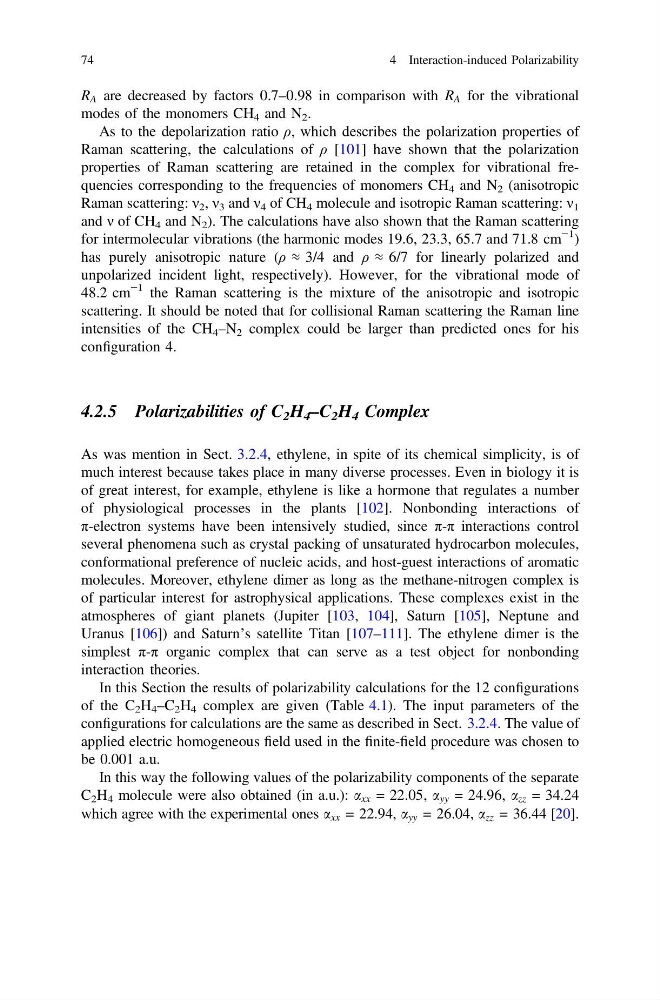
R A are decreased by factors 0.7–0.98 in comparison with R A for the vibrational
modes of the monomers CH 4 and N 2 .
As to the depolarization ratio ρ, which describes the polarization properties of
Raman scattering, the calculations of ρ [101] have shown that the polarization
properties of Raman scattering are retained in the complex for vibrational frequencies corresponding to the frequencies of monomers CH 4 and N 2 (anisotropic
Raman scattering: ν 2 , ν 3 and ν 4 of CH 4 molecule and isotropic Raman scattering: ν 1
and ν of CH 4 and N 2 ). The calculations have also shown that the Raman scattering
for intermolecular vibrations (the harmonic modes 19.6, 23.3, 65.7 and 71.8 cm
−1 )
has purely anisotropic nature (ρ ≈ 3/4 and ρ ≈ 6/7 for linearly polarized and
unpolarized incident light, respectively). However, for the vibrational mode of
48.2 cm
−1 the Raman scattering is the mixture of the anisotropic and isotropic
scattering. It should be noted that for collisional Raman scattering the Raman line
intensities of the CH 4 –N 2 complex could be larger than predicted ones for his
configuration 4.
4.2.5 Polarizabilities of C 2 H 4 –C 2 H 4 Complex
As was mention in Sect. 3.2.4, ethylene, in spite of its chemical simplicity, is of
much interest because takes place in many diverse processes. Even in biology it is
of great interest, for example, ethylene is like a hormone that regulates a number
of physiological processes in the plants [102]. Nonbonding interactions of
π-electron systems have been intensively studied, since π-π interactions control
several phenomena such as crystal packing of unsaturated hydrocarbon molecules,
conformational preference of nucleic acids, and host-guest interactions of aromatic
molecules. Moreover, ethylene dimer as long as the methane-nitrogen complex is
of particular interest for astrophysical applications. These complexes exist in the
atmospheres of giant planets (Jupiter [103, 104], Saturn [105], Neptune and
Uranus [106]) and Saturn’s satellite Titan [107–111]. The ethylene dimer is the
simplest π-π organic complex that can serve as a test object for nonbonding
interaction theories.
In this Section the results of polarizability calculations for the 12 configurations
of the C 2 H 4 –C 2 H 4 complex are given (Table 4.1). The input parameters of the
configurations for calculations are the same as described in Sect. 3.2.4. The value of
applied electric homogeneous field used in the finite-field procedure was chosen to
be 0.001 a.u.
In this way the following values of the polarizability components of the separate
C 2 H 4 molecule were also obtained (in a.u.): a xx = 22.05, a yy = 24.96, a zz = 34.24
which agree with the experimental ones a xx = 22.94, a yy = 26.04, a zz = 36.44 [20].
74
4 Interaction-induced Polarizability
modes of the monomers CH 4 and N 2 .
As to the depolarization ratio ρ, which describes the polarization properties of
Raman scattering, the calculations of ρ [101] have shown that the polarization
properties of Raman scattering are retained in the complex for vibrational frequencies corresponding to the frequencies of monomers CH 4 and N 2 (anisotropic
Raman scattering: ν 2 , ν 3 and ν 4 of CH 4 molecule and isotropic Raman scattering: ν 1
and ν of CH 4 and N 2 ). The calculations have also shown that the Raman scattering
for intermolecular vibrations (the harmonic modes 19.6, 23.3, 65.7 and 71.8 cm
−1 )
has purely anisotropic nature (ρ ≈ 3/4 and ρ ≈ 6/7 for linearly polarized and
unpolarized incident light, respectively). However, for the vibrational mode of
48.2 cm
−1 the Raman scattering is the mixture of the anisotropic and isotropic
scattering. It should be noted that for collisional Raman scattering the Raman line
intensities of the CH 4 –N 2 complex could be larger than predicted ones for his
configuration 4.
4.2.5 Polarizabilities of C 2 H 4 –C 2 H 4 Complex
As was mention in Sect. 3.2.4, ethylene, in spite of its chemical simplicity, is of
much interest because takes place in many diverse processes. Even in biology it is
of great interest, for example, ethylene is like a hormone that regulates a number
of physiological processes in the plants [102]. Nonbonding interactions of
π-electron systems have been intensively studied, since π-π interactions control
several phenomena such as crystal packing of unsaturated hydrocarbon molecules,
conformational preference of nucleic acids, and host-guest interactions of aromatic
molecules. Moreover, ethylene dimer as long as the methane-nitrogen complex is
of particular interest for astrophysical applications. These complexes exist in the
atmospheres of giant planets (Jupiter [103, 104], Saturn [105], Neptune and
Uranus [106]) and Saturn’s satellite Titan [107–111]. The ethylene dimer is the
simplest π-π organic complex that can serve as a test object for nonbonding
interaction theories.
In this Section the results of polarizability calculations for the 12 configurations
of the C 2 H 4 –C 2 H 4 complex are given (Table 4.1). The input parameters of the
configurations for calculations are the same as described in Sect. 3.2.4. The value of
applied electric homogeneous field used in the finite-field procedure was chosen to
be 0.001 a.u.
In this way the following values of the polarizability components of the separate
C 2 H 4 molecule were also obtained (in a.u.): a xx = 22.05, a yy = 24.96, a zz = 34.24
which agree with the experimental ones a xx = 22.94, a yy = 26.04, a zz = 36.44 [20].
74
4 Interaction-induced Polarizability