

a aa ¼ À
EðF
0
a ; F
0
a Þ À 2Eð0; 0Þ þ EðÀF
0
a ; ÀF a Þ
2ðF 0
a Þ
2
;
a ab ¼ À
EðF
0
a ; F
0
b Þ À EðF
0
a ; ÀF
0
b Þ À EðÀF
0
a ; F
0
b Þ þ EðÀF
0
a ; ÀF
0
b Þ
4F 0
a F
0
b
; a 6 ¼ b:
ð4:1:1Þ
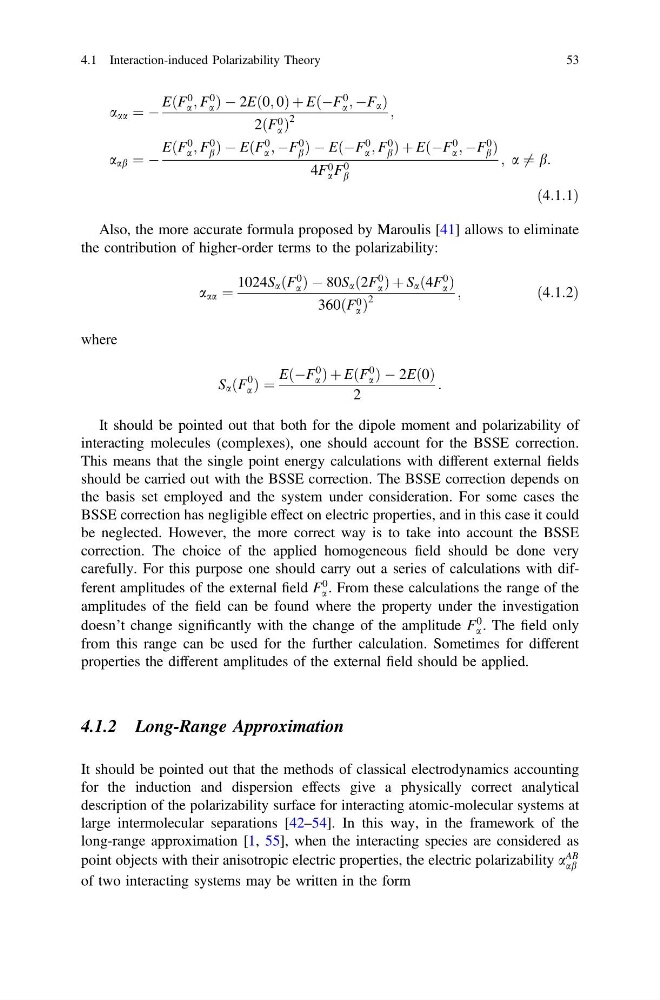
Also, the more accurate formula proposed by Maroulis [41] allows to eliminate
the contribution of higher-order terms to the polarizability:
a aa ¼
1024S a ðF
0
a Þ À 80S a ð2F
0
a Þ þ S a ð4F
0
a Þ
360ðF 0
a Þ
2
;
ð4:1:2Þ
where
S a ðF
0
a Þ ¼
EðÀF
0
a Þ þ EðF
0
a Þ À 2Eð0Þ
2
:
It should be pointed out that both for the dipole moment and polarizability of
interacting molecules (complexes), one should account for the BSSE correction.
This means that the single point energy calculations with different external fields
should be carried out with the BSSE correction. The BSSE correction depends on
the basis set employed and the system under consideration. For some cases the
BSSE correction has negligible effect on electric properties, and in this case it could
be neglected. However, the more correct way is to take into account the BSSE
correction. The choice of the applied homogeneous field should be done very
carefully. For this purpose one should carry out a series of calculations with different amplitudes of the external field F
0
a . From these calculations the range of the
amplitudes of the field can be found where the property under the investigation
doesn’t change significantly with the change of the amplitude F
0
a . The field only
from this range can be used for the further calculation. Sometimes for different
properties the different amplitudes of the external field should be applied.
4.1.2 Long-Range Approximation
It should be pointed out that the methods of classical electrodynamics accounting
for the induction and dispersion effects give a physically correct analytical
description of the polarizability surface for interacting atomic-molecular systems at
large intermolecular separations [42–54]. In this way, in the framework of the
long-range approximation [1, 55], when the interacting species are considered as
point objects with their anisotropic electric properties, the electric polarizability a
AB
ab
of two interacting systems may be written in the form
4.1 Interaction-induced Polarizability Theory
53
EðF
0
a ; F
0
a Þ À 2Eð0; 0Þ þ EðÀF
0
a ; ÀF a Þ
2ðF 0
a Þ
2
;
a ab ¼ À
EðF
0
a ; F
0
b Þ À EðF
0
a ; ÀF
0
b Þ À EðÀF
0
a ; F
0
b Þ þ EðÀF
0
a ; ÀF
0
b Þ
4F 0
a F
0
b
; a 6 ¼ b:
ð4:1:1Þ
Also, the more accurate formula proposed by Maroulis [41] allows to eliminate
the contribution of higher-order terms to the polarizability:
a aa ¼
1024S a ðF
0
a Þ À 80S a ð2F
0
a Þ þ S a ð4F
0
a Þ
360ðF 0
a Þ
2
;
ð4:1:2Þ
where
S a ðF
0
a Þ ¼
EðÀF
0
a Þ þ EðF
0
a Þ À 2Eð0Þ
2
:
It should be pointed out that both for the dipole moment and polarizability of
interacting molecules (complexes), one should account for the BSSE correction.
This means that the single point energy calculations with different external fields
should be carried out with the BSSE correction. The BSSE correction depends on
the basis set employed and the system under consideration. For some cases the
BSSE correction has negligible effect on electric properties, and in this case it could
be neglected. However, the more correct way is to take into account the BSSE
correction. The choice of the applied homogeneous field should be done very
carefully. For this purpose one should carry out a series of calculations with different amplitudes of the external field F
0
a . From these calculations the range of the
amplitudes of the field can be found where the property under the investigation
doesn’t change significantly with the change of the amplitude F
0
a . The field only
from this range can be used for the further calculation. Sometimes for different
properties the different amplitudes of the external field should be applied.
4.1.2 Long-Range Approximation
It should be pointed out that the methods of classical electrodynamics accounting
for the induction and dispersion effects give a physically correct analytical
description of the polarizability surface for interacting atomic-molecular systems at
large intermolecular separations [42–54]. In this way, in the framework of the
long-range approximation [1, 55], when the interacting species are considered as
point objects with their anisotropic electric properties, the electric polarizability a
AB
ab
of two interacting systems may be written in the form
4.1 Interaction-induced Polarizability Theory
53