

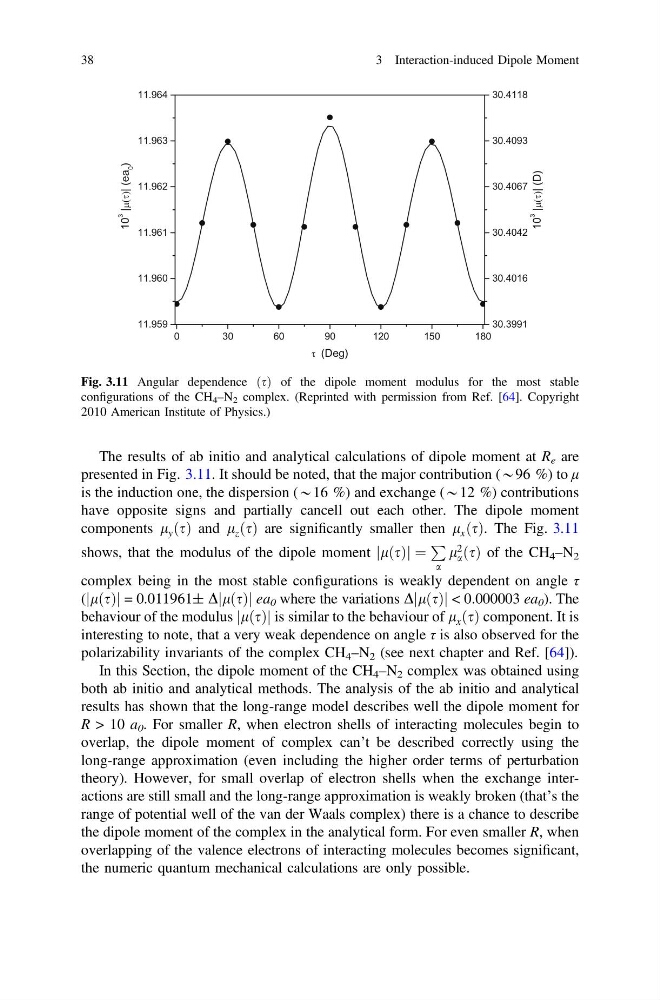
The results of ab initio and analytical calculations of dipole moment at R e are
presented in Fig. 3.11. It should be noted, that the major contribution (*96 %) to μ
is the induction one, the dispersion (*16 %) and exchange (*12 %) contributions
have opposite signs and partially cancell out each other. The dipole moment
components l y s
ð Þ and l z s
ð Þ are significantly smaller then l x s
ð Þ. The Fig. 3.11
shows, that the modulus of the dipole moment lðsÞ
j
j¼
P
a
l
2
a ðsÞ of the CH 4 –N 2
complex being in the most stable configurations is weakly dependent on angle τ
( l s
ð Þ
j
j= 0.011961± D l s
ð Þ
j
jea 0 where the variations D l s
ð Þ
j
j< 0.000003 ea 0 ). The
behaviour of the modulus l s
ð Þ
j
jis similar to the behaviour of l x s
ð Þ component. It is
interesting to note, that a very weak dependence on angle τ is also observed for the
polarizability invariants of the complex CH 4 –N 2 (see next chapter and Ref. [64]).
In this Section, the dipole moment of the CH 4 –N 2 complex was obtained using
both ab initio and analytical methods. The analysis of the ab initio and analytical
results has shown that the long-range model describes well the dipole moment for
R > 10 a 0 . For smaller R, when electron shells of interacting molecules begin to
overlap, the dipole moment of complex can’t be described correctly using the
long-range approximation (even including the higher order terms of perturbation
theory). However, for small overlap of electron shells when the exchange interactions are still small and the long-range approximation is weakly broken (that’s the
range of potential well of the van der Waals complex) there is a chance to describe
the dipole moment of the complex in the analytical form. For even smaller R, when
overlapping of the valence electrons of interacting molecules becomes significant,
the numeric quantum mechanical calculations are only possible.
0
3 0
6 0
9 0
1 2 0
1 5 0
1 8 0
11.959
11.960
11.961
11.962
11.963
11.964
30.3991
30.4016
30.4042
30.4067
30.4093
30.4118
10
3
|
| (D)
10
3
|
| (ea
0
)
(Deg)
Fig. 3.11 Angular dependence s
ð Þ of the dipole moment modulus for the most stable
configurations of the CH 4 –N 2 complex. (Reprinted with permission from Ref. [64]. Copyright
2010 American Institute of Physics.)
38
3 Interaction-induced Dipole Moment
presented in Fig. 3.11. It should be noted, that the major contribution (*96 %) to μ
is the induction one, the dispersion (*16 %) and exchange (*12 %) contributions
have opposite signs and partially cancell out each other. The dipole moment
components l y s
ð Þ and l z s
ð Þ are significantly smaller then l x s
ð Þ. The Fig. 3.11
shows, that the modulus of the dipole moment lðsÞ
j
j¼
P
a
l
2
a ðsÞ of the CH 4 –N 2
complex being in the most stable configurations is weakly dependent on angle τ
( l s
ð Þ
j
j= 0.011961± D l s
ð Þ
j
jea 0 where the variations D l s
ð Þ
j
j< 0.000003 ea 0 ). The
behaviour of the modulus l s
ð Þ
j
jis similar to the behaviour of l x s
ð Þ component. It is
interesting to note, that a very weak dependence on angle τ is also observed for the
polarizability invariants of the complex CH 4 –N 2 (see next chapter and Ref. [64]).
In this Section, the dipole moment of the CH 4 –N 2 complex was obtained using
both ab initio and analytical methods. The analysis of the ab initio and analytical
results has shown that the long-range model describes well the dipole moment for
R > 10 a 0 . For smaller R, when electron shells of interacting molecules begin to
overlap, the dipole moment of complex can’t be described correctly using the
long-range approximation (even including the higher order terms of perturbation
theory). However, for small overlap of electron shells when the exchange interactions are still small and the long-range approximation is weakly broken (that’s the
range of potential well of the van der Waals complex) there is a chance to describe
the dipole moment of the complex in the analytical form. For even smaller R, when
overlapping of the valence electrons of interacting molecules becomes significant,
the numeric quantum mechanical calculations are only possible.
0
3 0
6 0
9 0
1 2 0
1 5 0
1 8 0
11.959
11.960
11.961
11.962
11.963
11.964
30.3991
30.4016
30.4042
30.4067
30.4093
30.4118
10
3
|
| (D)
10
3
|
| (ea
0
)
(Deg)
Fig. 3.11 Angular dependence s
ð Þ of the dipole moment modulus for the most stable
configurations of the CH 4 –N 2 complex. (Reprinted with permission from Ref. [64]. Copyright
2010 American Institute of Physics.)
38
3 Interaction-induced Dipole Moment