

where α is the polarizability of the inert atom Y, H jj —quadrupole moment of X 2 ,
P
m
n cos h
ð
Þ—associated Legendre polynomials. The first terms in Eqs. (3.2.2) and
(3.2.3) correspond to the point model and the second terms give contribution into
dipole moment of complex caused by size effect of the molecule X 2 . In Fig. 3.2b
the R and θ dependences of the dipole moment components for N 2 -Ar complex are
shown.
X 2 -Y 2 complex. Analogous approach can also be applied to the X 2 -X 2 and X 2 -Y 2
complexes. In the modified model the tensors of polarizability and quadrupole
moment of effective atoms X(Y) are equal each to other and their total polarizability
and quadrupole moment are the same as that of the molecule. So, retaining the
leading term, the dipole moment of the complex X 2 -X 2 may be written as
l a ¼
X
p\q
ðl
pq
a Àl
qp
a Þ
ð 3:2:4Þ
where
l
pq
l ¼
1
R 7
pq
X
ijk
a
p
il H
q
jk 5R pq;i R pq;j R pq;k À R
2
pq R pq;i d jk À R
2
pq R pq;k d ij À R
2
pq R pq;j d ik
n
o
Á
ð3:2:5Þ
In Eq. (3.2.5) a
p
il and H
q
jk are the polarizability and quadrupole moment tensors
of pth and qth atoms respectively; R pq is the separation between pth and qth atoms,
R pq;i is the projection of the vector ~ R pq on the axis i and d ij is the Kronecker delta.
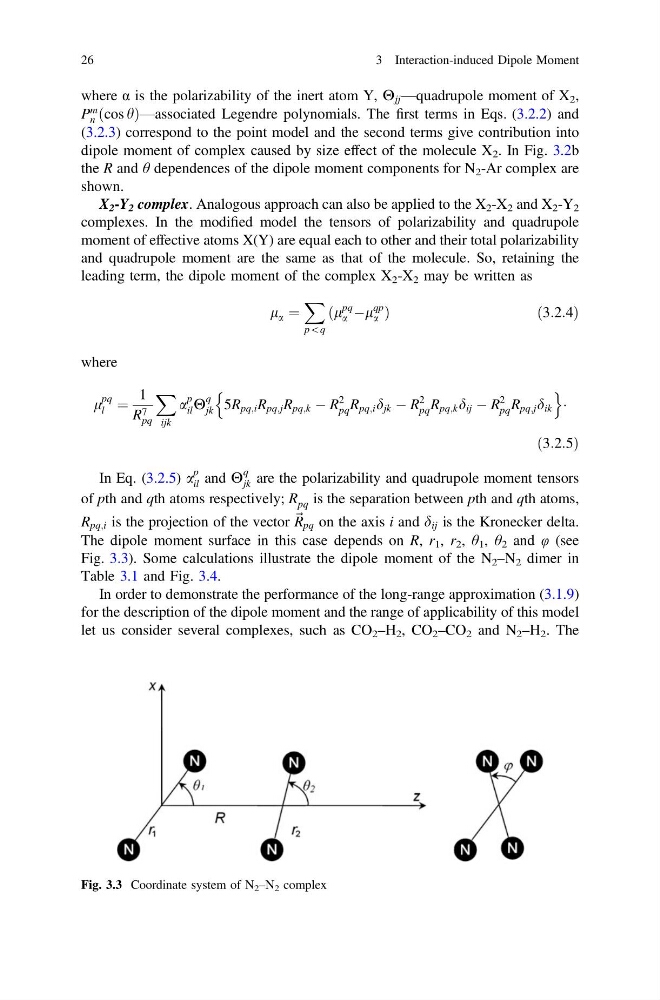
The dipole moment surface in this case depends on R, r 1 , r 2 , θ 1 , θ 2 and φ (see
Fig. 3.3). Some calculations illustrate the dipole moment of the N 2 –N 2 dimer in
Table 3.1 and Fig. 3.4.
In order to demonstrate the performance of the long-range approximation (3.1.9)
for the description of the dipole moment and the range of applicability of this model
let us consider several complexes, such as CO 2 –H 2 , CO 2 –CO 2 and N 2 –H 2 . The
Fig. 3.3 Coordinate system of N 2 –N 2 complex
26
3 Interaction-induced Dipole Moment
P
m
n cos h
ð
Þ—associated Legendre polynomials. The first terms in Eqs. (3.2.2) and
(3.2.3) correspond to the point model and the second terms give contribution into
dipole moment of complex caused by size effect of the molecule X 2 . In Fig. 3.2b
the R and θ dependences of the dipole moment components for N 2 -Ar complex are
shown.
X 2 -Y 2 complex. Analogous approach can also be applied to the X 2 -X 2 and X 2 -Y 2
complexes. In the modified model the tensors of polarizability and quadrupole
moment of effective atoms X(Y) are equal each to other and their total polarizability
and quadrupole moment are the same as that of the molecule. So, retaining the
leading term, the dipole moment of the complex X 2 -X 2 may be written as
l a ¼
X
p\q
ðl
pq
a Àl
qp
a Þ
ð 3:2:4Þ
where
l
pq
l ¼
1
R 7
pq
X
ijk
a
p
il H
q
jk 5R pq;i R pq;j R pq;k À R
2
pq R pq;i d jk À R
2
pq R pq;k d ij À R
2
pq R pq;j d ik
n
o
Á
ð3:2:5Þ
In Eq. (3.2.5) a
p
il and H
q
jk are the polarizability and quadrupole moment tensors
of pth and qth atoms respectively; R pq is the separation between pth and qth atoms,
R pq;i is the projection of the vector ~ R pq on the axis i and d ij is the Kronecker delta.
The dipole moment surface in this case depends on R, r 1 , r 2 , θ 1 , θ 2 and φ (see
Fig. 3.3). Some calculations illustrate the dipole moment of the N 2 –N 2 dimer in
Table 3.1 and Fig. 3.4.
In order to demonstrate the performance of the long-range approximation (3.1.9)
for the description of the dipole moment and the range of applicability of this model
let us consider several complexes, such as CO 2 –H 2 , CO 2 –CO 2 and N 2 –H 2 . The
Fig. 3.3 Coordinate system of N 2 –N 2 complex
26
3 Interaction-induced Dipole Moment